Showing posts with label Movie Review. Show all posts

Thursday, August 22, 2013

Movie Review: Battle Royale

Directed by: Kinji Fukasaku, 2000

Pros: creepy premise, mostly stays close to the book, great acting

Cons: some unnecessary changes from the book, lots of graphically violent scenes

In a future dystopian Japan, the collapsed economy has led to a generation of kids with few prospects and no respect.  In order to make kids learn respect, the government has instituted the Battle Royale program, choosing one grade 9 class at random to duel to the death.

First of all, let me clarify that I'm not a fan of graphically violent movies or books (hence why that's in the 'con' category) but I have read the book and knew going into this that the movie would be graphically violent.  The film comes with a 16+ rating for a reason.  Having said that, if you're looking for a Hunger Games style film where most of the violence occurs off screen, this is not that film.

I was impressed by how much of the film matched the book's content.  There were a few changes I wondered about (like making 2 of the participants transfer students for the purpose of the game only rather than students from the class and the kids not knowing what the battle royale was in advance).  I loved that the man running the games had a personal grudge against this particular class.  Not only did it show that their selection for the game was rigged, it added to the terror because HE knew what was coming.  The one change I didn't really like was the reasoning for the games in the first place.  There's a chilling moment at the end of the novel where you finally learn why the government has instituted the program.  That moment's gone here, as the film has a different motive for the program, told via a quick narration at the start of the film.

Beyond those issues, the story - as far as I can remember - follows the novel pretty closely.  Shuya Nanahara (Tatsuya Fujiwara) tries to protect Noriko Nakagawa (Aki Maeda) while evading the other students and danger zones.  I was impressed by the acting chops of the kids.  They all did an amazing job.

All in all I was impressed by the film.  It's definitely not for everyone, but if you liked the book it's a  good adaptation.

Thursday, December 13, 2012

Movie Review: The Hunchback of Notre Dame


Director: Wallace Worsley, 1923

The hunchback living at Notre Dame Cathedral in Paris (Lon Chaney) hates and is hated by the populace.  Like the Arch-Deacon's brother, Jehan (Brandon Hurst), and Captain Phoebus (Norman Kerry), he becomes enamored of the gypsy dancer Esmeralda (Patsy Ruth Miller), foster daughter of Don Claudio (Nigel de Brulier) the King of Thieves.

Based on the book by Victor Hugo, this film details the treachery of Jehan, the love affair between Phoebus and Esmeralda, the torment of Quasimodo and more.  Much of the film is set in and around the Cathedral of Notre Dame, a magnificent edifice, and wonderful backdrop for such a complicated story.

I was impressed by the number of side plots the writers kept in and how expressive the actors were given the silent nature of the film.  Black and white is a great medium for a dark tale, though unlike some other b&w films I've seen the director didn't make as much use of light and shadow as he could have.

The music was fairly repetative at the beginning getting more interesting and varied as the film progressed.

Lon Chaney's performace as the hunchback was fantastic.  The make-up looked great and he managed to look hideous while still being sympathetic in the right places.

In fact, all the characters were well cast.  Esmeralda was beautiful, Phoebus charming and handsome, Jehan somewhat creepy, etc.  The acting was a bit more restrained than in other silent films I've seen, while still being expressive.

If you've read the novel, you'll notice some major changes, namely Phoebus and Esperalda not sleeping together and the happy ending they gave the film.

Still, it's well done and whether you've read the book or not there's no trouble following the plot.

The film is in the public domain and you can watch it for yourself here or here.

Thursday, November 8, 2012

Movie Review: The Thirteenth Floor


Directed by: Joseph Rusnak, 1999

Pros: smart SF, fantastic 30s sets

Cons: several other movies have done smiliar things, making it easier to guess the twists towards the end

Three men working on the 13th floor of an office building for the past 6 years have created a virtual replica of 1937, complete with people who don't know they're in a computer simulation.  When the genius behind the idea, Hannon Fuller (Armin Mueller-Stahl), is killed, his subordinate Douglas Hall (Craig Bierko), tries to find out what secret he'd discovered.  Meanwhile Detective McBain (Dennis Haysbert) tries to solve Fuller's murder, making Douglas a suspect and Fuller's previously unmentioned daughter Jane (Gretchen Mol) attempts to shut their company down.

Given the nature of the twists at the end, it's best not to read too much about this film before seeing it.  Other films have done similar things, and their comparisons reveal what is otherwise quite a brilliant revelation.  It's a shame too, as this movie is very smart and excellently plotted.

The inclusion of the 30s virtual reality gives it a noir SF feel.  That atmosphere carries out from the computer world into the stark sets of the present and the grim expression of the protagonist.  

The mystery is intriguing even for those who figure out what's going on before the end.

Thursday, October 25, 2012

Movie Review: Invasion of the Body Snatchers (1978)

Director: Philip Kaufman

Pros: lots of famous - and terriffic - actors, several nods to the original film

Cons: overly dramatic music, bizarre camera angles

Elizabeth Driscoll (Brooke Adams) discovers a new flower and brings a bloom home.  Her co-worker, and fellow health inspector Matthew Bennell (Donatld Sutherland) doesn't believe her when, the next day, she complains that her boyfriend isn't her boyfriend anymore.  He convinces her to attend his friend, a psychiatrist,'s book launch.  Dr. David Kibner (Leonard Nimoy) has heard similar stories and discounts it, but Elizabeth and Matthew discover more and more evidence that something sinister is going on.

This film is both a sequel to and remake of the far superior 1956 film of the same name.  While the acting here is great, with several famous people (including Jeff Goldblum and Veronica Cartwright - from Alien).  Among the many nods to the original film is a brief appearance of Kevin McCarthy, the Doctor who discovers the pods in the 1956 version (it's this inclusion as well as the fact that it takes place in a city with obvious farms working at growing the pods, that make this feel like a sequel).

Where the film goes bad is with its overly dramatic soundtrack that's constatly bombarding you and the extreme use of bizarre camera shots - non-level shots, camera jiggle, seeing action via mirrors or through broken glass.  The pods are also more grotesque than in the original.

Several plot points that make perfect sense in the original don't here, because of the occupation changes.  It's natural to complain to a doctor in a small town who knows everyone that someone you love isn't right, not so natural to complain to the customer dropping off his dry cleaning.  Similarly, in the original, the changes between regular and pod people are so minor that only close relatives can tell the difference.  In this film the difference tends to be massive.  Take Elizabeth's boyfriend.  He starts out a die hard sports fan who'se very expressive.  The next day he's at work early, and couldn't care less about sports.  In other words, he changes in very easy to spot, unsubtle ways.  Unlike in the first film where the doctor talks to pod people and can't detect any difference, all Elizabeth should have needed to do here to convince Matthew she wasn't crazy was have him talk to her boyfriend.

The ending was pretty good, and different from that of both the earlier film and the novel.  Still, if you're interested in pod people, I'd highly recommend seeing the black and white 1956 version.

Thursday, October 18, 2012

Movie Review: Invasion of the Body Snatchers (1956)


Director: Don Siegel

Pros: brilliant use of light, shadows and sound, tight plot, tense storytelling, great acting

Cons: the studio enforced frame story 

Dr. Miles Bennell (Kevin McCarthy) returns home early from a medical conference due to a high number of patients, but when he arrives only a few remain.  These people claim that family members aren't actually family members, despite looking identical and having that person's memories.  Over the course of two days, as he woos the also recently returned former love of his life Becky Driscoll (Dana Wynter), Miles slowly comes to realize that something nefarious is indeed happening in Santa Mira.

I studied this film in university, so I remember that the frame story, where Miles speaks to a doctor outside Santa Mira, wasn't originally supposed to be there.  Indeed, the ending is much more terrifying if you take that frame out.

On this rewatch, I saw the black and white version of the film.  The use of shadows and light to enhance suspense and add to the horror was masterfully done, as is the soundtrack.  In one scene in particular, the music clues you in to a major change before the actions of the actors.

The actors are fantastic, showing love and concern at the beginning, and fear and horror towards the end.  The story arc allows for character development despite the film's taking place within a short period of time.  I also learned that 'going to Reno'  used to be slang for getting a divorce, mentioned near the opening of the film.

Generally believed to be a commentary on McCarthyism, Invasion of the Body Snatchers is a classic.  If you want a happy ending, read the book by Jack Finney that this was based on.  Want a brilliant science fiction movie, watch this film.  

(Note, I haven't seen the 1978 version, but I intend to soon.)

Monday, October 15, 2012

Movie Review: Frankenstein (1931)


I'm rather behind on my R.I.P. (Readers Imbibing Peril) picks, but here's my first.  If you want to see what else has been reviewed for R.I.P., go here.
--------------------------------------------------------------------------------------------------------------------------------

Directed by: James Whale

Pros: great acting, classic horror motifs

Pro/Cons: major divergences from the novel

Helped by his hunchbacked assistant Fritz (Dwight Frye) and witnessed by his fiancee (Mae Clarke), best friend (John Boles) and former professor (Edward Van Sloan), Henry Frankenstein (Colin Clive) plays God when he stitches body parts together and endows his creature with life. 

The movie diverges from the novel by Mary Shelley in several ways, not least of which is making the monster (Boris Karloff) unintelligent.  Switching Frankenstein's first name with that of his friend caused me a fair amount of confusion when watching the film.  Then again, this film is much more entertaining than the novel, with less of Frankenstein's woes.

This film has all the hallmarks of a good horror flick of its time: mad scientist, hunchbacked assisstant, scary monster, murder and mobs.  A few moments come close to being humerous, especially when viewed today.  Being in black and white really helps it keep the mood though.  The actors do such a great job, especially Karloff, whose Frankenstein has become the iconic image of that character. 

The monster is almost sympathetic, objecting to its mistreatment at the hands of Fritz and then Dr. Frankenstein.  It could be used as a cautionary tale of how bullying and abuse can create monsters, if the victim is pushed hard enough.

This movie has had such a huge influence on later films and it's worth the time to watch it.  And you can do so for free online.

Friday, October 12, 2012

Movie Review: Haxan


Director: Benjamin Christensen, 1922

Pros: mix of photographs and cinematic depictions, realistic sets/costumes/situations

Cons: only minor critical analysis, some of his facts/analysis have since been disproved *

The version of this film that I saw was black and white with red - and occasionally blue - colour tinting.  It had no soundtrack, which made the film... interesting to watch.  The film is split into seven parts.  It's done in a documentary style, with the background history of superstition explained using historical images and models before dealing specifically with witchcraft as understood in the middle ages.  Each part tackles the next progression in witchcraft, from generally understood practices, to their capture, torture and confession, denouncing of other 'witches', and what in the present times (the 1920s) might have been considered witchcraft in the past.

The production values are pretty good, the sets and situations somewhat overemphasized to show the director's points but within realistic lines.  More recent scholarship has disproved the number of witches he claims were killed (8 million in 8000 years)*, with older scholarship removing hysteria (his explanation of why women might have been accused of witchcraft in the past) as a disease.

I liked how he pointed out - if briefly - that people of his day still held on to some superstitious beliefs (specifically the spiritualism of the day that dealt with Ouija boards and seances).  His main point, that people have never been entirely free of superstitions (and probably never will) was a cautionary word against creating new witch hunts when dealing with things that are unexplained, or as a way of getting rid of unwanted people.

It's an interesting film if you're into the history of witches and medieval justice, though if it's the justice you're after, know that he does make some minor errors there too and use the information in this film as a jumping off point for more research rather than end source material.

* Turns out I'm wrong here.  I know the high number of witches executed were lower than assumed during the Middle Ages, but it's significantly higher in the Renaissance than I believed.

Thursday, September 13, 2012

Movie Review: The Cabinet of Dr. Caligari (Das Kabinett des Doktor Caligari)


Directed by: Robert Wiene, 1920  
colour tinted black & white, silent film

Pros: suspenseful, good use of shadows, clever ending

Cons: music was sometimes out of place

The version I saw was reconstructed by the Bundesarchiv-Filmarchiv of Germany with a musical score by Rainer Viertblock (1994) and English subtitles by Kino International (2002).

After hearing that a man sees ghosts, Francis (Friedrich Feher) tells the terrifying tale of recent events that affected himself and his fiancee Jane (Lil Dagover).  Francis is dragged to see the travelling fair by his friend Alan, who insists they see Dr. Caligari's somnambulist show and asks about his future.  Meanwhile several murders take place in the town.

This is a masterful film.  The director makes great use of shadows, making characters look sinister just by darkening the eye sockets and lips.  At times the music is used to advantage, heightening the suspense.

Having said that, there were other times when the jazz inspired score seemed out of place, using synthesizers and beets that thrust this viewer out of the scene.

The subtitle plates were up longer than necessary, but had a nice gothic look to them.

As with the other silent films I've seen, the acting was overdone with grand gestures and melodrama.  Given the horror aspects, the overacting actually works here, giving the drama a boost.

The ending's quite clever.  If you've wanted to try seeing a silent film, here's a good one to start with.

It's also in the public domain, meaning you can find it for free online.  You can find the version I saw here.

Thursday, August 30, 2012

Movie Review: Space Battleship Yamato


Director: Takashi Yamazaki, 2010

Pros: great character development, good special effects, interesting story

Cons: several plot holes, convenient pauses during battle for conversation (especially at the end), plot felt rushed

The year is 2199 and Earth's space fleet has been destroyed.  Only one ship that fled from the battle under Captain Okita (Tsutomu Yamazaki) survived the most recent attack by the alien Gamila.  Earth is a radioactive ruin, with survivors living underground.  On a scavenging mission, former pilot Susumu Kodai (Takuya Kimura) finds an alien device with schematics to an alien world outside the solar system.  It seems they have a cure for radiation and Captain Okita intends to get it from them using the newly repaired Space Battleship Yamato.

Kodai reinlists and quickly clashes with the captain, whom he believes left too many men to die including his older brother, when he ran away from the last battle.  As the mission progresses and the Gamilas attack more than once, Kodai is thrust into a position of leadership and learns that being a captain means making difficult decisions and personal sacrifices.

I was very impressed by Kodai's character arc.  He starts off as a brash and angry though competent young man, and ends as a mature and charismatic leader.  My only complaint about his character was that he was a little too perfect.  He was good at everything, a skilled pilot, good commander, concerned for the men and women under him, etc. etc.

His foil, in the form of Yuki Mori (Meisa Kuroki), ace pilot of the unit Kodai used to command, believes him a coward and not worth following.  Her realization of his tragic past and his humanity changes her from a brash and angry though competent young woman into a team player.

See a theme here?  But the coming of age stories of these two young people is offset by the very real dangers of the aliens.  The writers were not afraid of real world war situations.  Major characters get killed during battle, which increases the tension of the film and the viewer's concern for everyone.

The special effects were very well done, with a lot of explosions, a few warp jumps and some alien encounters (outside of the ships).

Based on an anime of the same name which ran for 28 episodes, the story in this live action film was rushed, having to set the scene, introduce the characters and mission, and then go on the entire mission and return.  The film does a great job of getting you to love the characters, but a lot of the journey is condensed and felt very rushed.  

On several occasions, most notably towards the end, the action paused so that two characters could have a sentimental moment.  While this was great for character building, it killed momentum for the action sequences and created a disconnect, as the viewers know the aliens would not wait so long before attacking again.

Despite it's flaws it's a fun movie with some good effects and great characters.

Thursday, August 16, 2012

Movie Review: Chronicle


Director: Josh Trank

Pros: interesting story, diverse protagonists

Cons: shaky cam, protagonist grated on my nerves

Chronicle tells the story of 3 boys who stumble across a mysterious object in a hole in the ground at a party.  They soon discover they've gained special powers and play around with them.  As time passes, Andrew (Dane DeHaan), whose mother is sick and father is abusive, starts to use his powers for selfish gains.

This film is shot entirely with hand held cameras, most of the time by Andrew Detmer, and later with a few shots from security cameras and the camera of a female friend of one of the boys.  In other words, get ready for a lot of shaky cam.  At times this made the story telling feel forced, as how often does someone film every moment of their lives?  Yes, there are cuts, but Andrew still manages to film himself running, going to bed, etc. etc.  This was especially noticable with the girlfriend, who also seemed to film every day of her life, when they needed a scene where Andrew wasn't present.

The characters developed their powers pretty quickly, going from moving small objects to flying in a remarkably short amount of time.  It was also surprising that no attempt was made to find out what the object was that gave them their powers.

While Andrew is portrayed as a sympathetic character, he had a sick mother, a selfish and abusive father, had trouble fitting in and making friends, had trouble with girls, etc. I still didn't like him.  His personality was very grating.   

The ending had some great special effects and reminded me of Akira, with one friend pitted against the other.  It was by far the best part of the movie.

If you like films with reluctant heroes or kids developming super powers, check this out.

Thursday, July 19, 2012

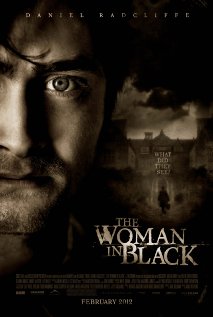
Movie Review: Woman in Black


Director: James Watkins, 2012

Pros: several good scares, creepy, atmospheric, good score, good acting

Cons: ending style seen before, volume fluctuated between very quiet and very loud

Arthur Kipps, a young lawyer, is sent to the mysterious Crythin Gifford to go through the house of a deceased client.  The locals are suspicious and superstitious, trying to force him out of town.  His desire to stay increases when he spots a woman wearing black around the grounds of the secluded house and tries to find out who she is. 

This is a great horror movie.  It's got some fantastic acting (with Daniel Radcliffe as the laywer), creepy sets and a wonderfully gothic atmosphere.  The music helps set the scenes and paves the way for some good scares.

I saw this film on an airplane, so the extreme fluctuations in sound between whispers and shouts was distracting.  This wouldn't be a problem when watching the film at home.  I also found the twist ending familiar (having seen similar things done in a number of horror films).

If you liked The Ring or The Others, you'll like this.

Thursday, June 28, 2012

Movie Review: Robo-G

I saw this on my flight to Germany and was sorely disappointed to see that it's not available in Canada - yet.

Director: Shinobu Yaguchi, 2012

Pros: humerous, great cast of characters, fun plot

Cons: not available in Canada yet

Three employees of the Kimura Electrical Comany with no robotics experience are ordered to create a robot to display at the upcoming robotics expo.  When their prototype is destroyed a week before the expo, the men decide to hire an actor to play the robot, assuming thir boss will quickly axe the project.  The old man whom they hire does such a good job that their robot becomes famous and they must keep up the charade. 

The humour in this movie could have been clicheed, but feels fresh.  Perhaps it's the addition of Japanese cultural norms, or Mickey Curtis, the old man who plays the robot, or just that there's enough seriousness to the story and limited slapstick.  The audition where a group of people are asked to act like robots was hilarious, as were the engineers introductions at the Robo Expo (where one of them mentions that his job used to be washing machine repair work).

The premise, of something going wrong and hiding that fact, isn't new.  But this movie used it well.  As things start to spiral out of control, they come up with a daring plan.

I was also impressed that the film used several plot threads.  In addition to the main story, there's a side plot involving the old man and his grandkids, a collage student studying robotics and a local reporter looking for a scoop.

If you can find a copy, it's definitely worth a watch.

Thursday, June 14, 2012

Movie Review: Black Death


Director: Christopher Smith, 2010

Pros: realistic medieval settings/costumes/ideas

Cons: witch finder is both worldly and naive, inauthentic execution methods

The bubonic plague is devastating England when news of an untouched village reaches the pope.  Convinced that the village is practicing black magic, a witch finder, Ulrich (Sean Bean), and several guards are sent to bring back the necromancer.  A young monk (Eddie Redmayne) who has had an indiscretion with a local woman, agrees to lead them to the remote village in hopes of reuniting with her along the way.

Black Death shows the middle ages in all its dirty, superstitious splendor.  The characters are surprisingly complex, given the way medieval historical films typically portray religion and superstition.

Despite having fantastic (and realistic) costumes and sets, the movie was ultimately disappointing.  The witch finder and his guards, quite worldly at the start of the film, are surprisingly naive when they reach the village, eating and drinking food prepared by people they know killed the previous witch finders who were sent.  

And the execution and torture methods used were... not typical for this time or place.  Witches were burned on the continent.  In England they tended to be hung.  Similarly, crucifixion was specifically Roman and, to the best of my knowledge, not used in England (a quick check of wikipedia varifies my belief but explains that crucifixion was used by more than just the Romans).

The ending was similarly disappointing.  I'm ok with films not having a happy ending, but at least give it an ending.  This seemed to peter off into nothing.

If you want a better - and more satisfying - medieval based movie, try The Name of the Rose.  There's an unnecessarily graphic love scene, but beyond that the film's pretty good.  Or, better yet, since the film messes with the ending, read Umberto Eco's book by the same name.

Thursday, June 7, 2012

Movie Review: Dr. Jekyll and Mr. Hyde (1920)


Director: John S. Robertson, 1920
IMDb listing

Pros: good Jekyll and Hyde swtiches, interesting reason for Jekyll's experiment

Cons: music, much longer than it needed to be

This version of Dr. Jekyll and Mr. Hyde is nothing remarkable.  The acting is similar to that of other silent films - over done with grand gestures and expressions.  The story is well told, if longer than necessary.  John Barrymore does a great performance in the titular roles.

The music track (which may differ from version to version since it would have been played live in the theatre) was surprisingly bad.  It consisted of mostly organ music, with little care for what was happening in the film.  So, for example, cheery music played while Hyde beat up on people.  At no point was the music employed to create fear or tension.

I found the inclusion of a reason for Hyde's creation interesting.  Jekyll is portrayed as a too perfect man.  A man with no vices.  So his perspective father in law suggests that he live a little, taste temptation and takes him to a bar.  Intrigued, Jekyll wonders if there's a way to split himself, so he can wallow in depravity while leaving his soul intact.  And creates the potion that destroys his life.

As with the 1913 version (directed by Herbert Brenon), the film includes a love story, though here it is more advanced.  And the subsequent irony and horror of Hyde's existence becomes apparent to the man who temped Jekyll in the first place.  

All told, if you're going to see a silent version of this film, stick to the 1913.  It's shorter and contains all the important elements of the story.  

In retrospect I should have skipped this version and seen the 1931 version instead.

Thursday, May 24, 2012

Movie Review: Attack of the Killer Tomatoes


Director: John De Bello, 1978

Pros: spoofs a lot of movies, takes the attacks seriously while taking itself as a joke

Cons: very cheesy, less humor than expected, boring at times

Several groups of misfits from the scientific, military and special ops communities, are brought in to deal with the menace of killer tomatoes.

In order to keep the menace under wraps, only the most incompetent people are sent to deal with the problem, with the exception of Mason Dixon (David Miller), who's actually quite smart.  This allows for a lot of quirky humor.  Add in 70s clothing and cheesy effects and there is stuff to laugh at, just not always what the film was going for.

The movie does well to take the killer tomato premise seriously.  It creates  a 'straight man' to play the spoof jokes off of.  And the movie does spoof a lot of other films.  My favourites were the nods to Jaws and Superman.

The only 'special effect' was the giant paper mache tomatoes.  Any other time something requiring special effects happened the camera focused on the people reacting to the incredible thing (tomatoes eating people, Superman flying, etc.).

On the whole, for a modern viewer, the movie is quite boring (mostly meetings with various people and little actual dealing with the problem or seeing people get eaten).  Lois Fairchild (Sharon Taylor), a reporter sent to get the story, does nothing and could have been cut from the film.  Her only purpose seemed to be as a Lois Lane reference.  And while there were a few good jokes, there weren't enough to keep me interested for a feature length film.

I'd give it a pass.

Thursday, May 17, 2012

Movie Review: 12:01

Director: Jack Sholder, 1993

Pros: fun story, quirky romance, touches of humour, days repeat enough to get the point but not enough to be annoying 

Cons: no actual science

Barry Thomas (Jonathan Silverman) is having a REALLY bad day.   He's late for work - again, he accidentally forgot to add Dr. Thadius Moxley's assistants to the payroll, he gets fired and the woman he likes (and finally got up the nerve to talk to) gets shot right in front of him.

When he wakes up the next day things are suspiciously similar, from the news story of Dr. Moxley's experiment to the phone call from his mom.  And no one seems to know about Lisa Fredericks (Helen Slater)'s death.

Barry must figure out why time is looping, why he can tell it's happening when no one else is aware of it, and how to stop it.  All while also trying to save the woman he's come to love from dying, and making her realize they're perfect for each other.  Every day.

Like Groundhog Day, this movie relies on repetition of events for its story telling.  Unlike Groundhog Day, the days only repeat a limited number of times, and the emphasis is on figuring out what's happening and trying to stop it.  Each day is unique despite the repeated events, and the romance between Barry and Lisa is completely different each day.

There's a fair amount of humour involved with Barry trying to explain to Lisa who he is and why she should believe that the experiment she's an assistant on has gone bad.  Barry's cubicle neighbour is also a riot, playing pranks on him that go the wrong way in increasing degrees as Barry encounters the same tricks each day.

The science behind the experiment is never mentioned in detail, so if you're looking for hard SF look elsewhere.

As a made for TV movie, it's surprisingly clever, with some good acting and fun dialogue.

Thursday, April 26, 2012

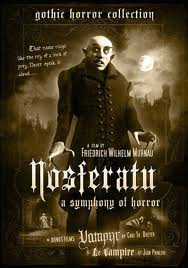
Movie Review: Nosferatu, A Symphony of Horror


Director: F. W. Murnau, 1922

Pros: very creepy vampire, atmospheric, ending is different from the book (so it's a surprise), good soundtrack (in the restored version)

Cons: drags in the middle, supporting characters have little purpose, tinting made time of day difficult to determine

review contains mild spoilers

restored 2006 under the direction of Luciano Berriatua (including newly translated title cards, reconstructed score, variously tinted frames)

Real estate agent Hutter is sent to Transilvannia to arrange the sale of the house across from his in Wisborg, Germany, to Count Orlok.  The Count turns out to be a vampire, Nosferatu.  The sudden rise in deaths in Wisborg is blamed on the Plague, believed brought by the Count's ship.

The filmmakers were unable to get the rights to Dracula, but that didn't stop them from modelling their film very closely on the book.  Aside from the names, the movie follows the book almost exactly until Count Orlok arrives in Wisborg.  The action here (Act V) is truncated and ends very differently from the book when Ellen (the Mina character, played by Greta Schroeder) discovers how to defeat the monster.

The first Act is devoted to setting up Hutter (Gustav V. Wangenheim) and Ellen as a couple very much in love.  This is important as later in the film their connection saves Hutter's life.  It also makes the ending more profound. 

The Count, played by Max Schreck, is terrifying.  His head is bald, his nose large and crooked and when he shows up as the vampire, his ears become pointy, his teeth sharp and his torso, arms and fingers elongated.  Even his silhouette is terrifying.  This film contains the iconic vampire image of the Count rising from his coffin - though his arms are outstretched here, rather than crossed on his chest as later films use. 

The use of the plague to explain the deaths was, I thought, rather clever.  I was disappointed that Professor Bulwer (the Van Helsing character) didn't have much of a role.  In fact, they could have left him out completely and nothing would have changed.  The same can be said for some of the other supporting characters.

The restored version I watched had a fantastic reconstructed score (which helped set the mood and add to the creepiness) and distracting tinted frames.  I'm not sure if it was due to the tints or the photography, but title plates had to explain when it was night time, as you otherwise couldn't tell (and yellow tints made it look like afternoon).  In a film wherein the antagonist is only out at night, knowing when it's day and night is rather important.  It makes me curious how the film was originally released (as the tinted frames used were taken from different preserved versions of the film).

The movie drags a bit in the middle, but on the whole is an enjoyable retelling of Dracula.

Thursday, April 19, 2012

Silent Movie Reviews

Before this week the only silent movie I'd seen was a non-restored cut of Fritz Lang's Metropolis.  After seeing three more films, here are some general impressions I've made about silent films:

1) for complicated stories title cards are necessary to understand the plot (Frankenstein and Dr Jekyll); for simplistic plots they're unnecessary (Le Voyage Dans La Lune)
2) once you've read the title card, grand gestures by the actors get other aspects of the film across
3) music really makes a difference (two of the films I saw were completely silent, one - Frankenstein - had an added soundtrack.  The music increased the tension by marking when the monster appeared and reducing tension for the scenes with Frankenstein's sweetheart.
4) they tended to be quite short and so had to distill the essence of the stories, removing character development *

Now on to more specific observations about the films themselves.

Frankenstein
Producer: Thomas Edison, 1910
IMDB listing, view it online at Archive.org

Victor Frankenstein creates a monster that then haunts him and threatens his sweetheart.

Frankenstein (at least the version I saw) is a black and white film with some tinted images.  Yellow tints were used for scenes with the monster, a light purple for scenes with Frankenstein's lady love and blue when the creature attacks.  Even if you know the story, you'll need the title cards to understand what's happening.  The creation of the monster is done very differently from both the book and later films (a slowly built up skeleton standing in a cauldron).  The monster itself looks different (seen above) and causes much less damage to Frankenstein.

The mood is very tense during the creation scene and again when the monster visits Frankenstein at his home.  There's no development of the creature, no intelligence such as it shows in the novel.  In fact, the film sort of ends with no resolution.

Still, it's only 16 minutes, and worth a look if you're interested in film history or monster movies.

Le Voyage Dans La Lune
Director: Georges Melies, 1902
IMDB listing, view on Archive.org (b&w untinted version)

A group of men make a rocket and travel to the moon, fight the creatures living there, and return home.

Originator of one of the most iconic images in science fiction film history, the movie itself is short (14 minutes), and yet at the same time, too long.  As it uses no title cards everything must be explained via gestures - and the movie really drives its point, having each scene drag on longer than necessary.  The moon people are men wearing bird style masks and crab claws and look pretty cheesy, but the woman in the moon is a nice set design.

Interesting only as a curiosity, it certainly shows why moving pictures captured the imagination but isn't that interesting to watch.  Perhaps a soundtrack (played in theatres but missing here) would have improved it?

Dr. Jekyll and Mr. Hyde 
Director: Herbert Brenon, 1913
IMDB listing, view on Archive.org

Kind Dr. Jekyll tests a solution that transforms him to the deformed and malicious Mr. Hyde.

By far the longest of these three picks, Dr. Jekyll clocks in at a whopping 26 minutes.  This allows it to do what the other two films didn't have time for - add character.  To Hyde that is.  Jekyll isn't given much time, just a scene (and card) to show he does charity work.  From then on, the actor is mostly Hyde, who does horrible things that Jekyll must pay for (generally with money).

The plot actually develops well and the transformation between Jekyll and Hyde is well done and frankly scary (the actor, King Baggot, stoops and changes his mannerisms, rather than using make-up).  There's also more subtlety with the acting.  It's all still wide gestures, but you can better see the despair in Jekyll as he realizes Hyde is taking over as well as Hyde's joy in wanton destruction.

Of the three films here, I'd recommend this one the most.

* This holds true for the three films reviewed here and other early silent films, but later silent films were feature length, like Nosferatu.

Sunday, March 25, 2012

Movie Review: The Hunger Games

Directed by: Gary Ross, 2012

Pros: fantastic acting, faithful to the book, great costumes, both touching and brutal

Cons: too much unnecessary shaky cam

For Parents: no swearing, no sex, lots of violence in the last 3rd of the film (though there's little blood and most of the deaths occur offstage, you do see a few of the tributes kill each other)

The Hunger Games is a faithful adaptation of Suzanne Collins' popular dystopian YA novel of the same name.  Katniss Everdeen is chosen as one of two District 12 tributes to fight to the death in the 74th Hunger Games, a televised sport spectacular used to punish the 12 Districts for rising against the Capitol years before.  

Katniss has hunting skills and is desperate to return to her beloved little sister, but there are 23 other tributes, some of whom have trained for the games all their lives.  And her people skills, important to garnering support and help during the games, are vastly underdeveloped.

I was a little worried by Woody Harrelson's casting as Haymitch (I still see him as the 'boy next door' from Cheers, and had trouble picturing him as a drunk), but thought he - and the other actors - did an amazing job.  Jennifer Lawrence, who played Katniss, was especially good, showing apathy, fear, determination and finally the desire to game the system and give the audience what they wanted in hopes of surviving to the end.  Indeed, though brutal at times, the film managed to also portray the tragedies associated with the games (watching the reactions of kids forced to kill other kids and sorrow over certain deaths) without overdoing it.

The special effects were good - contrasting the poverty of District 12 with the opulence and technology of the Capitol.  And the costumes, especially the flaming outfits, were spectacular.

I appreciated the few minor additions to the story - scenes not from Katniss's POV, and therefore not in the book - that helped flesh out the world a bit more.

My only real complaint was with the amount of shaky cam/hand held camera usage at the beginning of the film.  There were times when the effect was used to show scenes from Katniss's POV, which were well done.  But there was also a lot of unnecessarily blurry shots of Katniss running and people milling around.  Thankfully, as the action increased towards the end of the film this became less and less noticeable.

If you haven't read the books you'll have no problem following the story.  Everything you need to know is explained, though people who have read the book will get more out of the scenery/costumes, etc..


***** Spoiler Area *****


I was disappointed that the scene where Rue's district sends a parachute to Katniss was cut, but appreciated the scene they replaced it with.  

I also thought the scene with the berries at the end was cut short.  In the book the pair have the berries in their mouths before the games are called off.  I didn't believe the Capitol would accept anything less than the pair having the berries in their mouths, considering the stakes involved for those running the Games.

The game masters also have more specialized control of the arena in the movie.  For example, they specify what tree will fall when expanding the forest fire and send fire blasts at Katniss.  My husband pointed out that this would invalidate the betting that went on as to which tribute would win.  If the people running the games can target and kill specific players, then what's the point of betting that a particular player can outsmart/kill the others?

Friday, December 30, 2011

Movie Review: Darkest Hour

Director: Chris Gorak, 2011
imdb listing

Pros: action interspersed with reflection, set in Moscow, humans all work together after the attack despite nationalities, interesting alien design and premise, good special effects

Cons: protagonists aren't particularly likable, scientific impossibilities

Four Americans and a Swede visiting Moscow band together after an invasion of invisible aliens wipes out the city.

Once you get past the scientific impossibilities (which, if you're not scientifically inclined you may not even notice are present - my husband had to explain them to me later), this movie takes the best elements of Cloverfield and joins them with 28 Days Later.  You see the aliens land and watch a terrifying first contact, after which the protagonists hole up for a few days.  When they emerge, they must deal with the wreckage of a decimated Moscow.

There's no shaky cam footage and tension is increased by occasional quiet moments when the full extent of the invasion is considered, the director's willingness to kill off characters and the 'early warning' system the characters devise.  The characters themselves, while not particularly likable are more 'everyman' than irritating targets you're cheering the aliens on to kill.  Having said that, only one death made an impact on me emotionally.

It was great to see Russian actors playing the Russian characters, and an invasion movie that doesn't take place in the US (or Japan, for that matter).  Moscow was a fun location, and seeing the Americans and Russians work together without 'we're better than you' posturing was a real treat.

The special effects were well done and the alien design original.  The premise behind the aliens themselves was quite clever.  And there's a real beauty to the falling alien craft at the beginning of the film, bringing to mind the meteor shower in The Day of the Triffids. 

The movie has a surprisingly upbeat ending.  It was a little contrived, but ultimately showed humanity at its best, willing to fight for their planet.

Ultimately, it's a fun way to waste a few hours.