Showing posts with label Horror. Show all posts

Tuesday, September 24, 2013

Book Review: The Crimson Labyrinth by Yusuke Kishi

Translated by Masami Isetani and Camellia Nieh

Pros: creepy premise, interesting characters

Cons: introduced to too many characters at once making them hard to remember

When Yoshihiko Fujiki wakes up in a red stone canyon in the rain, he has no idea where he is or what's happened to him.  All he has are a few basic supplies and a handheld game system welcoming him to the Mars Labyrinth.  Before he has the chance to follow the directions to the first checkpoint he runs into another player, Ai Otomo.  Her game system is broken, so they team up to face... whatever comes next.

This is a novel that starts slowly - with Fujiki trying to figure out what's going on - but quickly builds momentum.  Like the characters, you're horrified by the turns the 'game' takes, as some of the players become less and less human.  And though Fujiki has some ideas of what's happening behind the scenes, figuring that out isn't as important as staying alive.

Try not to read the book's back cover synopsis as the first paragraph contains a spoiler that will colour how you read the novel.

The premise of the book is pretty creepy.  It starts off as a survival game with everyone in the wilderness.  As time goes on and a trap set by those running the game is activated, things shift and it becomes a different kind of survival game. 

The protagonists are pretty interesting, with down on their luck backgrounds.  Fujiki took a while to grow on me, but I liked his tenacity and cleverness.  While Ai gives good advice at times, she mainly stays in the background, letting Fujiki make most of the decisions.  The other players all have unique personalities, though you don't see much of them.

Fujiki and Ai encounter the other players at the first checkpoint and you're given a quick introduction of all of them.  It's too many people, too fast, several of whom have similar names.  I found that later in the book, when the pair met up with them again, I couldn't remember who was who.

I'd recommend this to people who would like a less violent Battle Royale.  It's got a bit of mystery, a bit of survivalistic writing, a tiny bit of romance and several violent, though not too graphic, deaths.


Tuesday, August 27, 2013

Book Review: Psycho by Robert Bloch

Pros: great writing, unique twist

Cons: if you've seen the movie, you know the story (including the twist ending)

When Mary Crane's boss hands her an envelope containing $40,000 to bring to the bank she thinks her troubles are over.  She impulsively drives to her boyfriend's town, intending to use the cash to pay off his debts so they can finally get married.  But heavy rain makes her miss a turn and she ends up spending the night at the Bates Motel.

If you've seen the Alfred Hitchcock movie you know the story.  There are some differences, particularly with regards to Norman Bates, who in the book is 40, overweight, and converses more with his mother than he does in the film.  Mary's also given more motivation for stealing the money.  Mrs. Bates is quite horrifying, especially given how Norman covers for her.

It is a highly suspenseful book, with a great twist ending if you haven't seen the film (and even if you have, the skill with which the author makes Norman's home life bizarre but plausible is wonderful).


With such a great story it's no wonder Hitchcock thought it would make an excellent film, and kept the plot so close to that of the book.  It's short (just over 200 pages) and a very quick read.

Tuesday, July 2, 2013

Book Review: The 'Geisters by David Nickle

Pros: creepy premise, well written

Cons: uncomfortable and potentially triggering subject matter

Anne LeSage is getting married, and while she often has trouble distinguishing between the feelings of fear and love, she's sure this is love.  But when things start to go wrong around her new husband, she's afraid the poltergeist that has haunted her all her life, and which she finally trapped as a teen after a terrible accident, has broken loose.  It doesn't want to go back in its box however.  And her husband's acquaintances don't want it to either, because they've got their own plans for her 'insect'.

This is a difficult book to review.  As a horror novel it definitely succeeds.  I found parts of the book, particularly Anne's early revelation that she can't distinguish between fear and love, terrifying.  Especially given how things turn out.

So what's the problem?  The plot revolves around a group of men trying to use poltergeists for... sexual purposes.  There are no real descriptions of abuse, but you know that abuse is happening, and that makes for an uncomfortable read.

The ending left me feeling somewhat ambiguous.  It fit the story, but I'm still not sure I liked it.  

In several ways this felt like a Stephen King novel, with great characterization and some chilling scares, without many details.  The fear is often in what you're not told.  Or not told explicitly.  And Nickle's good at leaving things to the reader's immagination.


David Nickle recently appeared on John Scalzi's Whatever talking about the book if you'd like more information about the book. 

Friday, April 12, 2013

Movie Trailer: Antiviral

This film, available on Sundance Now (for, presumably, Americans, since it won't work for me) as well as other venues, has a very... unique premise.  I'd like to believe that humans aren't dumb enough to do this, but I suspect we are.

Syd March is an employee at a clinic that sells injections of live viruses harvested from sick celebrities to obsessed fans. Biological communion – for a price. Syd also supplies illegal samples of these viruses to piracy groups, smuggling them from the clinic in his own body. When he becomes infected with the disease that kills super sensation Hannah Geist, Syd becomes a target for collectors and rabid fans. He must unravel the mystery surrounding her death before he suffers the same fate.

Written and Directed by: 
Brandon Cronenberg
 
Starring: 
Caleb Landry Jones, Sarah Gadon, Douglas Smith, Wendy Crewson, Malcolm McDowell


Friday, January 4, 2013

Author Interview: Christopher Farnsworth

Novels:
Blood Oath
The President's Vampire
Red, White & Blood

Website: chrisfarnsworth.com

> What is the Nathaniel Cade series about? 

Nathaniel Cade is the President's Vampire. Turned into a blood-drinking abomination in 1867, he was bound by a special blood oath to serve and protect the President of the United States. For almost 150 years, he has served as the first response and last line of defense against the supernatural evils that lurk in the dark. He's partnered with a human handler, who deals with the daylight world for him. Right now, this is Zach Barrows, a young political operative who's yanked out of a promising career in the White House to work with Cade. Together, they face undying evil and shadowy conspiracies -- and sometimes, the scariest monsters are the ones that are human.


> The character Nathaniel Cade is based on an actual sailor who reportedly turned to vampirism in the late 1800s.  How did you hear about this story and why did you decide to write novels about him?

I read the original story in a book called THE PRESIDENT'S VAMPIREby Robert Damon Schneck. According to some newspaper accounts, President Andrew Johnson pardoned a man who allegedly killed two of his crew mates on a whaling vessel and drank their blood. He was sent to an asylum for the criminally insane, and no one really knows why Johnson spared him. But I kept wondering, what if that were just the cover story? What if the man really was a vampire? What would the President of the United States do with his own vampire? And the first book took off from there.

> What were some of your other literary and/or historical influences for Blood Oath?
I've always been fascinated by tales of the paranormal and the strange, so I got to use a lot of the weird lore I read as a kid: books by John A. Keel, Loren Coleman, and the father of high weirdness in America, Charles Fort. I also looked for inspiration from Stephen King, Mike Mignola (author of HELLBOY), and Trevanian, the author of what I still believe is the best spy novel written, SHIBUMI. And of course, comic books. I learned a lot at an early age from Stan Lee and Jack Kirby.

> What made you want to be a writer?
Honestly, I have no other marketable skills. I knew I wanted to write when I was five years old, and most of my life since then has been one long attempt to figure out how to do that. I got a job as a reporter, and worked in journalism for years, then managed to sell a script, and finally turned one of my ideas into a novel. I'm an extremely lucky guy.

> If you could, would you change places with any of your characters?
Not a chance. Cade and Zach live in a world where the monsters are real, and there are very hungry things in the dark just waiting for their chance at us. They're burdened with the responsibility of keeping everyone else safe from unspeakable evil. They fight the War on Horror every day. It's not an easy job, and I wouldn't want it.

> Was Blood Oaththe first novel you wrote and how long did it take to write it?
BLOOD OATH was actually my fifth novel, but my first published. I wrote a terrible novel for my undergraduate degree, then tried to write a few more thrillers and sell them before I had any success with Cade. It took me about eight months to write, but I had some distractions in between, like buying a house and the birth of my first daughter.

> When and where do you write?
I try my best to treat writing just like any other job I've held. So I go to an office within walking distance of my home and sit at a desk for up to eight hours a day. Sometimes I don't accomplish anything more than Facebook updates. Other days, I can get twenty or thirty pages done. But I always put in the time. A friend of mine once said, "The only way to write it is to write it."

> What’s the best/worst thing about writing?
The best thing: when the words are just flowing, and everything is falling into place. It makes me feel as if I'm fluent and smart and actually good at this job. The worst: when that's not happening, and every thought I have seems like it should be handled with disinfectant and rubber gloves.

> What is something you didn’t know about the publishing industry before you had your first book published?
My experience had been in journalism and screenwriting, so I was pleasantly surprised to find how seriously the author is still taken in publishing. People listened to my opinions about my own work. That hadn't happened much before. In Hollywood or at a newspaper, the writer is just the first part of the process, then everyone else gets to tear up the story. In my experience, at least, my editors and publishers allowed me to decide how it would look in the final draft.

> Do you have any advice for hopeful authors?
I've said this before, but never be ashamed of your enthusiasms. I spent a lot of time writing what I thought other people wanted to read, and I only sold a book when I started writing what I wanted to read -- a completely insane story about a vampire secret agent working for the White House. Listen when people tell you things about your craft, about how you're telling the story, about presentation and plot and narrative devices. That criticism is valuable and important. But if someone tells you that no one else will ever want to read about your favorite thing -- well, they're wrong. If you love it, keep writing it until you find someone else who does, too.

> Any tips against writers block?
Don't let the blank screen terrify you. Find one detail and start from there. Just fill the page as best you can, and go back and dump whatever doesn't work later. But sit down and write, no matter what.
> How do you discipline yourself to write?
It's still fun. Even when it's work. And, as I said, I don't know what else I would do.

> How many rejection letters did you get for your first novel?
Dozens. I can remember walking to my mailbox every day, finding the rejections, and then trudging back to my apartment. It was important and useful. I learned how to take disappointment. It took me a while to realize that failure is the only way to learn. You have to try, over and over, and fall down a lot, on your way. It was not an easy lesson, and I still don't like repeating it. But it still holds true. As Salman Rushdie once wrote, you have to try again, and fail better the next time.

Friday, November 16, 2012

New Author Spotlight: Christopher Buehlman

New Author Spotlight is a series designed to introduce authors with up to 3 books in the different SF/F subgenres.

Today's spotlight shines on Christopher Buehlman!

Winner of the 2007 Bridport Prize in Poetry and author of several plays, his novels are:

  • Those Across the River by Christopher Buehlman (Ace)
  • Between Two Fires by Christopher Buehlman (Ace)
Here's the cover copy for Those Across The River:

Haunted by memories of the Great War, failed academic Frank Nichols and his wife have arrived in the sleepy Georgia town of Whitbrow, where Frank hopes to write a history of his family's old estate-the Savoyard Plantation-and the horrors that occurred there. At first their new life seems to be everything they wanted. But under the facade of summer socials and small-town charm, there is an unspoken dread that the townsfolk have lived with for generations. A presence that demands sacrifice.  
It comes from the shadowy woods across the river, where the ruins of the Savoyard Plantation still stand. Where a long-smoldering debt of blood has never been forgotten. Where it has been waiting for Frank Nichols…
Check out these other books if you like horror novels about things lying in wait in old houses:

  • A Twisted Ladder by Rhodi Hawk (Tor Books)
  • Black Creek Crossing by John Saul (Ballantine Books)
  • Neverland by Douglas Clegg (Vanguard Press)

Friday, October 26, 2012

New Author Spotlight: Gretchen McNeil

New Author Spotlight is a series designed to introduce authors with up to 3 books in the different SF/F subgenres.

Today's spotlight shines on Gretchen McNeil! Her books are:

  • Possess by Gretchen McNeil (Balzer + Bray)
  • Ten by Gretchen McNeil (Balzer + Bray)
Here's the cover copy for Ten:
Don't spread the word!
Three-day weekend. House party.
White Rock House on Henry Island.
You do not want to miss it.
It was supposed to be the weekend of their lives, three days on Henry Island at an exclusive house party. Best friends Meg and Minnie each have their own reasons for wanting to be there, which involve their school's most eligible bachelor, T. J. Fletcher, and look forward to three glorious days of boys, bonding, and fun-filled luxury.
But what they expect is definitely not what they get, and what starts out as fun turns dark and twisted after the discovery of a DVD with a sinister message: Vengeance is mine.
Suddenly, people are dying, and with a storm raging outside, the teens are cut off from the rest of the world. No electricity, no phones, no internet, and a ferry that isn't scheduled to return for three days. As the deaths become more violent and the teens turn on each other, can Meg find the killer before more people die? Or is the killer closer to her than she could ever imagine?
Check out these other books if you want some creepy serial killer tinged Halloween reading:

  • Daemon Hall by Andrew Nance (Square Fish)
  • Beyond by Graham McNamee (Wendy Lamb Books)
  • The Body Finder by Kimberly Derting (HarperCollins)

Tuesday, October 16, 2012

Book Review: Beyond by Graham McNamee


This is my second R.I.P. (Readers Imbibing Peril VII) review, and the first book.  I'm not sure I'll be able to get a second book in as planned, but we'll see.  If you want to see what reviews others have written, check here.

----------------------------------------------------------------------------------------------------------------------------------
Pros: great characters, fast paced, honest chills, no romance

Cons: too short!

For Parents: no content

The real reason behind Jane's numerous brushes with death is too crazy for anyone but her fellow 'creep sister' to believe.  So when she starts hearing voices and seeing things - in addition to her already extreme sleepwalking and migranes - she only tells her friend Lexi what's really going on.  Somehow, she's picked up a ghost.  One who wants her dead, and is able to use her own shadow - and body - to kill her.

This is a brilliantly written teen novel.  The chapters are short and punchy, making it very fast paced and quick to read.  The characters are fully fleshed: Jane's parents who love their daughter and want to help but don't know how.  Jane, who wants to explain but knows they won't believe her.  Lexi, whose father left when she was young, and who makes dark films in order to understand the world.

The story is explained through quick flashbacks to Jane's various deaths, her friendship with Lexi and dealing with the present.  There is a love interest, but it's kept low key and just barely factors into the plot.

The ghost is suitably terrifying, as is it's reasoning for wanting Jane.  There is some adult creepiness involved with the ghost's past that comes into play with Jane's present, but it's passed over with limited details.

It's a great book for younger teens to adults who want a decent - but not gory or too terrifying - scare.   And the author's Canadian. :)

Thursday, September 13, 2012

Movie Review: The Cabinet of Dr. Caligari (Das Kabinett des Doktor Caligari)


Directed by: Robert Wiene, 1920  
colour tinted black & white, silent film

Pros: suspenseful, good use of shadows, clever ending

Cons: music was sometimes out of place

The version I saw was reconstructed by the Bundesarchiv-Filmarchiv of Germany with a musical score by Rainer Viertblock (1994) and English subtitles by Kino International (2002).

After hearing that a man sees ghosts, Francis (Friedrich Feher) tells the terrifying tale of recent events that affected himself and his fiancee Jane (Lil Dagover).  Francis is dragged to see the travelling fair by his friend Alan, who insists they see Dr. Caligari's somnambulist show and asks about his future.  Meanwhile several murders take place in the town.

This is a masterful film.  The director makes great use of shadows, making characters look sinister just by darkening the eye sockets and lips.  At times the music is used to advantage, heightening the suspense.

Having said that, there were other times when the jazz inspired score seemed out of place, using synthesizers and beets that thrust this viewer out of the scene.

The subtitle plates were up longer than necessary, but had a nice gothic look to them.

As with the other silent films I've seen, the acting was overdone with grand gestures and melodrama.  Given the horror aspects, the overacting actually works here, giving the drama a boost.

The ending's quite clever.  If you've wanted to try seeing a silent film, here's a good one to start with.

It's also in the public domain, meaning you can find it for free online.  You can find the version I saw here.

Tuesday, September 4, 2012

Public Domain Short Story Reviews

I started reading these stories months ago and keep forgetting to post the reviews.  All of these stories are public domain, so free to read on the internet.  I found them in several places, but the best concentration is Gutenberg.org, followed by Many Books.net.  If you have an Apple device, there's a great book reader called 'Free Books'.  It's all public domain stuff and if you don't mind the ads, it's free.

Unlike my novel reviews, I decided to go with a star rating on the stories, as there isn't enough plot to do a pro/con for each one.  Five stars means the story was excellent in every way.  Four means it was very good.  Three is good, two is ok and one is mediocre.  I've dated the stories, then give a very short synopsis and my, rather condensed, thoughts on the story.

Some of the links are to the stories themselves, others are to where you can download the stories in multiple formats.


**** "Most Dangrous Game" - Richard Connell (1924)

Very creepy story about a hunter who washes up on a Caribbean island owned by a Russian aristocrat, who has discovered the best thing to hunt.

Even knowing what's coming, the story is creepy.  The actual hunt is less detailed than I'd have liked, given the fantastic set-up.


***** "Keep Out" - Fredric Brown (1954)

Altered humans form a new colony on Mars.

Chilling story.  It's short but carries a very forceful message.


*** "The Ultimate Experiment" - Thornton DeKy (1941)

A robot achieves what the last humans on Earth couldn't: creating new homo sapiens

A interesting premise narrated by the robot.


**** "2+2 Makes Crazy" by Walter Sheldon (1954)

A public liason officer gives a man from the Information Department a tour around Computer City, showing him the computer that's increasingly running their world.

A plausible look both at the importance of computers in the world, and the paranoia of humans when dealing with the unknown/misunderstood.


***** "This World Must Die!" by Horace Brown Fyfe (1951)

Four convicts, individuals who have murdered, or tried to commit murder, are asked to do what no others in normal society are capable of: destroy a ship full of plague victims before it can reach the inhabited Mars.

A complex story that explores many angles of morality.  The convicts have no knowledge beside what they're told, have seen no plague victims and have dubious histories (not all of which are violent).  This one will make you think.


***** "Time and Time Again" by Henry Beam Piper (1947)

43 year old Allen Hartley is sedated after being injured in World War III.  He wakes up in his 12 year old body in 1945.

A time travel story that questions whether the past can - or should - be changed.


**** "The Prize of Peril" by Robert Sheckley (1960)

A man slowly rises in the reality game show circuit to the top: trying to stay alive for a week while being hunted by a gang of thugs.

This is the last few hours of the Prize of Peril game show, and Jim Raeder is convinced he's a walking dead man, because for every 'good samaratin' who's willing to help him, there's another person screaming his location to the thugs he's trying to avoid.

It's an interesting look at what people are willing to risk in the hopes of earning a quick buck.  Reality TV didn't exist when this was written and yet you can see how even the man betting his life is so far removed from reality that it's only in the last few hours of the game that he questions what made him decide to play in the first place.  And what kind of society allowed this show to floroush.

Given the debate around The Hunger Games and Battle Royale recently, this is an interesting story to look at.  These premises - of humans killing humans for sport - are obviously not new.  And we're not as far from the gladatorial arenas of ancient Rome as we'd like to think.


** "The Dunwich Horror" by H. P. Lovecraft (1929)

A small rural village has some bizarre goings on as a boy is born who grows up remarkably fast and who has a malignant aura, unleashes a horror on the locals.

Originally serialized, this story is a lot longer than it needs to be.  Narrated by a character who faces the horror, the story tells of Wilbur Whateley's birth and youth, and the odd things that happen at the farm where he lives with his mother and grandfather.  There's a lot of build up towards a dual climax, one dealing with the boy, the other with the horror he's conjured.  The plot is interesting but there's so much unnecessary description that reading it was fairly boring.  The horror elements are also subtle (as the creatures mentioned are only haphazardly described).


**** "The Call of Cthulhu" by H. P. Lovecraft (1928)

Written as an account by an unnamed man who discovers the existence of a terrifying creature living underwater after going through his great-uncle's papers and researching the matter himself.

This story was quite scary, both in its attempts to be scholarly and realistic, and in it's slow build up of evidence to support the existence of the Cthulhu Cult and the monster itself.  If you're interested in trying H. P. Lovecraft, start here.

Thursday, July 19, 2012

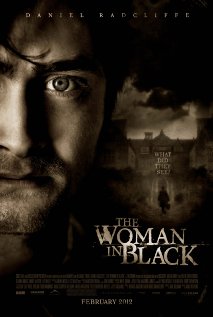
Movie Review: Woman in Black


Director: James Watkins, 2012

Pros: several good scares, creepy, atmospheric, good score, good acting

Cons: ending style seen before, volume fluctuated between very quiet and very loud

Arthur Kipps, a young lawyer, is sent to the mysterious Crythin Gifford to go through the house of a deceased client.  The locals are suspicious and superstitious, trying to force him out of town.  His desire to stay increases when he spots a woman wearing black around the grounds of the secluded house and tries to find out who she is. 

This is a great horror movie.  It's got some fantastic acting (with Daniel Radcliffe as the laywer), creepy sets and a wonderfully gothic atmosphere.  The music helps set the scenes and paves the way for some good scares.

I saw this film on an airplane, so the extreme fluctuations in sound between whispers and shouts was distracting.  This wouldn't be a problem when watching the film at home.  I also found the twist ending familiar (having seen similar things done in a number of horror films).

If you liked The Ring or The Others, you'll like this.

Tuesday, June 12, 2012

Book Review: Claws and Saucers by David Goldweber


Pros: covers a LOT of movies, lots of cross-referencing, lots of interesting information about the films, directors, actors and DVD extras, spoiler warnings

Cons: limited commentary on famous films, mentions a lot of personal stories

Claws and Saucers: Science Fiction, Horror and Fantasy Film 1902-1982 is a 680 page self-published movie guide covering a huge number of films.

Unlike most books, I did not read this through cover to cover.  After reading the introduction and the interesting films by decade feature, I started by reading reviews of films I've seen to get an idea of how the author approaches reviews and how my tastes/opinions matched his.  After that, I randomly flipped through the book and came away with so many movie suggestions I was afraid I'd miss interesting films, and so started at the beginning.  I then read reviews at random throughout the whole book.  And created a large list of movies to watch and short stories to read.

The book covers a LOT of movies.  There are over 1500 entries.  The author mentions a few adventure films (like the 1932 The Most Dangerous Game) but not Disney films, James Bond films or others that stray too far from the genre lines.  He gives a good explanation of what is in and out of the book at the beginning.

The author defers commentary on famous films, assuming the reader knows something about them, or is willing to look elsewhere for information if he/she doesn't.  Instead, for those films he often give stories - when he first saw the film, how he felt about it then vs now.  For example, with Jaws he gives some facts about great white sharks.

In other cases, the information he gives is fantastic.  For example, King Kong.  He sets the film in its place historically, critiques it with regards to other works (the score, the special effects), mentions the features worth watching on the bonus DVD, facts about the director, etc..  He also mentions when the movie is based on or has a connection to a short story (like Aliens' connection to the short story "The Black Destroyer" by A. E. Van Vogt), or comics that would appeal to people who like particular movies.

Despite the negatives, the book is fantastic value given all the movies it mentions.  The paperback is available through Lulu and priced at $45.95, which sounds like a lot until you consider its size.  Don't want to pay that much, then get the ebook for only $8.95 on Lulu (epub format) or 7.99 at the iTunes store.  (The author's website states that the book will be available from Amazon, but I was unable to find listings for it there.)

Want to check out the guide for yourself before you buy it?  The author's put up the entire "C" listing on his website

Out June 20th.

Thursday, June 7, 2012

Movie Review: Dr. Jekyll and Mr. Hyde (1920)


Director: John S. Robertson, 1920
IMDb listing

Pros: good Jekyll and Hyde swtiches, interesting reason for Jekyll's experiment

Cons: music, much longer than it needed to be

This version of Dr. Jekyll and Mr. Hyde is nothing remarkable.  The acting is similar to that of other silent films - over done with grand gestures and expressions.  The story is well told, if longer than necessary.  John Barrymore does a great performance in the titular roles.

The music track (which may differ from version to version since it would have been played live in the theatre) was surprisingly bad.  It consisted of mostly organ music, with little care for what was happening in the film.  So, for example, cheery music played while Hyde beat up on people.  At no point was the music employed to create fear or tension.

I found the inclusion of a reason for Hyde's creation interesting.  Jekyll is portrayed as a too perfect man.  A man with no vices.  So his perspective father in law suggests that he live a little, taste temptation and takes him to a bar.  Intrigued, Jekyll wonders if there's a way to split himself, so he can wallow in depravity while leaving his soul intact.  And creates the potion that destroys his life.

As with the 1913 version (directed by Herbert Brenon), the film includes a love story, though here it is more advanced.  And the subsequent irony and horror of Hyde's existence becomes apparent to the man who temped Jekyll in the first place.  

All told, if you're going to see a silent version of this film, stick to the 1913.  It's shorter and contains all the important elements of the story.  

In retrospect I should have skipped this version and seen the 1931 version instead.

Thursday, April 26, 2012

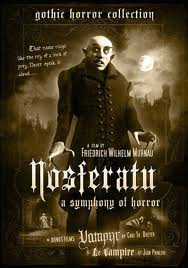
Movie Review: Nosferatu, A Symphony of Horror


Director: F. W. Murnau, 1922

Pros: very creepy vampire, atmospheric, ending is different from the book (so it's a surprise), good soundtrack (in the restored version)

Cons: drags in the middle, supporting characters have little purpose, tinting made time of day difficult to determine

review contains mild spoilers

restored 2006 under the direction of Luciano Berriatua (including newly translated title cards, reconstructed score, variously tinted frames)

Real estate agent Hutter is sent to Transilvannia to arrange the sale of the house across from his in Wisborg, Germany, to Count Orlok.  The Count turns out to be a vampire, Nosferatu.  The sudden rise in deaths in Wisborg is blamed on the Plague, believed brought by the Count's ship.

The filmmakers were unable to get the rights to Dracula, but that didn't stop them from modelling their film very closely on the book.  Aside from the names, the movie follows the book almost exactly until Count Orlok arrives in Wisborg.  The action here (Act V) is truncated and ends very differently from the book when Ellen (the Mina character, played by Greta Schroeder) discovers how to defeat the monster.

The first Act is devoted to setting up Hutter (Gustav V. Wangenheim) and Ellen as a couple very much in love.  This is important as later in the film their connection saves Hutter's life.  It also makes the ending more profound. 

The Count, played by Max Schreck, is terrifying.  His head is bald, his nose large and crooked and when he shows up as the vampire, his ears become pointy, his teeth sharp and his torso, arms and fingers elongated.  Even his silhouette is terrifying.  This film contains the iconic vampire image of the Count rising from his coffin - though his arms are outstretched here, rather than crossed on his chest as later films use. 

The use of the plague to explain the deaths was, I thought, rather clever.  I was disappointed that Professor Bulwer (the Van Helsing character) didn't have much of a role.  In fact, they could have left him out completely and nothing would have changed.  The same can be said for some of the other supporting characters.

The restored version I watched had a fantastic reconstructed score (which helped set the mood and add to the creepiness) and distracting tinted frames.  I'm not sure if it was due to the tints or the photography, but title plates had to explain when it was night time, as you otherwise couldn't tell (and yellow tints made it look like afternoon).  In a film wherein the antagonist is only out at night, knowing when it's day and night is rather important.  It makes me curious how the film was originally released (as the tinted frames used were taken from different preserved versions of the film).

The movie drags a bit in the middle, but on the whole is an enjoyable retelling of Dracula.

Thursday, April 19, 2012

Silent Movie Reviews

Before this week the only silent movie I'd seen was a non-restored cut of Fritz Lang's Metropolis.  After seeing three more films, here are some general impressions I've made about silent films:

1) for complicated stories title cards are necessary to understand the plot (Frankenstein and Dr Jekyll); for simplistic plots they're unnecessary (Le Voyage Dans La Lune)
2) once you've read the title card, grand gestures by the actors get other aspects of the film across
3) music really makes a difference (two of the films I saw were completely silent, one - Frankenstein - had an added soundtrack.  The music increased the tension by marking when the monster appeared and reducing tension for the scenes with Frankenstein's sweetheart.
4) they tended to be quite short and so had to distill the essence of the stories, removing character development *

Now on to more specific observations about the films themselves.

Frankenstein
Producer: Thomas Edison, 1910
IMDB listing, view it online at Archive.org

Victor Frankenstein creates a monster that then haunts him and threatens his sweetheart.

Frankenstein (at least the version I saw) is a black and white film with some tinted images.  Yellow tints were used for scenes with the monster, a light purple for scenes with Frankenstein's lady love and blue when the creature attacks.  Even if you know the story, you'll need the title cards to understand what's happening.  The creation of the monster is done very differently from both the book and later films (a slowly built up skeleton standing in a cauldron).  The monster itself looks different (seen above) and causes much less damage to Frankenstein.

The mood is very tense during the creation scene and again when the monster visits Frankenstein at his home.  There's no development of the creature, no intelligence such as it shows in the novel.  In fact, the film sort of ends with no resolution.

Still, it's only 16 minutes, and worth a look if you're interested in film history or monster movies.

Le Voyage Dans La Lune
Director: Georges Melies, 1902
IMDB listing, view on Archive.org (b&w untinted version)

A group of men make a rocket and travel to the moon, fight the creatures living there, and return home.

Originator of one of the most iconic images in science fiction film history, the movie itself is short (14 minutes), and yet at the same time, too long.  As it uses no title cards everything must be explained via gestures - and the movie really drives its point, having each scene drag on longer than necessary.  The moon people are men wearing bird style masks and crab claws and look pretty cheesy, but the woman in the moon is a nice set design.

Interesting only as a curiosity, it certainly shows why moving pictures captured the imagination but isn't that interesting to watch.  Perhaps a soundtrack (played in theatres but missing here) would have improved it?

Dr. Jekyll and Mr. Hyde 
Director: Herbert Brenon, 1913
IMDB listing, view on Archive.org

Kind Dr. Jekyll tests a solution that transforms him to the deformed and malicious Mr. Hyde.

By far the longest of these three picks, Dr. Jekyll clocks in at a whopping 26 minutes.  This allows it to do what the other two films didn't have time for - add character.  To Hyde that is.  Jekyll isn't given much time, just a scene (and card) to show he does charity work.  From then on, the actor is mostly Hyde, who does horrible things that Jekyll must pay for (generally with money).

The plot actually develops well and the transformation between Jekyll and Hyde is well done and frankly scary (the actor, King Baggot, stoops and changes his mannerisms, rather than using make-up).  There's also more subtlety with the acting.  It's all still wide gestures, but you can better see the despair in Jekyll as he realizes Hyde is taking over as well as Hyde's joy in wanton destruction.

Of the three films here, I'd recommend this one the most.

* This holds true for the three films reviewed here and other early silent films, but later silent films were feature length, like Nosferatu.

Friday, January 27, 2012

New Author Spotlight: Hank Schwaeble

New Author Spotlight is a series designed to introduce authors with 3 books or less in the different SF/F subgenres.

Today's spotlight shines on Hank Schwaeble!

His novels are:


He also co-edited this short story collection:

  • FIVE STROKES TO MIDNIGHT by Tom Piccirilli, Gary Braunbeck, Deborah LeBlanc, Hank Schwaeble & Christopher Golden (Haunted Pelican Press)

The cover copy for Damnable is:

Jake Hatcher is a combat veteran who's been trained to extract information by any means necessary-and is serving a military prison sentence for it. After he's granted an unexpected release to attend the funeral of a brother he never knew, Hatcher becomes drawn into a mystery connected to the alluring woman his brother apparently died saving. Before long, Hatcher realizes the police are hiding information and covering up what really happened, and he is determined to find out why.

At the same time, an enigmatic plutocrat named Demetrius Valentine is murdering young women in Manhattan in grisly fashion. Seemingly untouchable and assisted by a sociopathic hulk of a man, Valentine proceeds with a plot few beyond what most could imagine.

Hatcher's digging soon uncovers a hidden community few among the living know exist, one populated by irresistibly beautiful women whose motives and intentions are difficult to discern, inhuman females known as Carnates. Facing inscrutable adversaries and uncertain alliances, Hatcher becomes an unwitting component of Valentine's plan, a plan intended to channel the one being that can end the reign of Heaven, a plan to undo the very concept of salvation itself.

But Valentine may have underestimated his foe, for Jake Hatcher is no ordinary man. He's a man who's been damned in almost every conceivable way; by his government, by his past, by the police. A man who's left part of his soul in battle, and part on the blood-stained floors of third-world interrogation rooms—a man with nothing left to lose. Nothing, that is, but the souls of everyone else, everywhere ...

Some other books in a similar vein are:
       
  • The Descent by Jeff Long (Jove)
  •    
  • Supernatural: War of the Sons by David Reed & Rebecca Dessertine (Titan Books)
  •    
  • Requiem for the Devil by Jeri Smith-Ready (Grand Central Publishing)