Showing posts with label superhero fiction. Show all posts

Friday, September 20, 2013

New Author Spotlight: Tom King

New Author Spotlight is a series designed to introduce authors with up to 3 books in the different SF/F subgenres.

Today's spotlight shines on Tom King! His debut novel is A Once Crowded Sky.

Here's the cover copy:
The superheroes of Arcadia City fight a wonderful war and play a wonderful game, forever saving yet another day. However, after sacrificing both their powers and Ultimate, the greatest hero of them all, to defeat the latest apocalypse, these comic book characters are transformed from the marvelous into the mundane.
After too many battles won and too many friends lost, The Soldier of Freedom was fine letting all that glory go. But when a new threat blasts through his city, Soldier, as ever, accepts his duty and reenlists in this next war. Without his once amazing abilities, he's forced to seek the help of the one man who walked away, the sole hero who refused to make the sacrifice--PenUltimate, the sidekick of Ultimate, who through his own rejection of the game has become the most powerful man in the world, the only one left who might still, once again, save the day.
If you like superhero novels (and 1 graphic novel), here are some you might want to check out:


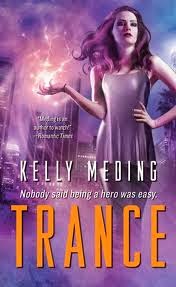
Trance by Kelly Meding (Pocket Books)
Ex-Heroes by Peter Clines (Crown Publishing)
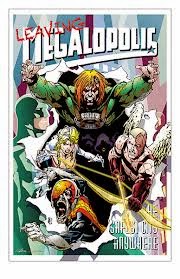
Leaving Megalopolis by Gail Simone and Jim Calafiore (Kickstarter Project I supported, which I assume will be on sale once the delayed kickstarter copies have been printed and sent out.)

Tuesday, January 22, 2013

Book Review: Blaze of Glory by Sheryl Nantus


Pros: very interesting premise, fun characters, partly set in Toronto 

Cons: characters learn things remarkably fast (eg: new aspects of their powers), don't study the NYC attack to learn about the aliens, just try same techniques

When Jo Tanis, aka Surf, and her sidekick Metal Mike, are called by the Agency to help fight aliens over New York City they know something is wrong.  First, they weren't scheduled for a fight today and second, A-List supers are dying.  This isn't a staged fight but Jo heads out because defying the Agency would force Mike, who's also her Guardian, to detonate the bomb in the back of her neck. 

One of the few survivors of the battle, Jo heads home to Toronto and forms an underground team of supers to take care of the aliens and stop the Agency's control of supers around the world.

The story is told from Jo's point of view, with occasional flashbacks to explain her relationship with Metal Mike.  She's a feisty woman with the power to control electromagnetic waves, giving her the ability to fly and shoot lightning bolts.  

The team she puts together is formed of those who answer her call for aid and consists of one villain who can melt things, a telepath, a guardian with inside Agency information and a guy who can control animals.  It's impressive what the team accomplishes considering their powers aren't formidable.  The animal talker especially surprised me, showing significantly more versatility than expected from such a 'lame' power.

The characters have incompatible personalities, making for some fun dialogue and scenes.  Their villain likes porn and coarse language, the telepath doesn't like crass behaviour.  And Jo's stuck in the middle trying to make things work.

Jo's a strong character, who shows weaknesses at the appropriate times (ie, when her team can't see her break down).  She's not given time to mourn the loss of those who die in the NYC attack and given little time to rest before getting right back out there.  This made her feel genuine.  She asks for help when she needs it but maintains control of the group through tough talk and leadership skills.

I loved the set-up that the superhero battles were all manufactured for TV, with the populace believing they're real.  I can definitely see a government agency contacting people who develop superpowers and not giving them the chance to say no to joining the program.  This also causes Jo problems as she has to explain to her former friends what happened to her, what the battles really were and why she couldn't contact them after her powers developed.

There's a minor romantic thread running through the book.  I was afraid the author would take things too fast, given the events in Jo's recent past, but she didn't, which I was thankful for.  I suspect the romance elements will be stronger in the second book of the series.

As for the problems the book has, the alien plot gets solved rather... easily all things considered.  There are some good fight scenes, but the ultimate resolution is pretty cliche.  

Jo, who had just started training how to carry someone when flying, manages to carry 4 people, without any practice.  Her jump in skill is testament to her determination, but also felt somewhat fake given she's never managed to carry 1 person before, let alone more.

I'd expected them to research the NYC battle before facing the aliens again, trying to learn what the other supers did and what powers / defences the aliens have.  Nope.  They just ran back into battle with the aliens, trying a lot of the same things and hoping they'd work this time.

Ultimately, I loved seeing Toronto featured in a science fiction book and thought the story was a lot of fun, flaws notwithstanding.

Friday, October 5, 2012

Author Interview: Adam Christopher

Novels:
Empire State
Seven Wonders

Short Stories: several, some of which you can read for free here

Website: www.adamchristopher.co.uk

> What is your new novel, Seven Wonders, about?  


Seven Wonders is an all-out, spandex-clad superhero adventure. It's set in the city of San Ventura, California, the home of the world's last superteam, the Seven Wonders, who are locked in an endless game of cat and mouse with the world's last supervillain, the Cowl. One day, an ordinary guy, Tony, wakes up with superpowers, and he decides he can finally do what the Seven Wonders have never been able to - take down the Cowl, once and for all. Only Tony soon discovers that the Seven Wonders aren't as grateful as he thought they'd be to have a new superhero in town...

> Your first novel, Empire State, also deals with super heroes, but in an alternate 20s New York.  How much research did you do on the prohibition era and what interested you in that period?
I've always been interested in the Prohibition and 1920s America - looking back, it's such a bizarre period, and it's amazing that the Eighteenth Amendment actually came to be. I remember a fascination with that period going right back to when I was about ten, I think! And looking ahead into the 1930s, you start to get the whole hardboiled detective thing, and the beginnings of what we'd recognise as modern comics, including superheroes. So it's an amazing and crazy period of history. And because of this, there has (fortunately) been plenty of research into the period. For Empire State, I leaned heavily on Dry Manhattan by Michael A. Lerner, which specifically deals with the impact of Prohibition in New York. The hardboiled/noir aspect of Empire State came from my love of Raymond Chandler and the great pulp writers - there is something very satisfying about writing those kind of characters, complete with trenchcoats and hats and that very dry sense of humour.

> What drew you to writing about superheroes?
I love superheroes, but I never grew up with comic books - when I was about seven, en route to our regular summer vacation, we stopped at a corner store and my dad bought me an issue of Batman, an issue of Iron Man, and one of those Marvel character compendium things (to shut me up in the car, I think - and in those days you could buy comics in corner stores!), and while I read each one cover-to-cover about a hundred times, I was more interested in the Marvel character encyclopedia. Years later, a friend at high school used to read 2000AD, the weekly British SF anthology comic, under his desk at the back of class, and I remember being fairly impressed with the stories, although after he moved away I kinda forgot about it.

Fast-forward again to about 2003, and I was browsing the magazine rack in a book store and saw 2000AD there. I picked it up on a whim, and was hooked immediately - for some reason, at the grand old age of 25, I'd discovered something that I felt was really for me. So after reading 2000AD for a while, I decided to go for broke and try some superhero comics, starting with Iron Man and Batman. And that was it - it was like a switch was turned on in my brain. I'd found my home, and since then superhero comics have been a burning passion.

So it made sense to write a superhero novel, to get it all out of my system, as it were! Seven Wonders was the second novel I wrote, and Empire State was next.

> If you could have a super power, what would it be?
Super-speed, like The Flash! I could get so much done! Although, when you think about it, it's a weird power, because The Flash's mental processes also accelerate to match his speed (they have to, obviously)... but that means if he runs to China, and it takes like one second in real time, for him it has still taken three months! So yeah, with super-speed I could write a novel a day... but from my point of view, that would still feel like 9-12 months! Hmm, on second thoughts...

> What made you want to be a writer?
I've always written - we wrote at school regularly, starting when I was seven - it was just something you did. This coincided with a huge repeat run of old Doctor Who on New Zealand television, which I became completely obsessed with, so most of what I was writing was my own interpretation of whatever episode had been on the previous week! As I got older, the creative writing was replaced with things like essays and assignments (I followed a science path, rather than something like English), but I kept my hand in with some Doctor Who fan fiction for TSV, the fanzine of the New Zealand Doctor Who Fan Club (which I eventually ended up editing, and won a Sir Julius Vogel Award for in 2010).

Just as I was moving to the UK, a new SF publisher was being set up and they were open to unagented submissions, so I decided to give it a shot. I was rejected, of course, but it was an important moment, a real turning point. Because that made me realise that a) I really did want to be a writer, and b) if I was going to make it, it had to be the most important thing in my life. Having had that lightning bold realisation, I started listening to writing podcasts, not just for writing advice but to find the community. One of the first ones I came across was I Should Be Writing, by Mur Laffterty, which was a huge help and really set me on my path. And it worked! Which is still a constant source of wonder and surprise for me.

> If you could, would you change places with any of your characters?
Good grief, no way! The main character in Empire State, Rad, gets put through the wringer, and I'm not sure I'd want to go through the events of Seven Wonders myself! But that's the point of a good story - nobody comes out the other end unchanged. For some it is for the better, but for some it is definitely for the worse!

> What were your literary influences for Seven Wonders andEmpire State?
Seven Wonders: a lot of comics, obviously - Astro City by Kurt Buseik was the biggest influence, but also the work of Greg Rucka, Ed Brubaker, Geoff Johns, Grant Morrison, Paul Levtiz, and many others. Not forgetting the greats of the Golden and Silver Ages of comics - I've described Seven Wonders as my homage to the Silver Age, with a dose of Bronze Age angst and grit thrown in!

Empire State: Raymond Chandler (The Big Sleep is one of my favourite novels - in fact, the idea for Empire State came about after reading that novel, and wondering what it would have been like if Chandler had written science fiction - which he famously hated), and a fascination I have with period superheroes .The Golden Age adventures of superheroes like the Green Lantern and Batman were frequently bizarre, and I've always thought that the film Batman Begins would have been brilliant if it had been set in 1939.

> You've had several stories nominated and longlisted for awards, and have posted the stories for free on your website.  Beyond the matter of length, do you find it easier writing short stories or novels?
Novels, absolutely. I don't particular enjoy reading or writing short fiction - the short fiction I have written only came about when the idea and plot arrived in my head complete from beginning to end, but I'd never actually sit down and say, right, I'm going to write a short story! Also, I think that old advice of starting on short fiction then graduating to novels is completely bogus - they are two different forms entirely, and writing one will not teach you anything about writing the other. You should write whatever you like, no matter if it is 1000 words or 100,000!

> What's the first novel (published or unpublished) that you wrote and how long did it take to write it?
The first novel I wrote is called Dark Heart, and it's sitting in a trunk somewhere. It was an important achievement, and it told me that yes, I can write a 100,000-word story. It's an occult steampunk novel, and while the plot is pretty solid (as far as I can remember), it needs a heck of a lot of work - like, a total rewrite - to bring it publishable quality. Maybe I'll dig it out and have a go, one day!

> When and where do you write?
I write in blocks of 1,000 words with breaks in between, and try to fit as many of those into a day as I can - which depends on my schedule, but the minimum is 2,000 words a day when I have other work to do, and around 3-4,000 words if I'm writing full time. For the first draft, I work on my laptop in a comfy chair in our library (really a converted dining room!), which is nice and relaxed, and then for the edits I shift upstairs to my office and sit at my desk, because that's a little more formal and business-like, and I have a big monitor so I can have multiple documents and notes open at once, which is handy for copying and pasting and rearranging stuff.

> What’s the best/worst thing about writing?
The best thing is being paid to make stuff up and write it down. I mean, come on, that's the best job in the world! The worst thing is knowing that I've got more ideas than I'll ever be able to write in one lifetime.

> What is something you didn’t know about the publishing industry before you had your first book published?
The whole thing has really been a learning experience and I find the publishing process fascinating - there is a reason it takes a year or more for a book to go from submission to the store shelf! Probably the biggest thing has been discovering how amazing and valuable good editors and good copyeditors are. My goodness, the magic they weave.

> Do you have any advice for hopeful authors?
Keep writing. You learn by writing, and writing, and writing, and the more you write, the better you get. Write something, send it out, get rejected, write the next thing, and the next thing, and the next thing. Keep writing and keep getting rejected. I think there are four key factors to a career as an author - talent, skill, luck and perseverance. Talent is something those lucky few are born with, but for the rest of us you can skill up, learn things, get better. Getting published is a combination of hard work and good luck, but you can get yourself into the right situations where you might get lucky by persevering. Keep on trucking - that's my advice. Print that off and stick it on the wall above your desk!

> Any tips against writers block?
Write through it. Write total garbage, it doesn't matter, you can fix it later. And by writing garbage you might discover something new and unexpected. The most important thing is not to worry about it.  Re-outlining can help, just give yourself a few more tentpoles for the section you're working on.

> How do you discipline yourself to write?
Deadlines are a great motivator! But seriously, whether you have an actual contract deadline or whether you're unpublished and working on your craft, set yourself deadlines. Make them realistic, and assign a reward to each of them. If you plan everything out and schedule it - whether it's the work you need to do for your editor, or agent, or publisher, or what you want to achieve in your own work over the next year, you know where you are going and you can take charge of your time.
Friday, September 14, 2012

New Author Spotlight: Adam Christopher

New Author Spotlight is a series designed to introduce authors with up to 3 books in the different SF/F subgenres.

Today's spotlight shines on Adam Christopher!

 Mr. Christopher's books are:

  • Empire State by Adam Christopher (Angry Robot)
  • Seven Wonders by Adam Christopher (Angry Robot)

Here's the cover copy for Seven Wonders:

Tony Prosdocimi lives in the bustling Metropolis of San Ventura - a city gripped in fear, a city under siege by the hooded supervillain, The Cowl. When Tony develops super-powers and acts to take down The Cowl, however, he finds that the local superhero team Seven Wonders aren't as grateful as he assumed they'd be...
Check out his books if you like noir style super hero stories. Or any of these:
  • Astro City Vol. 5: Local Heroes by Kurt Busiek (WildStorm)
  • A Once Crowded Sky by Tom King (Touchstone)
  • Watchmen by Alan Moore (DC Comics)

Friday, February 10, 2012

Author Interview: Myke Cole

Novel: Shadow Ops: Control Point

Short fiction and non-fiction article listings can be found here.

Website: mykecole.com

> What is SHADOW OPS: CONTROL POINT about?

I like to hearken back to Peter V. Brett's blurb of "Blackhawk Down meets the X-Men" to which I always add "Harry Potter joins Delta Force." The core description would be that it's about a special operations unit that uses sorcery. The longer description would add that it is asking the tough question about how the military confronts sudden and dramatic social changes and how rigid bureaucracies shift paradigms when they feel themselves threatened. But the bottom line is that I think it's really damn cool to have SOF operators casting fireballs and I've always wanted to pit a tank against an ogre.

> How has your military experience affected your writing?

It has colored every aspect of it. On one level, being in the military (and being a mercenary and paramilitary civilian in war zones) unquestionably built the discipline and persistence I needed to finish and refine my novels to the point where they could sell in the first place. On another level, working inside a military bureaucracy got me very interested in the inherent rigidity of culture in big organizations. They move slowly and change slowly, and are thus ill-equipped to deal with major, earthshaking societal shifts. The sudden emergence of magic into that scene gives you have a perfect recipe for the kind of cool conflict that drives great stories. 

> If you could have a superpower, what would it be?

That's easy. To read, write and speak all languages with perfect fluency. The ability to communicate clearly with anyone, anywhere, at any time would revolutionize my ability to do my job, both as a writer and a coast guard. The writing implications are obvious. On the military side, I would be able to deescalate tense situations with ease and aplomb. So much of operations nowadays cover "human terrain" and involve interaction with civilians who don't speak English. I would have a much better chance of knowing when I was being lied to, or walking into an ambush. I could detect linguistic-cultural nuances that would tip me off to when something bad was going to happen. In short: I could *talk* my way out of situations without having to pull a trigger. When you're in the military, that's a very good day. 

> If you could, would you change places with any of your characters?

It's a tough call, but no. Obviously, having the ability to fly, or summon fire, or raise the dead, or freeze anything solid, would be pretty damn cool. But in the world of CONTROL POINT, those abilities put a person permanently outside mainstream society. Even when a Sorcerer is sanctioned, trained and trusted by the government, even when the public is grateful to that Sorcerer for protecting them, those abilities keep him/her apart from the normal world for the rest of his/her life. Anyone who has met me knows I'm intensely social. I love people. I need to be around them. Isolation is rough on me. I don't think I could handle being magically Latent, no matter how cool my abilities were. 

> Beyond the matter of length, do you find it easier writing short stories or novels?

Novels, hands down. Short stories don't give me the latitude to fully explore the ideas I want to, and I have a tough time arcing the plot with sufficient oomph without more space to do it. I've sold some short stories in the past, and I still write them from time to time, but they are much more challenging for me. Novellas are easier, but still challenging.

> What made you want to be a writer?

If you had asked me what made me want to write fantasy, I'd have given you a different answer. As for why I wanted to become a writer: this is kind of sad, but it was the only thing I was ever any good at. I like success. I respond to praise and attention. My family was math/science averse, and from the moment I could read, my family drilled into me that the world of letters was where our strengths lay. As my ability to write developed, I was rewarded by institutions (A's in English class, etc . . .). I naturally gravitated towards my strengths. Later on, I discovered that it's really REALLY hard to make a living as a writer. By then, I'd developed the military ethic of cold anger and a need to charge down and choke into submission any challenge that daunted me. People always told me I couldn't be a professional writer. Go ahead, tell me what I can't do. Then stand back while I do it.  

> What was the first novel (published or unpublished) that you wrote and how long did it take to write it?

The first novel I ever finished was LATENT, an early version of the book that you now know as CONTROL POINT. It took me about a year or two to write it, and I finished it in 1998. But it's kind of a trick question, because I'd been writing pretty much all my life up to that point. LATENT had some nice points (and the core concept obviously worked because it's what got me a book deal), but I put it aside and wrote two more novels, CLOUD SOWER and TEA ROAD, before finally writing LATENT all over again. That final version became CONTROL POINT. All in all, I think I've been seriously trying to write professionally in genre for about fifteen years.

> What was the hardest scene for you to write?

It's always tough for me to step into belief systems and perspectives that are not my own. I have worked really hard all my life to cultivate a sense of empathy with others, especially those whom I'm charged to fight/bring to justice. It's still tough. When you work in the military/law enforcement (the Coast Guard is both), you become hardened against those you are taught to perceive as "the enemy" or "the bad guys." This attitude will KILL you as a writer, because you can't make compelling characters if you don't empathize with them. There are recalcitrants, weaklings, cowards, whiners and just plain jerks all over the SHADOW OPS series (wait'll you meet Fitzy, or the "No No Crew"),  and fleshing them out with the attention and complexity they deserved was seriously challenging for me. 

> When and where do you write?

Normally, I set my alarm for exactly 8 hours from when I turn off the lights (but I'm lucky to sleep for 4 of those. I have intense insomnia). I get up, PT (Physical Training), shower, then grab my laptop and walk to a nearby coffee shop. I listen to movie soundtracks (lyrics distract me) and write until the late afternoon. Then I head home, do my errands and writing-business-that's-not-actual-writing and get back to more real writing after dinner in the evening. I mentioned before how social I was. Even though I'm not talking to people (headphones are in), being around people helps me a lot. I can write a little at night in my apartment alone, but doing it all day would seriously depress me. My existence is solitary enough as it is.

> What’s the best/worst thing about writing?

The best thing is precisely what you'd think it is: watching your work succeed. I just finished up doing a panel and book signing at New York Comic Con and I am still coming down off the high. [Editor's note: Mr. Cole answered these questions in November, just after Comic Con.] Genre nerd fans are the best, because they establish a direct intimacy with the author in a way that no other group of fans does. This is because most fantasy authors come up out of fandom (I certainly did), so we all have the same secret handshakes and inside jokes. It was like being in a convention center with a hundred thousand of my closest friends, some of whom were actually there to see me, and were getting jazzed by what I was doing. That is priceless. 

The worst thing is the uncertainty and the pressure. Professional writing (especially genre writing) is incredibly financially uncertain. If it weren't for the reserves, I'd have no health insurance, no steady income, and would probably be homeless. As it is, I still can't rest on my laurels. As soon as one series is under contract, you have to be thinking about what your next writing gig is going to be, even as you work on completing the one you sold. I don't need to tell you that publishing is facing a unprecedented period of uncertainty right now, and sometimes books go out into the marketplace and fail for reasons nobody understands. Being an author is also rather public. Being successful (again, especially in genre writing) depends on making strong connections with fans. If you go to a convention or write a blog post and come off as a jerk, you've blown it. We have a saying in the military: "one hundred atta' boys are undone by a single aw' shit." Add that to the pressure to make EVERY book the best book ever written, and you are in an environment that's unforgiving to say the least. Mess up at a day job, and you may get a scolding from your boss. Mess up as a writer? You're done.

> What is something you didn’t know about the publishing industry before you had your first book published?

(I've actually blogged about this too)  How much I would be responsible for on my own career. I had this crazy notion that a big, New York publishing house would swoop in, take over, and the only thing I'd have to do is write and turn in my writing. Nothing could be further from the truth. Even with a major book deal, a writer is largely responsible for their own editing (and I mean from the creative right down to the proofing), marketing and publicity. Publishers bring a LOT to the table (I don't thumb my nose at self-published authors, but neither do I think it's a particularly good idea), but in the end, it's YOUR book and YOU have to be willing to put in the attention and hard work necessary to make it a success.  

> Do you have any advice for hopeful authors?

It's all about the quality. A lot of beginning writers (and I was guilty of this) put the cart before the horse. They focus on image, or social media presence, or networking at conventions. All of that is important, but it is the sizzle. The steak is a dynamite book that people can't put down. The only way you're going to write one of those is by focusing on your craft and writing and editing and writing and editing until you want to drop dead. Go to conventions infrequently (still go, just not all that often), make your connections and do your grip-n-grinning, but be sure to be talking to pros about how they tackle character development, plot problems and narrative arc. If you have to be better at one thing in writing, make that one thing character development. People are at the heart of every story, and understanding people is the most important skill a writer can have (see my concerns about empathy above). 

> Any tips against writers block?

Yes, cowboy up and get to work. Writers block is crap. It doesn't exist. Sit down and write. You wrote crap? Too bad, so sad. Chuck it and start fresh. Lather, rinse, repeat until you are producing good work. All writers have uninspired days. But writing is just like PT. I've said this in other blog posts. Your body is binary, it knows 0 or 1. It either gets the exercise it needs to develop like you want it to, or it doesn't. It doesn't care if you're tired, or unmotivated. Your novel is the same way. Blocked? Write anyway.

> How do you discipline yourself to write?

I have an internal drill sergeant who screams at me, tells me that I'm a worthless failure, and that if I can't cut it he's got a line of people around the block waiting for my job. I know, I know. It's neurotic and weird, but it works. Brandon Sanderson has a famous quote where he imagines a cubicle chasing him - the consequence of failing as a fantasy writer. I keep that in my head too. But the bottom line is that this is where the military background helps tremendously. I've spent years in an environment where my needs don't matter. Everybody has a job to do - you suck it up and do the job, even when you don't want to, or you suffer the consequences. You're not special. You're not precious. You're here to work. Well, my job is to write. I bite down and get it done no matter what. 

> How many rejection letters did you get for your first novel or story?

My first ever short story was rejected by every professional market I sent it to (I limited myself to SFWA pro-paying markets - just $0.03/word at the time). Even back then, I think there were only 10 or so markets around. I think I amassed a total of around 200 short story rejections before I started focussing on novels. Each of my novels that didn't sell received only a single rejection, from my agent. By then I was serious, and knew that if it wasn't impressing him, then it wasn't ready for prime time. I didn't bother sending them to other agents (I didn't want anyone else to represent me), and I didn't bother revising them unless he felt it was fixable. This is because by then we had become dear friends and I had developed an unshakable faith in his ability to make good calls on manuscripts. That faith was ultimately rewarded by his selling my SHADOW OPS series. 

Monday, January 30, 2012

Book Review: A Class Apart by Stephen Henning

Pros: very interesting characters, good pacing, fair amount of suspense and action, compelling

Cons: story jumps between heads a lot, actions seem sped up at times

For Parents: some violence and deaths, no language or sexual content

The school bus 14 year old twins James and Samantha Blake are on is bombed, while returning from a field trip.  The survivors are taken to Brent Valley General Hospital where strange things start happening.  The twins discover they have somehow developed super powers and that someone is after them.

Despite the media blackout surrounding the hospital, Jasmin Sharma of 24/7 Interactive News is going for a big story and she doesn't care what laws she has to break or who she has to cozy up to in order to get it.

The twins are interesting protagonists, and Mr. Henning does a good job of showing their good and bad sides (how Sam is bullied but won't fight back, how James is popular but feels like he should do more to protect his less popular sister).  Even more interesting - mostly due to her duplitious nature - is Jasmin.  She's beautiful, intelligent and ruthless.  Minor characters are also fairly well fleshed out, giving the story nice depth.

In many ways this reminded me of the X-Men storyline that introduced Kitty Pride (the Dark Phoenix Saga).  The kids doubt their sanity when odd things happen and only slowly realize that they now have special abilities.

The pacing is good, with time for the characters to question what's going on in the hospital and for action packed scenes, making the book hard to put down.  The climax itself is pulse pounding if a bit over the top.

While jumping between heads to know what everyone is thinking was common in the past, most writing advice guides now recommend page breaks if you're going to change heads, in order to maintain clarity.  I had no problem following the jumps but other readers may find the technique confusing.

There were a few scenes where the action seemed sped up.  For example there's a scene where Sam is trying to put out a fire.  The implication is that she's trying hard to do this for several minutes, and yet she manages to successfully put it out in the same sentence that explains how hard this is for her. 

In the end it was a quick, fun read.  And while the book ties up one plot arc, there is definitely more to the story. 

Sunday, January 29, 2012

Book Excerpt - A Class Apart

I don't normally read self-published books (I'm a bit of a snob that way, I find most of the ones I've seen have been rife with grammatical errors and/or in severe need of editing).  So it's with great pleasure that I post this excerpt from Stephen Henning's self-published novel, A Class Apart.  I'll be posting my review of it tomorrow, but wanted to show off its prologue (with the permission of the author), which was so well written I agreed to give the book a chance.  The rest of the novel is just as well written, and is the start of a series involving teens who acquire super powers.

_______________________________________________


Prologue
Sunday 12 June
Samantha Blake sat up in her hospital bed. She tried to read the article about her on the 24/7 Interactive News website, but her eyes kept flicking nervously to the door of her private room. Nobody was there.
      The article had been updated only five minutes ago. It was chilling and surreal to read about the events that she was experiencing – as they were actually happening. The text flowed across the screen of her phone.
      Breaking News – School Bus Bombing – Were Twins Targeted?
      Fears that teenage twins were targeted in terror attack, amid reports of SECOND strike in victims’ hospital!
      Sam could feel her heart thumping and her pulse quickening as she read the piece. Targeted? Really? Her and James? They must be the twins referred to, as there hadn’t been any others on the coach. Surely the bombing hadn’t been an attack on them? It was stupid! Who would want to target them?
      Sam looked around nervously. The report claimed there been an attack on the hospital. Within the isolation of these four walls, she had heard nothing, seen nothing. She was alone, but she could almost imagine an assassin in the bathroom, or a bomb under her bed. She had no way of being sure, because she could not move from the bed or leave the room. She wished her brother, James, was here.
      Eight days ago it had been their 14th birthday. They’d had a big party with all their school friends. Many of them were no longer alive.
      Now she lay in this hospital bed, cold, alone, scared and hungry.
      She scrolled further down the page. There was another video report, but this one was from three hours ago.
      Mystery Death Dive at Bomb Survivors’ Hospital
      Bosses refuse to confirm whether a teenage boy has fallen out of 36th-storey window at Brent Valley General
      Sam watched the video, her heart in her mouth. The reporter was standing outside the hospital, pointing at fragments of glass on the ground and a broken window at the top of the huge building. The reporter said that eyewitnesses had claimed that a body had come through the window, although the whereabouts of the body was unknown and unexplained.
      Three hours ago, James had told her he was heading up to the 36th floor. That was the last she had heard from him. Could it have been James who had fallen out of the window?
      Sam jumped in fright. Through the glass panels in her door, she saw a shape. A figure in the corridor. She couldn’t see who it was. Friend or enemy?
      Samantha Blake shrank down into her bed. Even with the amazing things that she could do, she had reason to be fearful.
      The door opened, and Sam breathed a sigh of relief. It was a friend. Everything was ok.
      And then all of a sudden, it wasn’t...

_______________________________________________

The Author has also set up some cool websites, one for the book itself, one for 24/7 Interactive News (with a few 'news broadcasts') and a blog written by the twins.