Showing posts with label Author Interview. Show all posts

Friday, September 6, 2013

Author Interview: Samantha Shannon

Novel: The Bone Season

Website: www.boneseasonbooks.com

Blog: samantha-shannon.blogspot.com

[Taken from an interview for The Today Show. Reprinted here with permission.]

> When did you begin writing The Bone Season and what inspired the story?

I started writing The Bone Season when I was nineteen years old, shortly after completing an internship at David Godwin Associates (DGA), a literary agency in Seven Dials, a small district in London. While I was there, I had a vivid image of a girl having the same day at work as me, but she happened to be clairvoyant – and The Bone Season was born. I sent the finished book to the same agency in April 2012 and it was bought by Bloomsbury a month later.

> Can you describe The Bone Season and the world of Scion? What inspired you to come up with the idea of clairvoyant powers?

The novel begins in 2059, two hundred years after the day that triggered its events, but 1859 still shapes the world of Scion. The way I handle this in the book is through anachronism. You’ll see gramophones, Victorian clothes and herbal remedies in the same space as oxygen bars, data pads and advanced painkillers. I’ve tried to find a word that fits what I’m doing with the novel in this respect. One of the guys at Bloomsbury suggested ‘penny farthing futurism’, which I love. The idea of clairvoyant powers just came to me while I was working at Seven Dials.

> Some of the themes are quite complex, how did you research the book? How many of the clairvoyant ideas are from historic stories, and how many created by you?

I wanted my clairvoyant society to be a cross-section of historical types of divination, extending to encompass twenty-first century parapsychology. I did quite a bit of reading about classical and Renaissance impressions of augury, soothsaying and so on. After that I moved on to nineteenth century Spiritualism, mainly using The Book on Mediums by Allan Kardec. I also integrated Native American legend for Paige’s gift. Although I did a lot of research, I wanted to put my own spin on each type, hence the Seven Orders classification system. I wanted there to be a sense of inheritance and progression, a coming together of legends and phenomena.

> Why is fantasy/dystopia as a genre growing steadily in popularity? Do you think women authors seem to have a better handle on it currently? How does the fantasy aspect of the book help you to get your ideas across?

I think they're still two distinct genres – dystopia tends to veer more towards science fiction than fantasy – but both crucially allow the reader to escape from reality. Personally I like writing and reading dystopian fiction because it takes its characters to the edge: the edge of sanity, of safety, of survival. They're in extremis, and that allows you to see a side of them that you wouldn't be see if they were in, say, a kitchen sink drama, which is pure realism. Fantasy provides a more luxurious escapism. It can often be as gritty as a dystopia, but instead of being woven from nightmares, it plays with the stuff of dreams.

I don't think female authors necessarily have a better handle on the genres, although it certainly can't be disputed that they're writing most of the 'blockbusters': Harry Potter, The Hunger Games, The Mortal Instruments and so on. Part of the success of these books may be that they boast female characters in leading roles. The vogue for ‘strong heroines’ has transformed the face of fantasy. While it’s great that so many series have female protagonists, the fact that they are still considered noteworthy shows that we need to keep writing them. I’ve never yet been asked why I put ‘strong male characters’ in my book. I think it’s time we stopped being surprised when female-driven books become successful. Paige is ‘strong’ in that she’s relatively independent, a fighter, not defined by her love interest, and driven by the need for freedom, but she has plenty of weaknesses. She’s proud and stubborn, has a knack for
trusting the wrong people, and in many ways, she’s very vulnerable. I try to treat my characters first and foremost as people, not as sexes.

> Do you have any advice for budding authors?


Be open to constructive criticism, don't be afraid to start again, and whatever you do, don't give up at the first hurdle.

Friday, August 9, 2013

Author Interview: Mark Lawrence

Novels:
Prince of Thorns
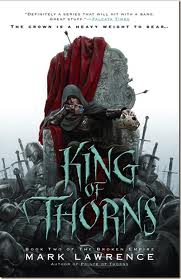
King of Thorns
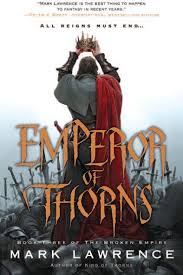
Emperor of Thorns

In addition to writing novels, Mr. Lawrence also writes short stories and poetry (click the links to read several of each).

Website: princeofthorns.com

> What can readers expect from your Broken Empire trilogy?

I think a lot of authors find this a hard question to answer. Authors like to talk about the writing. Talking about the story is more difficult because it's asking for hundreds of thousands of words to be shoe-horned into tens of words.

The Broken Empire trilogy is about a charming, dangerous, and amoral boy growing into a charming, dangerous, and amoral young man. On the journey he cuts down pretty much everything and everyone who gets in his way, and he's rather creative when it comes to the business of killing.

Where Prince of Thorns differs from a lot of fantasy books is that the story is the main character, Jorg. It's as much about who he is and why he is as it is about what he does. There's no evil overlord threatening the goodly lands of Generica. There are no dragons, no fireworky mages spewing out magic like they just ate a bad spell. Our protagonist is a nasty piece of work and no crime seems too bad for him if it’s a path to his goals. He makes no apologies for his actions and isn’t seeking redemption. However, if you read between the lines he delivers, you discover a new perspective on him that whilst it doesn't excuse his deeds, does go some way to explaining them.

So, turning tens of words into ten, it's a violent enthusiastic fantasy with a deeper sub-text.

> Why did you decide to make Jorg an anti-hero rather than a traditional hero figure?
I find these tags of hero, anti-hero, and villain rather restrictive, as if fantasy were something laid out according to certain rules, when in reality it should be the least constrained of all fiction.

The inspiration for the character came from Anthony Burgess’ A Clockwork Orange which also features a violent and amoral protagonist who confuses us by being at the same time charming and intelligent. I wanted to see if I could work a similar magic in a fantasy book.

 > You've worked in the field of artificial intelligence.  Why do you write fantasy rather than science fiction?

I still work in that field, but if I worked as a doctor should I then write medical dramas? Or if I were a lawyer should I write fiction about crime and judgement? If that were true who would we be left with to write fantasy? Would we need people who worked by day as unicorn wranglers or dragon farmers to write fantasy? Fantasy was my first love long before I discovered I could solve equations. My mother read me Lord of the Rings when I was seven.

> What made you want to be a writer?

I never harboured any great desire to be a writer, and certainly no expectation of it. I just enjoyed writing – so I did! Nobody was more surprised than me when someone wanted to print my work and sell it.
 > If you could, would you change places with any of your characters?

No. My life isn’t all milk and honey but my characters all have it much tougher than I do. I’m much happier on this side of the keyboard.

> What were your literary influences for the Broken Empire trilogy ?
The inspiration for the protagonist, Jorg, came from A Clockwork Orange. Beyond that I have no influences I’m aware of, and probably many that I’m not aware of. Certainly reading George Martin’s A Game of Thronesreawakened my interest in fantasy, convincing me that the elements I loved in fantasy when growing up could be re-imagined in a much more adult and literary fashion without losing that magic.

> Beyond the matter of length, do you find it easier writing short stories, poems or novels?

When it’s time for a poem then a poem comes easy. But I couldn’t write one every day. The shorter the form the more effort per word I would say in general, but that effort is mainly in waiting for the idea or sentiment or vision to bubble up from wherever it is that these things bubble from.

> What was the hardest scene for you to write?

Emotionally that would be a scene in King of Thorns involving a dog. I had my only ever piece of hate-mail over that.
> When and where do you write?
I write wherever I can sit down and get some quiet, normally late at night when all my other duties are taken care of.
> What’s the best/worst thing about writing?
Writing is like scratching an itch. The need to do it builds up. Then you do it, and for a while the need is satisfied. So the best thing is that it scratches that itch. If I didn’t write I’d have to do something else creative.
I’m having difficulty coming up with a worst thing... it’s all pretty good. I guess the worst thing is that it’s time consuming and you could have done something else good in those hours. I’ve not managed to play a computer game in two years and I’d really quite like to. It’s just I’d rather write.

> What is something you didn’t know about the publishing industry before you had your first book published?

That would be EVERYTHING. I didn’t have the slightest clue about or interest in the publishing industry before my first book was published. I guess my biggest misconception was that the authors of the books in the bookshops were making their living by writing, when in fact very few of them can afford to give up the day job.

> Do you have any advice for hopeful authors?

Keep hoping.

But really it’s only sensible to invest all that time and effort if you enjoy it and find the writing to be its own reward.

> Any tips against writers block?

No. I’ve never had it. If I don’t want to write, I don’t write. I don’t consider that to be writer’s block.

> How do you discipline yourself to write? 

I don’t. I write if I want to.

Friday, July 5, 2013

Author Interview: Will McIntosh

Novels:
Soft Apocalypse
Hitchers
Love Minus Eighty
* Defenders (forthcoming from Orbit and optioned for film)

Short Stories: way too many to mention, but you can find them listed here

Website: willmcintosh.net

> What is Love Minus Eighty about? 

It’s about a cryogenic dating center, where young, beautiful, dead women try to convince wealthy men to pay a massive fee to give them a second chance at life.  It’s about Rob, a poor young man who runs over Winter, a beautiful young woman, then sells everything he owns to visit her at the cryogenic dating center to apologize for what he’s done, only to fall in love with her.  It’s about love and dating, one hundred years in the future.

> Why did you decide to expand your 2010 Hugo Award Winning story, "Bridesicle" into the full length novel Love Minus Eighty?


When I finished the story, I thought I was finished with the Bridesicle world, then an idea came to me: What if you accidentally killed someone, and she ended up in the bridesicle dating center, and you felt compelled to visit her to apologize?  I thought that was a scenario worth exploring.  The novel grew from there.

> Would you say that having a psychology degree has helped you as a writer? 


 Probably not as much as it might seem.  My degree is in Social Psychology.  I was an experimental psychologist, so I didn’t see clients.  I conducted research and analyzed data (and, of course, taught classes).  Sometimes some of the things I learned as a psychologist--about the nature of memory, or characteristics of successful romantic relationships, or the symptoms of obsessive-compulsive disorder--come in handy.  But a degree in experimental psychology doesn’t really prepare you to delve into the psyche of one particular individual, real or fictional.

> What made you want to be a writer?


It grew slowly.  It started on a lark, grew into a hobby, and I loved it so much that when it became feasible to write for a living, I couldn’t imagine a more enjoyable and fulfilling vocation.

> In the books you've written, who is you favourite character and why? 

I’d have to say it’s Deirdre, the manic, extremely damaged love interest of the protagonist in my first novel, Soft Apocalypse.  She turned out so much more strange and compelling than I’d intended.  After the novel was published, a young aspiring actress emailed to say if the book ever became a movie, she absolutely wanted to play Deirdre.

> If you could, would you change places with any of your characters?

I can’t think of one of my characters who hasn’t had a hard life.  Some of them are dead and frozen (in Love Minus Eighty), some were possessed by their dead friends or relatives (in Hitchers), and many lived (or didn’t live) through an apocalypse (in Soft Apocalypse).  I wouldn’t trade my relatively trauma-free existence, or my pleasant life as a writer, with any of theirs.

> As an author who's been writing short stories for years and has recently started publishing books, do you find it easier writing short stories or novels?


I can write a 100,000 word novel more quickly than I can write 100,000 words of short stories, because you only need one central idea, one setting, and one set of characters for the novel.  But novels take more out of me, because it’s hard to build such a big story with a consistent pace and voice, and to keep track of all the details of what happened when.

> How long did it take you to write your first novel?


About two years.  Not counting the year I set it aside, because it was badly broken.  When I went back to it, I rewrote about two-thirds of it.

> When and where do you write?


Since I quit my position as a psychology professor last year, I write nine to five, Monday to Friday, minus an hour for lunch/exercise.  I write in a recliner, with my laptop on a lap bench  (I have back problems, so sitting at a desk seven hours a day is uncomfortable).  The recliner faces a big window that looks out at  woods and a hiking trail that runs close to our house.  Music is always playing, loudly, while I write.

> What’s the best/worst thing about writing?

The best thing is the creative side.  Coming up with ideas, inventing characters, figuring out what will happen, what the world will look like.  Getting a flash of inspiration about a terrific plot twist or a powerful, emotional confrontation between two characters.

The worst part is the uncertainty.  Writing is a very uncertain way to make a living.  Once you finish a novel, copies are printed, your book is placed on shelves with a million other books, and you have no idea if it will do well, or tons of copies will be sent back to the publisher to be pulped.  If it’s the latter, you’re not going to make a living as a writer for very much longer.  You have to hope people will notice your book, buy it, enjoy it, and tell others about it, because that’s how a book becomes successful.

> What is something you didn’t know about the publishing industry before you had your first book published?

That the author has very little say about what will be on the cover.  I consider myself the luckiest writer in the world that the cover of Love Minus Eighty is as beautiful as it is.  I had absolutely nothing to do with it--it just appeared as an attachment on an email message from my editor one day.  Here’s an interesting exercise: walk around the bookstore and look at the art on the covers, and imagine how you would feel if you’d written the book, and this was the art that would represent it.  You can feel elated or crushed looking at that cover for the first time.  I was elated.  My agent said when he first saw it, he printed it out and ran through his office showing it to everyone. 


> Do you have any advice for hopeful authors?


Write a lot.  Write as much as you can, and at first don’t worry too much about whether you publish what you write.  Seek feedback from writers who are a little farther along than you are, and ask them to be honest.  Crave their criticism more than their praise, because the criticism will help you improve more quickly than the praise, and that’s all you want—you want to get better.

> Any tips against writers block?


If you get stuck, either switch to another writing project, or skip ahead and work on another part of the story you’re writing.  Usually you have to step away from the block, give it some space, try not to force the next scene to come.

> How do you discipline yourself to write?

It’s the other way around for me.  I have to discipline myself to stop.  I love to write.  If I sit down in the morning and know that I have seven hours of writing ahead, I’m in my glory.  I know many writers struggle to get their butts in the chair and get some words on the page, but I’ve never, ever had that experience.

Friday, June 7, 2013

Author Interview: Jenn Bennett

Novels:
Kindling the Moon
Summoning the Night
Leashing the Tempest (ebook original novella)
Binding the Shadows

Website: www.jennbennett.net


> What is your Arcadia Bell series about?

Arcadia "Cady" Bell is a mage who runs a Tiki bar in Central California. She's been living under an alias because her family is wanted by the FBI for allegedly murdering the leaders of several occult organizations. She also has the rare ability to identify Earthbound demons—humans on the outside, demons on the inside—which leads her to partner with an Earthbound demon named Lon Butler.

> You were born in Germany and have lived and travelled to a number of places and now live in the U.S.  What's the coolest place you've been and why?

Probably Hong Kong. It's dense and energetic, easy for English speakers to navigate, and surrounded by lush beauty.

> Have your travels influenced your writing at all?

Absolutely. Traveling not only opens you up to a variety of locales, but a variety of people and experiences, as well. You can't get falling-down drunk in a Taipei karaoke bar surrounded by drag queens and "working girls" with rooms in the back without some of that leeching into your well of inspiration.

> What made you want to be a writer?

My college background is in art and painting, but I ended up doing the 9-to-5 corporate office thing (marketing and product development), which made me ridiculously unhappy. One day, my then-boss asked me what I'd do if I wasn't working there. I immediately blurted out, "I'd write a novel." I'd never really thought seriously about writing before that moment. A few months later, I gave into temptation and wrote my first book.

> Why did you choose to make your protagonist a renegade magician bartender?

Urban fantasy already had its fair share of detectives, bounty hunters, and generic monster slayers. I suppose I wanted to do something a little outside the box. I've always had a fascination with the occult, and I’m rather fond of the retro kitsch vibe of the Tiki scene. But the heart of my series is the characters and their relationships—not the setting or the world building.

> What were your literary influences for the Arcadia Bellseries?

Neil Gaiman, the Brothers Grimm, Diana Gabaldon, Anaïs Nin, Philip Pullman, Laura Kinsale, Loretta Chase, Mary Shelley.

> What are you working on now?

I have a new paranormal romance series set in 1920s San Francisco coming from Berkley/Penguin in January 2014: bootlegging, fog, ghosts, Chinatown, magical hexes, bawdy humor, and steamy romance. Huzzah!

> What's the first novel (published or unpublished) that you wrote and how long did it take to write it?

The first novel I wrote centered on portals into a fantasy realm. It was awful. I had zero idea what I was doing—I just flailed around in the dark and hammered it out in a month. KINDLING THE MOON was the third book I wrote. It snagged me a literary agent, who sold it to one of the Big 6 New York publishing houses in five weeks. From the time I wrote my first word until I sold my first book: 1 1/2 years. That was two years ago. I’ve since sold six books and one novella.

> What was the hardest scene for you to write?

The final two scenes in BINDING THE SHADOWS. I shed a few tears putting those words together. I knew that they were scenes that had to be written, because that was the story that needed to be told, but it was physically painful to do it.

> When and where do you write?

Surrounded by clutter in my home office. I write best when there are no distractions: either in the middle of the night when everyone's asleep, or really early in the morning when everyone's asleep. Basically, as long as everyone else is sleeping (including my pugs), I'm good to go!

> What’s the best/worst thing about writing?

Best? Creating characters than readers love. Worst? The famously s-l-o-w machine that is the traditional publishing house. By the time a book comes out, I’ve already written three more.

> Do you have any advice for hopeful authors?

Learn how to do things the right way (grammar, plotting, page count, genre expectations), then have the guts to break a few rules and forge your own path.

> Any tips against writers block?

Walk around outside. Take a drive in a place you don't visit often. Play a video game. Read a book in a new-to-you genre. Do something that flexes your mental muscles in a way that isn't explicitly related to writing—one that requires you to look at things differently.

Friday, May 10, 2013

Author Interview: Wesley Chu

Novel: The Lives of Tao

Website: www.chuforthougth.com

> What is The Lives of Tao about? 
Here’s the 140 character tweet version.
Loser meets snarky alien. Gets in shape. Fights war over control of humanity’s evolution. Finds a girlfriend. Not in order of importance.

> What drew you to writing about alien brain hitchhikers? 

I've always been fascinated with history not so much for what happened, but why things happened. I didn't want to rewrite it. History is fascinating enough as it is, but I wanted to explore the logic behind it. How did we get to where we’re at today? What were these famous historical figures thinking?

My original idea was to explore and retell that why, and tie it in with the present. Basically, is it murder or manslaughter, because that matters. Now, let's toss in a few more variables. Add an alien civil war, toss in a lazy loser who hates his life, and let the fun begin.

> What made you want to be a writer when you already know kung-fu and moonlight as an actor? 

I often say a writer can’t help but write. My first short story was in second grade when I wrote about the planets in the solar system always running into each other and getting into fist fights. My English professor Father read it and was like “this doesn't suck.” And if a traditional Asian parent tells you that, it must be pretty decent.

I've always had interests in many different hobbies, but writing was the one thing I always came back to. At the end of the day, when I had to choose what I wanted to do with my life, writing won out. Getting a little older of course helps in the decision making process. I’m not as limber as I used to be, you know.

> The protagonist of The Lives of Tao, Roen Tan, shares your Information Technology day job. Do you have anything else in common?

We’re both terribly insecure, love pizza, and hear voices in our head. Oh, and we’re both Kung Fu masters and we both tried to mug someone who was trying to mug us.

> If you could, would you change places with any of your characters?

Good question. That’s a tough one. On one hand, it would be awesome to have this eternally wise alien who once invented Tai Chi and inhabited great historical figures doling out free advice. On the other hand, getting caught in an alien civil war and hunted by an international cabal sounds like it would suck. And I heard the job doesn't pay well either.

In the end though, I probably wouldn't do it. After all, as an author, I already have the best job in the world. Besides, I have a very low pain threshold.

> When and where do you write?

I used to do the whole café circuit around Chicago, but it kind of became a waste of time. These days, I write at home. There’s something to be said about having a set place and time every day that gets someone in the right frame of mind to write. I also get to write in my bathrobe.
  
> What’s the best/worst thing about writing? 

The best thing about writing is creating that story. It’s the most difficult and most rewarding thing I've ever done. The downside is these books are our babies. I lived, ate, and dreamt The Lives of Tao for years, and I’m just so ready to release it to the world. It’s like the world’s longest pregnancy.

> What is something you didn’t know about the publishing industry before you had your first book published?

The author needs to do a lot of marketing. You don’t just write a book and let the publisher do the rest. In the age of social networking, it’s up to the author to engage and grow his fan base. It’s a lot of work, and can be a massive time sink that could be spent writing instead.

However, there’s also this direct connection with the reader that an author makes that is very rewarding as well. Guess while we’re at it, please look me up at:

Twitter: wes_chu

Facebook: facebook.com/wesleychuauthor

Website: www.chuforthougth.com

> Do you have any advice for hopeful authors?

Write for yourself, not for the money or fame. The odds are slim you’ll get much of either. It’s a long road filled with potholes and road kill. Keep at it. Don’t ever show anyone your first draft. Keep reading books as you write. Don’t lose touch with your friends.

And get a dog or cat. Trust me on that last one. Eva Da Terrordale dragging me out for walks was the only thing that got my increasingly pasty white arse to see the sun once in a while.

> Any tips against writers block? 

Keep writing. Write crap. Hate your words, but keep at it. It’s the only way you’ll bust out of the writers block. If you can’t think of anything to write, pretend you don’t have a backspace key and just plug away. Write about your day, your lunch, about how much your hamster Harold means to you. Just get something down and worry about sorting things out later.

And then have a scotch; neat. Then maybe an ice cream; just not at the same time. It doesn't taste good together. I’ve tried. You’ll feel better afterward.

> How do you discipline yourself to write?

You also have to treat writing as a priority. Give it the same respect and passion you would for anything else you’re serious about. It shouldn’t be something you do at the end of the day if you have time. Writing should be something you feel guilty for not doing.

Be hard on yourself. Go to war with it. Conquer it. Always remember have a beer with it at the end of the day. Then do it all over again tomorrow

> What's the first novel (published or unpublished) that you wrote and how long did it take to write it? How many rejection letters did you get for it?

The first book I ever wrote was a 190k monstrosity called Woes, Toads, and Crossroads. How many rejections do you think I got? =) It took a year to write the rough draft and was pretty much a hot mess.

I will say this. It was probably the most important thing I’ve ever written. The lessons I learned from it were invaluable for my writing career.

Friday, April 19, 2013

Author Interview: Chandler Klang Smith

Novels: Goldenland Past Dark  
            - two ghostwritten YA novels

Website: http://www.chandlerklangsmith.com

> What is Goldenland Past Dark about?


Goldenland Past Dark tells the story of a hunchbacked clown, Webern Bell, who survives unpleasant experiences by translating them into circus performances that come to him in dreams. When murder, heartbreak, and betrayal throw his life entirely off the rails, though, he loses his already frail grip on reality and falls into the vortex of his imagination. Other characters include a delusional ringmaster, a haughty Lizard Girl, an imaginary friend with a mind of his own, and a kindly, Scotch-swilling ape.

> What drew you to writing about a travelling circus?


Circuses are like misfit families, made up of people united by their difference from the norm – not necessarily their similarity or compatibility with each other. I was interested in the variety of characters a circus would allow me to use, and the colorful conflicts and personality clashes that would result. Also, as a writer in a culture that’s usually focused on celebrities and new media more than books, I wanted to explore an art form that was going out of fashion, as the circus was in the 1960’s, when my book is set.

> Were the various talents of the characters in your book drawn from real circus acts or did you create some of them yourself?  


It was really a combination. As part of my “research,” I attended a bunch of live circus, clown, and carnival shows: Ringling Bros & Barnum and Bailey, Cirque de Soleil, the New York Goofs, the Coney Island Sideshow, and most notably, Circus Contraption (an extraordinary vaudeville team from Seattle). I also watched many classic films, including Children of Paradise, Tod Browning’s Freaks, The Greatest Show on Earth, and Charlie Chaplin’s The Circus, to get a sense of historical perspective. These all seeped into my imagination in various ways and informed the performances I describe in my book.

> You've ghostwritten two YA novels. How did that process differ from being published under your own name?


Ghostwriting taught me a lot about how to create a page-turning structure, and how to write quickly, even when I didn’t feel inspired or excited about it. But it’s not something I’d want to do again, unless the money was amazing. Writing is inherently an act of communication, and there’s something straining and false-feeling about speaking for that many pages in a voice that’s not your own.

> What made you want to be a writer?


I’m an only child, and, like many writers, grew up feeling lonely, awkward, and weird. Reading gave me a way of feeling connected not only with fictitious characters, but also with the authors who created them. My hope is that someday my books will reach readers the same way.

> If you could, would you change places with any of your characters?


Probably not – a lot of terrible things happen to them! But I do greatly admire the way that clowns, stage magicians, and other performers can create their art on the spot, in front of a live audience. I wish I could do that.

> What’s the best/worst thing about writing?


It’s ironic that I became a writer partly because of loneliness, because it’s one of the loneliest activities a person can undertake. So that’s the downside. The upside, though, is that it’s one of the few modes of creative expression where it’s possible to do practically anything you want. Unlike filmmaking or theater, you don’t have to consider the cost and logistics of special effects, costumes, or sets when you come up with fantastical imagery to use in your work. If you can find the words to describe it, then it’s there. To me, that’s magic.

> What is something you didn’t know about the publishing industry before you had your first book published?


Fortunately or unfortunately, I had a lot of experience working in publishing prior to the publication of my first book, even successfully selling a nonfiction title by a client during a stint as an associate agent at a literary firm. So there weren’t a lot of surprises in the process for me… although I did learn that it feels very different when it’s your own work at stake!

> Do you have any advice for hopeful authors?


Don’t get too attached to your first draft of a novel – keep yourself open to reimagining even the major things, like structure and characterization.

> Any tips against writers block?


If you’re struggling to muster the enthusiasm and energy required to get through a scene or expository passage, take a second to pull back and consider what purpose you want the section to serve in the work. Why does it matter? Too often, I think writers (myself included) get it in their heads that certain events or ideas have to be included in the book when they’re actually just an unnecessary slog – for writer and reader both. Jonathan Lethem has a great quote about how to avoid this conundrum: "I learned to write fiction the way I learned to read fiction - by skipping the parts thatbored me."

Thursday, April 4, 2013

Author Interview: Julie Czerneda

Novels: WAY too many to list. She's written numerous science fiction novels one fantasy novel and several short stories. She has also edited anthologies. 

Website: www.czerneda.com

> What made you want to be a writer? 

I can't say I ever did. I've always wanted to be a biologist. There was a time when I passionately wanted to be a nuclear physicist too, because that skill set -- according to the movies -- guaranteed me a spot on the first starship to go forth and greet any aliens. Being of a family where the motto was do your best, whatever you do, with a hefty dose of anything's possible if you work at it, I did my utmost to figure out how to do just that, only to be stopped by the whole “astronauts must be test pilots” bit. (I did enrol in ground school, but that's another story.) Suffice to say, by the tender age of ten, I'd decided I'd best stick with biology and stay interested in everything else. In Case.

Being a writer wasn't remotely on my radar. Though it was about then I started typing out my own stories, but they were for my own fun. A hobby.

I was on maternity leave from the University of Waterloo when a job writing textbooks found me, through a friend who knew my “hobby.” After my surprise -- weren't published authors dead people? -- I realized here was something to keep my brain active, while bouncing a baby, while earning a living. Bring it on! Writing about science turned out, to my joy, to be something I was good at and thoroughly enjoyed. After all, I could stay interested in biology and everything else! Before I knew it, I was a professional writer and editor -- even a publisher.

As for my own stories, well, those were still in a drawer. It took a fair amount of convincing before I put one of them out into the world. That was A Thousand Words for Stranger. I haven't looked back since.

> You have a background in biology and have written quite a number of science fiction novels. What made you decide to switch to fantasy for, A Turn of Light?

Several things came together to make it happen. I'd been working, quietly, towards writing fantasy for many years. It's something I love, and I've many favourite authors who do it sublimely. At last, I felt I had a story worth telling. But when? I'd finished the prequels in The Clan Chronicles, setting the stage for the final trilogy. I knew I could use a change of pace and wanted to write something lighter. So the time seemed right. My editor at DAW, Sheila Gilbert, was willing to let me take the gamble, though she cautioned I'd be a “new” author again. (This is why Turn is in trade paperback rather than hardcover. I'm new!) Last, but not least, I had to see if I could do it. Could I develop a strong fantasy “voice” in my writing? Could I find the words, the cadence, the flow that, to me, makes fantasy stories come alive? The only way was to do my best and work at it.

> You've also edited several anthologies. How has editing others' writing affected your own?

It's made me humble. There are writers out there of astonishing ability and imagination. Whenever I read their work, I'm overwhelmed with delight that it's ALL MINE!!! Yes, I eventually share their stories with the world, but believe me, there's chortling and greedy sighs of joy first. Editing is a joyful occupation.

I do work with authors who need a wee polish or two, and that interaction is something I treasure, especially with new authors. MINE!!! (Sorry. My inner chortle at that never ends. Ask MY authors.) As for any impact on my work? I relish discovering how many authors, new and pro, are better than I am. It gives me confidence that I've more to learn and do. I love that challenge. Otherwise, there's no overlap. I was a professional editor for several years and it's a hat I don when required, then take off. Yes, I know what will make production's job a little easier and I try not to make the same mistakes two books in a row, but otherwise, as an author, I'm as much a quivering bowl of jelly as the next.

> When and where do you write?

I have an office in my home. I do the bulk of my writing there. In summer, I take a laptop out beside the pond, but I suspect that's more to sit by the pond than it is to really produce much. Bus and train stations. Airplanes. I write in those. The bathtub. As for when? Whenever I can. I'm a morning person, so early is my preference. That said, some stories insist on taking off just before supper, so meals can be late. Others are evening tales. Close to deadline -- or to a story's end -- I'll write non-stop unless reminded about the exercise/sleep/be social thing.

> Any tips against writers block?

I don't believe in it, so I'm not sure what help I can be. Writing is my job. Sometimes it's hard, sometimes ridiculously easy. If I catch myself fixated by a blinking cursor, i.e. not accomplishing much, I get up and do something else for a while. The brain needs a break and so does the body. I'll get dirty in the garden. Bike around the block. Play. Sometimes I'll take a pad of paper anywhere but my office, lie down, and scribble some other part of the story. After a bit (bit can be 10 minutes or a couple of days), I go back to my office, sit down, and write.

> How do you discipline yourself to write?

Fear helps. Okay, maybe not fear but definitely a sense of responsibility. This is how I earn my living, after all, and has been since 1985. Deadlines matter. My readers matter. Doing my best matters most. The books I've yet to write are the only job security available. I like that feeling, but it's not for everyone.

But there's more. A long time ago, I heard Cory Doctorow describe writing a novel as a marathon. It's that. The finish line is beyond the horizon and you can't use it as a goal. You have to be satisfied by the innumerable steps along the way. This scene, that paragraph, those words. And every now and again, they work so well your heart pounds with joy.

You asked at the start what made me want to be a writer. That's what's made me stay one. Those moments. That joy. I wish it for everyone.

Friday, March 22, 2013

Author Interview: Andrew Post

Novel: Knuckelduster

Website: andrewpost.blogspot.ca

> What is Knuckleduster about? 

Knuckledusteris about friendship and the lengths we go to for the ones we love. That concept is enveloped in a near-future science fiction tale that’s steeped in throwback noir, gadgetry, a few laughs, a car chase, robots, and conspiracy-uncovering derring-do.

> Where did you get the idea for the eye implants that Brody gets in Knuckleduster?


Brody’s carotene lenses came about when I was looking back on the early sci-fi writers and how much of what they dreamed up is now a reality. (Robotics and Isaac Asimov, Google Earth and Neal Stephenson.) I considered if something I wrote were to get into the hands of someone far smarter than I, what dreamed-up thing would I want made into a reality? I know someone who is currently losing their sight. And I wish carotene lenses, or even the sonar device Brody wears when not using the lenses, were possible today.

> What made you want to be a writer?

I was in the backyard at four or five. I found this vaguely humanoid-looking twig, and just started coming up with a whole story for this little person. Out of some river rocks and pine cones, I made a house for him. A kitchen, living room, dining room; bowls from acorn caps, a leaf for a bed, etc. Once I had everything “figured out” about his life and an answer for every need he might have, I went and got my mom and told her all about this stick person’s life. She patiently listened. When I was through, she looked at me and said, “You’re going to be a writer.” I liked the sound of that, that I could “figure out lives” of characters and it’d be, as a grown-up, an actual thing I could do with my life. From that point on, that’s how I identified myself. Later on, when I started hearing in my head narration to the action sequences of movies as I watched them, I kind of thought I should probably start writing my own stories down or seek medication. A few dozen notebooks filled with stories later, passed around to friends on the bus, or later, emailed to a girl I wanted to impress, I started asking myself if I didn’t do this for a living, what else would I do? I didn’t have an answer. I had to do it.

> If you could, would you change places with any of your characters?


In my next novel, Fabrick, the bulk of the story takes place in Geyser. It’s this city that’s been built around this enormous . . . well, geyser, and it’s easily one of my favorite locations I’ve ever come up with. I dream about that city. And, if I could, I’d live there. Maybe as a shoe cobbler or an employee at one of the markets, or a travelling salesman with a cart selling wind chimes or something. A character that doesn’t even get named in the book, but is still a citizen of Geyser, the main character in his own life. Maybe not an adventurer, or even one of the “weavers,” but just some guy, doing a job, living a life. On another planet.

> You've had short stories published in several magazines including Underground Voices, Cannoli Pie, and The Legendary. Beyond the matter of length, do you find it easier writing short stories or novels?

With short stories, the beginning-middle-end formula isn’t necessary. Which can be really fun. And a “hard” ending is easier to get away with. You can be ambiguous, hit the ground running in the middle of the scene, perhaps just give a slice-of-life story that could be a part of a novel someday. I’ve written a lot of short stories that I never even sent out because that was how I worked out a character, found the vibe for a novel to expand on. They’re great jumping-off points. Both Knuckledusterand Fabrickstarted out this way. I can’t really say I prefer one or the other, short stories or novels. Story is story, regardless of length or by what means it’s published. It all depends on what you want to say.

> What's the first novel (published or unpublished) that you wrote and how long did it take to write it?

The first novel I wrote was about a hard-nosed space trucker who gets wrapped up in an intergalactic war. I want to say I got to about 150,000-200,000 words or so before realizing it wasn’t very good. With a heavy heart, I let it go. I wrote that over the course of three years, I think. It was good to do, even if it never got submitted anywhere because I think all writers have one bad novel they need to write, just as a means to learn. But a lot of the ideas I came up with in that novel I have since used in other places. The main character was remarkably similar to Brody from Knuckleduster, actually.

> What was the hardest scene for you to write?

There were a few times in Knuckledusterwhere characters are expressing how much they care about either one another or a loved one that’s not currently present—like Thorp when he’s talking about his sister. Talking about love, expressing it, letting someone you know you really care about them, is hard enough to do in life without sounding silly, but when doing it in fiction, it has to sound natural while still be interesting to read. In fiction, unlike real life, you can go back and tweak things, erase the stuff that might come off as awkward or redundant. But I try my best to leave most of that in, though, because in real life when someone expresses themselves, it istough. It isawkward. There’s a lot of ‘ums’ being thrown around. And in fiction, if it’s true to the heart, it shouldn’t be any different. Finding that balance of realness and readability is a tight-rope sometimes.

> When and where do you write?

I tend to write in the morning, and cut myself off at midday. It’s when I’m at my best, I think, with a fresh cup of coffee and the radio on and the world isn’t quite awake yet. The morning, I believe, is when the good ideas are still floating around in the ether waiting to get snatched up. I tend to write in the same place I start a project at until it’s through. Geography is important, I think. Study the meteor where it landed, don’t haul it off to some new location to study. There might be some important pebbles that get left behind.

> What’s the best/worst thing about writing?


The best: going back over something you wrote a month ago and saying, “Hey, that was actually pretty good!” The worst: going back over something you wrote a month ago and saying, “What was I thinking?”

Seriously, though, the best thing is when you hear someone you’ve never met before say is they really enjoyed your book or story. We write to be read, and when someone does that, likes it, and tells you they liked it? So, so great. Warms the heart.

The worst thing is that the cursor of most word processors blink. Blink, blink, blink. It’s like that impatient person behind you in line at the ATM tapping their toe and sighing every three seconds. When I’m blocked or have written myself into a dead end, that ever-blinking cursor and I have a staring match. And he—always—wins. I keep going, grumbling at him, even if I feel what comes out might be wrong for the story at the time. But I remind myself it can be fixed or changed later. You can’t have a decent manuscript without getting through that first draft. It’s like cursor Morse code. Blink, blink, blink means “Keep. Writing. Keep. Writing.” A true love/hate relationship if I ever saw one.

> What is something you didn’t know about the publishing industry before you had your first book published?

That so many people will be willing to help you if you just ask. The publishing industry is full of helpful people and so many are willing to send you a link or the office of an agency who might be interested in your work, or even a currently-seeking publisher—if you just ask.

> Do you have any advice for hopeful authors?


It’s an oldie but a goodie. Never give up. If you want to achieve something—whatever it may be—no one ever got anything by throwing in the towel. And even if you could, would you want it? No. You want to earn it, make it on your own work and perseverance. The brass tacks tough love version: No one remembers the quitters.

 Any tips against writers block?

I do have one that I use. When working on a manuscript, find a song that really fits the feeling of your story. One that makes the world come alive in your mind when you listen to it. One you could expect to hear in the background of all the major scenes. Listen to it when writing and when you’re just thinking about the story for a while. Let your story and the song develop a sort of symbiotic relationship. Once that’s established—and this is the important part—neverlisten to that song again unless you’re blocked. Using songs as “mind keys” is an absolutely essential practice for me. For every project I have one squirreled away.

> How do you discipline yourself to write?

Before starting in, I tend to have a place in the plot I want to reach before the end of the day. I don’t outline the plots entirely, but I keep an idea of what I want the end to be and a few chapters ahead of where I currently am. If I flesh out the whole thing in outline, I get bored with it. If there’s no surprise in it for me as a writer, there sure won’t be one for a reader. Then, if I don’t manage to reach that projected plot point by the end of the day, I’m okay with it. I don’t beat myself up over it. But tomorrow, I darn well better get there.

> How many rejection letters did you get for your first novel or story?

The first novel I was very serious about sending around, I think I was rejected by every single literary agent working at the time. If not all of them, then a solid majority. Rejection and harsh criticism will drive you insane if you’re not careful. It comes with the territory, everyonegets rejected. So laugh it off and press on. If you think the manuscript absolutely cannotbe fixed, pluck out what you can use elsewhere and put the rest to bed. Try a new genre, try a different tense or perspective. Maybe that other work wasn’t really your voice and trying something new will bring it out. And never use phoenix metaphors like I almost did just now.

Friday, March 8, 2013

Author Interview: Kerry Schafer


Novel: Between

Website: www.kerryschafer.com


> What is Between about?


Vivian's life is finally on track. She has a job she loves as an ER doctor and has just met – literally – the man of her dreams. But when her eccentric grandfather is murdered and designates her as his next of kin, she discovers that she is the last of a race of beings known as dreamshifters. It is her task to guard the doorways between waking and dreaming, which have already begun to unravel, spilling dangerous creatures from dream into the waking world. When she sets out to close the open doors and protect her town and the people she loves, Vivian confronts dragons, intrigue, and the dark secrets of her own family history. In the end, she comes face to face with a sorceress seeking eternal life and ultimate power. Vivian must find a way to stop her, or reality will be forever altered.


> Where did your idea for dreamshifters come from?

My main character, Vivian, came up with it. I'm not kidding! I had explored several different alternate realities for her. One night I was journaling in her voice, and came up with the words, "dreamworld, wakeworld, and between." And that's when I really figured out the idea of a dreamshifter. 

> You were a nurse and now work as a mental health counselor.  Did making your protagonist an ER doctor require any research?  If so, how much?

There was some research required, because most of my nursing experience was in Labor and Delivery, which wasn't exactly relevant. I spent a lot of time in the ER as a mental health crisis specialist, so I had a pretty good idea about the environment, but I had to research specific details related to the medical needs of my characters. I used Google for some things, and then found an experienced ER nurse who was willing to clarify details and check my work for accuracy. 


> What made you want to be a writer?

I fell in love with words - there was nothing else to be done. 

> If you could, would you change places with any of your characters?

Nope. Part of writing an interesting book means making life hard for your characters. My reality is a much safer place to be.


> What was the hardest scene for you to write?

Probably one of the ones I ended up cutting. As for the scenes in the book - maybe the dragon fight at the end. Action scenes are tricky, because you have to be able to do choreography in your head. I struggle with that.


> When and where do you write?

Wherever and whenever I can find the time. I have a laptop, and it travels around with me.  


> What’s the best/worst thing about writing?

Best thing: when the story hands you things you could never have dreamed up for yourself. Worst thing: days when it feels like every word you write totally sucks

> Do you have any advice for hopeful authors?

Never give up on trying to get your work published, but while you're at it keep writing new (and better) things.

> Any tips against writers block?

Write anyway. If you truly can't get any work done on your current project, then switch to a journal. Write in your character's voice or your own. Write something. Write anything. If it's bad you can always throw it away later, but sometimes you have to write some really rotten stuff before getting to the gold.


> How do you discipline yourself to write?

I'm bad at self discipline, so I use other people. I'll throw something out on Twitter about my word goal and ask people to kick my butt if I keep wasting time. Or, better yet, I like to set up a sprint with friends. We choose a time to start and end, then write like crazy to see who can get the most words in. 

> How many rejection letters did you get for your first novel?

I lost count. Thirty maybe? There were a lot.