Showing posts with label Book Review. Show all posts

Tuesday, September 24, 2013

Book Review: The Crimson Labyrinth by Yusuke Kishi

Translated by Masami Isetani and Camellia Nieh

Pros: creepy premise, interesting characters

Cons: introduced to too many characters at once making them hard to remember

When Yoshihiko Fujiki wakes up in a red stone canyon in the rain, he has no idea where he is or what's happened to him.  All he has are a few basic supplies and a handheld game system welcoming him to the Mars Labyrinth.  Before he has the chance to follow the directions to the first checkpoint he runs into another player, Ai Otomo.  Her game system is broken, so they team up to face... whatever comes next.

This is a novel that starts slowly - with Fujiki trying to figure out what's going on - but quickly builds momentum.  Like the characters, you're horrified by the turns the 'game' takes, as some of the players become less and less human.  And though Fujiki has some ideas of what's happening behind the scenes, figuring that out isn't as important as staying alive.

Try not to read the book's back cover synopsis as the first paragraph contains a spoiler that will colour how you read the novel.

The premise of the book is pretty creepy.  It starts off as a survival game with everyone in the wilderness.  As time goes on and a trap set by those running the game is activated, things shift and it becomes a different kind of survival game. 

The protagonists are pretty interesting, with down on their luck backgrounds.  Fujiki took a while to grow on me, but I liked his tenacity and cleverness.  While Ai gives good advice at times, she mainly stays in the background, letting Fujiki make most of the decisions.  The other players all have unique personalities, though you don't see much of them.

Fujiki and Ai encounter the other players at the first checkpoint and you're given a quick introduction of all of them.  It's too many people, too fast, several of whom have similar names.  I found that later in the book, when the pair met up with them again, I couldn't remember who was who.

I'd recommend this to people who would like a less violent Battle Royale.  It's got a bit of mystery, a bit of survivalistic writing, a tiny bit of romance and several violent, though not too graphic, deaths.


Tuesday, September 17, 2013

Book Review: The Explorer by James Smythe

Pros: interesting premise, interesting examination of perceived experience vs the larger reality,  quick read

Cons: scientific errors, protagonist gets irritating at times

Six astronauts are on a voyage to explore space, going further than any manned mission in the past.  But almost immediately things start going wrong, and as the crew die - one by one - their reporter, Cormac, the least skilled among them, wonders if their mission will succeed.

This is an interesting novel about the worth of exploration and what it takes to leave everything you know for such an opportunity.  There's a twist at the quarter mark that propels this novel from a simple exploratory mission into an examination of how we perceive events based on limited knowledge, memory vs reality and causality.

We get to know Cormac the most, as it's his POV we follow, but through his observations and experiences we also get to know the other crew members.  The story alternates between what's happening on the ship and the process of being chosen for the mission back on Earth.

Cormac's experiences are interesting but his personality gets a bit grating as things break down and he can't do anything but wait for death.

Twenty or so pages before the end of the ebook, the climax hits.  I eagerly turned the page to find out what happened only to discover that the novel was over and the final pages were an excerpt for Smythe's next book.  This was incredibly jarring and meant I didn't appreciate the open style of the ending as I otherwise might have.

I enjoyed the book enough to pass it along to my husband.  Turns out it was a good thing, as the first draft of this review stated the science was accurate. My husband is a huge hard SF fan and he pointed out several errors the book makes with regards to space.  There's a scene that mildly irritated him where water didn't act the way it would in zero gravity.  But the main problem is that the ship is brought to a halt on several occasions for checks and repairs.  Not only would this waste their fuel, both to stop and to start up again (having killed their momentum), each stop would alter their course, which we're told has been pre-set.  These errors made it harder for him to enjoy the book.


It's an interesting novel, and a very quick read, but those of you looking for hard SF might want to give this one a pass.  

Tuesday, September 3, 2013

Book Review: All Our Yesterdays by Cristin Terrill

Pros: compelling writing, brilliant characterization, minor romance elements, stand-alone story

Cons: close calls start to feel contrived, ending feels abrupt 

For Parents: some violence (murder, torture), no swearing, off screen sex

When Em finds the note in the drain of her prison cell, she knows she and Finn have travelled back in time 14 times, and that they've failed in their objective to save the future.  There's only one course of action left to them, to kill the man who made time travel possible, their former best friend and the man Em used to love.

This book was VERY hard to put down.  The characters feel real, their emotions felt true to life but without the overarching angst that sometimes makes YA hard for adults to enjoy.  Marina has complex relationships with everyone in her life.  She's afraid her best female friends only like her because they want to get closer to James.  Her parents are having trouble in their marriage, using her as a go-between.  She loves James but isn't sure he feels the same way.  And she's jealous of how close Finn and James have become, and so treats Finn badly, even if he doesn't always deserve it.

It's the first YA novel I've read that captured how conflicted I felt as a teen, so I really connected with Marina's character.

Em and Finn - the future versions - are equally complicated characters, having to make a tough decision knowing the pain it will bring their younger selves.

The two guys, one girl, formula sounds familiar but Terrill does great things with it.  Marina loves James and dislikes Finn.  Finn likes Marina, but recognizes that she doesn't like him back, which makes him snarky and bitter towards her at times.  And James... well, it's unclear what he feels.  Even their older selves have a unique dynamic.

Though I felt that Em's compunctions about killing her former crush were realistic, I started to feel the scenes involving close calls with him became contrived towards the middle of the book.  The last quarter of the book shook things up again, which I really liked.


There's little told about the dystopian future the teens are from or the science involved with time travel, so if that's what you're looking for, look elsewhere.

The ending felt abrupt, but on further reflection - and rereading some scenes - I realized that it fit what the author said about time travel.  This is a great book to reread, as you pick up all sorts of details you miss - especially in the first few chapters - the first time through.  

Finally, it's great to read a YA dystopian novel and have it stand on its own.  I highly recommend this one.


Note: The author's done a series of prequel videos, which you can find on her website.  Note, these take place in the future with Em and Finn being tortured in prison before the start of the novel.

Tuesday, August 27, 2013

Book Review: Psycho by Robert Bloch

Pros: great writing, unique twist

Cons: if you've seen the movie, you know the story (including the twist ending)

When Mary Crane's boss hands her an envelope containing $40,000 to bring to the bank she thinks her troubles are over.  She impulsively drives to her boyfriend's town, intending to use the cash to pay off his debts so they can finally get married.  But heavy rain makes her miss a turn and she ends up spending the night at the Bates Motel.

If you've seen the Alfred Hitchcock movie you know the story.  There are some differences, particularly with regards to Norman Bates, who in the book is 40, overweight, and converses more with his mother than he does in the film.  Mary's also given more motivation for stealing the money.  Mrs. Bates is quite horrifying, especially given how Norman covers for her.

It is a highly suspenseful book, with a great twist ending if you haven't seen the film (and even if you have, the skill with which the author makes Norman's home life bizarre but plausible is wonderful).


With such a great story it's no wonder Hitchcock thought it would make an excellent film, and kept the plot so close to that of the book.  It's short (just over 200 pages) and a very quick read.

Tuesday, August 20, 2013

Book Review: The Bone Season by Samantha Shannon

Pros: intricate world-building, strong female protagonist, glossary of terms

Cons: lots of characters to remember (no character list)

Paige Mahoney is a dreamwalker, able to send her spirit into the aether.  She works for the criminal underworld of Scion London because clairvoyant powers like hers are illegal.  Unnatural.  A series of unfortunate events leaves her hunted by the Night Vigilance Division, voyants who work for the state against their own kind.  But it's a different group that finds her.  Instead of being executed or brought to the tower, she's drugged and woken up in a different city.  She finds herself a prisoner of a race of beings called Rephaite.  Beings who helped bring Scion to power.  Beings who are now her masters.

The world building in this novel is incredible.  Shannon has created 1) an alternate history from 1859, when clairvoyance became widespread, 2) a kind of caste system for clairvoyants, including numerous ways to access the aether, 3) a complex crime syndicate based in London, 4) a dystopian government that's extending its powers, 5) the Rephaite and Emim, and 6) the penal city of Sheol I.

While there are a few info dump style scenes, they're quick and intigrated into the story.  And you really need them.  So much is going on that the faster you're grounded in the background of each section, the more interesting the story is.  The information is explained in different ways, the branches of clairvoyance are delivered via an infographic at the start of the novel, there's an orientation meeting for Shoel I, and Paige learns more about the city from other inmates.  I really appreciated that Paige's flashbacks not only allowed you to learn more about her character but were used as a point of intrigue later on in the narrative.   

Paige is a flawed but still kick-ass protagonist.  She makes mistakes in the book and pays for them, but comes back fighting.  Her progression through the book feels realistic.  She's trying not to give in to hopelessness like so many others around her, while at the same time understanding that she has something to return to should she escape, unlike many of the others. 

The Rephaite are fantastic bad guys.  The more Paige learns about them, the more evil they become.  And yet, she's drawn to her keeper, who isn't quite like the others.  Their relationship is complicated and rather fun to read.

One of the few complaints I had about the novel was the large number of characters.  There are Paige's syndicate members (by name and codename), people in government, people from history, numerous Rephaite, and the people in Shoel I, who you have to remember by both name and number.  The numbers could confuse you too, as Paige was sometimes her full number, XX-59-40, sometimes XX-40 and sometimes just 40.  A list of characters, with their numbers/aliases, would have been a helpful addition alongside the included glossary of terms (which I had to refer to several times towards the end of the book).  

Another complaint was that amaranth became too powerful towards the end of the novel, which reduced tension in some otherwise tense scenes.


This is the first of a planned 7 book series.  Given everything introduced in this book, I can't wait to see what the author does next.  There's so much left unexplored, especially with regards to the Rephaite.  And while this book is definitely open ended, there is a sense of completion to this volume, which I appreciated.

Monday, August 12, 2013

Book Review: Her Ladyship's Curse by Lynn Viehl

Pros: interesting protagonist, solid world-building, fun premise

Cons: romance felt rushed

This is part one of Disenchanted & Co, which I took to be a duology since part one is out in August in ebook edition only, and part 2 (His Lordship Possessed) is out in October.  The reality is that Her Ladyship's Curse is the first half of the novel, which abruptly ends to be continued in the next volume.  Which explains why the books are slated for a paperback release as a single volume in January 2014.

It makes reviewing the book somewhat challenging as there's been no completion of any of the plot points.  This first half is, as to be expected, set-up for the rest of the novel.  We're introduced to the primary characters, the plot, with several interesting twists, and the world.  But it's hard to judge a work as a whole when you've only read half of it.

The world-building is solid, being an alternate reality USA where England won the Revolutionary War.  It's obvious that a lot of thought went into deciding how that loss would affect the people, with regards to fashion, attitudes and class structure.  The natives are still treated badly, which is painful to read but realistic given how actual history treated them.

I really enjoyed seeing Miss Kittredge using her brain to debunk the superstitions of others.  She's a great, spunky protagonist that will remind readers of Alexia Tarabotti from Gail Carriger's Parasol Protectorate series.

I'm not the biggest fan of heavy handed romances and the one here, though not given much page time, somewhat creeped me out.  The woman's adamant about hating the guy and he keeps trying to push himself on her.  Their inevitable liaison seemed forced, as there was no attempt by the hero to prove he wasn't the monster the heroine believed him to be.  Had this first half simply set the scene and shown her learning more about him (or even better, the two learning more about each other, as he doesn't seem to respect her position as a working woman), perhaps a liaison in the second half of the novel would have felt more organic.

This is a promising beginning with lots of potential.  It will be interesting to see how selling the novel as two ebook halves works out.

Tuesday, August 6, 2013

Book Review: Omens by Kelley Armstrong

Pros: interesting premise, fast-paced mystery, good set up for series

Cons: protagonists show little emotion, paranormal elements are light

Twenty-four year old socialite Olivia Taylor-Jones's life is turned upside down when she discovers that not only is she adopted, her birth parents are notorious serial killers.  Running to avoid the media and protect her mother and fiancee, Olivia ends up in Cainsville, a small town outside Chicago.  While trying to get by on her own she starts investigating the murder case that put her parents behind bars.  And her superstition about omens seems to be giving her good guidance lately.

There's a lot going on in this novel.  There's Olivia's coming of age, as she's forced from her home and social expectations and allowed to find what she wants out of life.  There's the murder mystery, long gone cold with few leads that haven't been followed by others.  And there's the town, with it's unique mixture of people, many of whom have some connection to Britain's folkloric past - though Olivia's mostly unaware of this and the reader's only given hints.  This book is primarily grounding for the new series.  We're introduced to the main players, including the town itself, with its numerous gargoyles and mysterious happenings.  

I loved the plot, that this girl discovers she's the kid of serial killers and how she deals with it.  And she deals with it remarkably well.  Despite the many things she learns, sees and does, she never breaks down.  Which is surprising, because she sees and does some horrific things.  It was strange not seeing her deal with the grief and shock that would have accompanied some of what she does/encounters.  But it certainly set her up as a strong character - much like Ripley from the Alien franchise.  Kick-ass and capable, but not always right.  In many ways she's well complemented by Gabriel Walsh, the lawyer who offers his aid - for a fee - who also displays little emotion.  I liked that the groundwork of a romance between them was set up, but that it's being allowed to develop naturally - assuming that's the direction the author is taking their relationship.


It's a quick, entertaining read and a good set up for what sounds like an interesting series.

Out August 20th.

Tuesday, July 30, 2013

Book Review: The World of the End by Ofir Touche Gafla

Translated by: Mitch Ginsburg

Pros: fascinating world of the after life, complex plot, lyrical writing, interesting and diverse characters

Cons: one plot point revolves around assault

Ben Mendelssohn is a righter of endings, an epilogist.  A year after his wife's unexpected death he kills himself, expecting a touching reunion on the other side.  But while he's correct that there's life after death, he's not expecting the complexity or strangeness of the otherworld.  And he's definitely not expecting that his wife is nowhere to be found.

The novel alternates between chapters of Ben's life/afterlife with those of seemingly random side characters.  As the novel progresses and the various side stories merge you start to realize how lives intersect and affect each other in the most bizarre ways.  

The alternating chapters ramp up the suspense as each chapter with Ben ends with him discovering something on his quest to find his wife.  But you don't find out what it is until his next chapter, propelling you through the book at a breakneck pace.

While I liked Ben, some of the side characters were harder to relate to.  For example, while I pitied Ann's childhood, her attitude as an adult, based on adult decisions, was in many ways reprehensible.  And yet, her part of the story was so interesting it was hard to stop reading. 

As a work in translation (from Hebrew no less) word choice becomes important.  There were two decisions that I wondered about.  The first was Ben's career as a righter (as opposed to writer).  I'm not sure if there was meant to be a deeper meaning to the choice that I simply didn't get (which I'm willing to accept as one chapter dealt with the writings of Salmon Rushdie, an author I've not read, and I'm sure it contained allusions I therefore missed).  Along the same lines I'm not sure if the Babel chip the citizens of the Other World get is just a reference to the Biblical story or if I was supposed to think of the Babel fish in The Hitchhiker's Guide to the Galaxy as well.  

The second word choice that surprised me was the use of the term 'midget' as opposed to the more politically correct 'little people' to describe two of the characters.  I do applaud the author for including not one but two little people in important supporting roles.  The only question I had here was that at one point one of them hosts someone at their home and I was left wondering if the furniture was sized for her, thereby potentially harder to use by her guest?

The world of the afterlife was fascinating.  I don't want to spoil anything, as the author slowly brings different aspects of the world into focus, but he really did flesh out the world well.  I did wonder why orientation didn't explain several things - particularly about the aliases - which would have been very helpful for the protagonist (and presumably countless others) to know.

One of the plot points revolves around an assault, which may be triggering for some readers though there is no gratuitous description.  Similarly, one character is revealed as a pedophile, though one who doesn't abuse children.  

I found the ending itself a touch anti-climactic, though it did fit the book perfectly. 

Ultimately this is a great book with a compelling mystery, discourses on death - and what, if anything, it means - some romance and a unique cast of characters.  You'll go through a gambit of emotions reading it as you race to the end.  

Tuesday, July 23, 2013

Book Review: Play or Die by Jen Cole

Pros: intelligent protagonist, interesting premise, several plot threads that merge, learn about the future people watching the game, plausible future

Cons: ending gets preachy, one stilted conversation, one info dump conversation

I received this book free during a promotion mentioned on SF Signal's daily Free SF, Fantasy and Horror feature.  There's a prejudice in the book industry against vanity presses that hasn't quite left me even though these books are now called 'self-published' or 'indie'.  While I've been trying to slowly break down my own snobbery, a few bad experiences with self-published books in the past have made me extremely wary of taking on such books for review.  Having said that, I have had some positive experiences lately that convinced me it's time to read one of the free Kindle books I've gotten over the last year.   The book blurb from Amazon for Play or Die was intriguing, so I decided to give this one a try.

Ready to play the game of your life?
Could you stay ahead of a sociopathic hunter being sent your co-ordinates every three hours? Jo Warrington is about to live this nightmare. On a Melbourne city street she is plunged into a game devised by people from the future. Her choices - play or die.
As Jo flees a remorseless Hunter, her watching audience places bets on how long she will survive and awards points for ingenuity. The points allow her to ask questions, but when the answer to one reveals her father's recent death to have been no accident, she resolves to play the game on her own terms. 
Desperately searching for clues as the assassin closes in, Jo is tempted when her father’s sexy equipment salesman turns up asking her to trust him, but Richard seems to have his own agenda.
Can Jo track down her father’s murderers before she herself is killed? And what of her viewers from the future? Will they be satisfied with anything less than her death?
A lot can happen in five days.

The premise, that there's a future game show based on watching a hunter kill human prey, isn't unique.  A while back I read a short story by Robert Sheckley called "The Prize of Peril" with that exact premise.  (The story came out in 1960 and is available free online.)  There is, of course, The Hunger Games by Suzanne Collins, The Running Man (which I've yet to read) by Stephen King and others.  (And I should mention that while teens killing teens is the premise of Battle Royale, the 'game' in that book isn't televised so all the public learns is who the winner is at the end, so it's not quite the same thing.) 

What Play or Die does differently is add two new elements.  First, in addition to being hunted, Jo learns that her father's recent death was murder, giving her something to investigate even as she's running from the hunter.  She uses Fitani to gain information about the murder, which is pretty gutsy given her position.  The second addition is information about those watching the game.  Normally these stories focus on the game itself with little, if any, information about how such shows became popular and what sorts of people enjoy watching them.  Jo asks about the people of the future, giving the reader a decent amount of information about how they live and why they're out for her blood. Later in the book there are more chapters that take place in the future fleshing out their world even more.

And the future Cole creates is quite plausible, given human nature.

Jo is a fantastic protagonist.  She's a highly intelligent 18 year old, who comes up with some very clever means of staying ahead of the hunter.  She does make several mistakes, which is only natural given her situation and the number of people who end up looking for her.  She feels real - trying to stay ahead, but aware that it's only a matter of time before she slips up and is caught.

I loved that the different plot threads eventually merged at the end, creating a cohesive whole.  

Since the book is self-published and it's usually my first question I'll mention that I did notice a few typos and 2 or 3 minor grammatical errors.  On the whole the editing in this book was very well done. 

My main complaints with the book were that there's one chapter towards the end of the book where two characters in the future are talking that's really an info dump for the reader.  While Cole avoids the telltale 'as you know', the characters do a weird 'tell me what you remember about X' conversation that feels off.  It's surprising because Cole otherwise was quite clever in how she gave information about the past, making this scene feel very out of place.

Also I got the feeling towards the end that the author didn't believe readers would get her message that it's bad how giant corporations are taking over small businesses because she has a conversation in which she gets downright preachy about it.  It's only one conversation but it's a stilted conversation as again, the characters are forced into an unnatural conversation style.  It's also unfortunate because the hammering home of the message is completely unnecessary.

All in all, it was a highly enjoyable read.  If you like dystopian fiction with some great chills and a few surprises, a touch of romance and social issues, then you'll like this book.


Tuesday, July 16, 2013

Book Review: Rogue Moon by Algis Budrys

Pros: interesting premise

Cons: tells more than shows, little is done with the interesting premise, dislikable characters

A structure is found on the moon and Dr. Hawks is in charge of the program to discover what it is.  Towards this end, he's created a machine that duplicates volunteers in such a way as when the copy on the moon dies - as it inevitably does - the one on Earth can explain what happened.  Unfortunately, all of the Earth copies go insane upon death.  Hawks decides to look for a new type of volunteer, one who doesn't fear death.  Which brings him to Al Barker.

The premise sounds cool, doesn't it?  Humans being duplicated, exploring an alien structure whose purpose and creators are unknown.  But the book is less about the structure on the moon and more about the interrelationships between Hawks, Barker and the people around them, as they try to manipulate each other into fitting their personal world views.  Including their views on death.  While you do, at the end, get to see the structure on the moon, it's almost shown as an after thought.

Meanwhile, the psychological thrust of the story might have been interesting if 1) the author had chosen to show how each of the principle characters believed things differently instead of simply having them tell each other how they believe the others see the world and 2) if the characters were likeable.  There was little depth or development to the characters due to being told everything about them instead of seeing how they react to each other over time.  Everyone also passes quick judgements that are inevitably true - despite making these pronouncements, in some cases, based on short aquaintnce or solely on the information of others. Indeed, on a few occasions characters told stories about themselves that seemed to have no relevance to the plot at all.

I have to say I found the book disappointing.  It didn't deliver the SF plot I was expecting and several of the conversations and personal developments seemed to go nowhere or make judgements I couldn't follow.

Tuesday, July 9, 2013

Book Review: Love Minus Eighty by Will McIntosh

Pros: creepy premise, realistic characters, fantastic world-building  

Cons: little action, all but one plot revolves around interpersonal relationships

When Rob kills Winter West in a car accident after a bad break-up with his girlfriend Lorelei, she's sent to Cryomed's 'bridesicle' facility, where she has the chance to attract a rich man willing to pay for her revival.  

The book is built around the award winning novella, "Bridesicle".  Scenes dealing with Mira, the oldest woman in the bridesicle program, are interspersed with the actions of the other characters.  It never feels out of place, and as the story progresses, the novella is actively pulled into the larger narrative. 

This is a book about the complexity of relationships - between friends, family and lovers.  It's a book about people and how they act and react to different situations.  It's about death and bringing someone back to life - how that act changes them, changes you.

McIntosh has created a cast of characters that feel like people you know in real life.  From the attention hog Lorelei, to the utterly depressed and despondent Rob, doing all he can to keep a promise.  Veronika, who knows she's not glamourous enough for the guy she loves, and Lycan, a super shy genius, who has trouble talking to women.  And the bridesicles, Mira and Winter, trapped in a living death, desperate to get out, not knowing when or if they'll be revived again.  These are all people, unhappy with life and unsure of how to make things better.  As their stories weave together they grow, change and learn.  And their stories touch you.

The world-building is top notch, taking into account all of the little things that are there but we don't always notice.  For example, there's no current day slang, it all pertains to recent tech in the Minus Eighty world.  Similarly, one of Lorelei's boyfriends takes on her speech patterns in an effort to impress her.  The tech itself is dependant on your status/wealth, with the characters occasionally passing through areas of the city (futuristic NY) that are poorer than others so you get a real feel for the entirety of the world of this future.  Even the cryogenics facility is class based, with the rich getting in and only the most beautiful of those uninsured women making the bridesicle program. 

This is a brilliant, heart-wrenching story set into one of the most realistically portrayed futuristic worlds I've read.  If you want a lot of action and adventure this isn't for you.  If you want a book about how humans treat each other, and why, then I highly recommend this.

And as a side note, the cover is beautiful.  Pictures don't do it justice.  Half of the image is on the book jacket, the other half on the vellum slipcover, giving the book an ethereal feel.  Here's a post on how it was made.

Tuesday, July 2, 2013

Book Review: The 'Geisters by David Nickle

Pros: creepy premise, well written

Cons: uncomfortable and potentially triggering subject matter

Anne LeSage is getting married, and while she often has trouble distinguishing between the feelings of fear and love, she's sure this is love.  But when things start to go wrong around her new husband, she's afraid the poltergeist that has haunted her all her life, and which she finally trapped as a teen after a terrible accident, has broken loose.  It doesn't want to go back in its box however.  And her husband's acquaintances don't want it to either, because they've got their own plans for her 'insect'.

This is a difficult book to review.  As a horror novel it definitely succeeds.  I found parts of the book, particularly Anne's early revelation that she can't distinguish between fear and love, terrifying.  Especially given how things turn out.

So what's the problem?  The plot revolves around a group of men trying to use poltergeists for... sexual purposes.  There are no real descriptions of abuse, but you know that abuse is happening, and that makes for an uncomfortable read.

The ending left me feeling somewhat ambiguous.  It fit the story, but I'm still not sure I liked it.  

In several ways this felt like a Stephen King novel, with great characterization and some chilling scares, without many details.  The fear is often in what you're not told.  Or not told explicitly.  And Nickle's good at leaving things to the reader's immagination.


David Nickle recently appeared on John Scalzi's Whatever talking about the book if you'd like more information about the book. 

Tuesday, June 18, 2013

Book Review: A Natural History of Dragons: A Memoir by Lady Trent by Marie Brennan

Pros: realistic world, fascinating protagonist, good pacing

Cons: protagonist is remarkably lucky 

Isabella, Lady Trent, looks back on her life in this memoir.  It begins with her as a child obsessed with dragons and some of the crazier things she did in order to learn more about them.  Her hijinks don't end as she becomes a young lady looking for a suitable match with a library he'll let her read.  The book concludes with the first of what would be many excursions researching dragons.

Peppered with illustrations by Todd Lockwood, this is a gorgeous book.  The print is a faded brown, rather than black, making it feel old and venerable.

Brennan obviously cribbed from history for this, as Scirland feels much like Victorian England in its social conventions and expansionist ideals.  Similarly, Vystrana made me think of Eastern European villages, perhaps along the Russian border (as they're ruled by a Tsar).  Regardless of what she cribbed from however, the world feels REAL.  There are numerous languages, religions, customs, economic concerns, social concerns (different for men and women), class concerns, etc.  In many ways, reading this memoir felt like reading an actual memoir, with just enough details about the daily life and times of the protagonist (which she mentions were different from the life and times of the present from which she's writing).

The pacing is great, with new challenges appearing for Isabella just as the previous ones are dealt with.  

The only problem I could see with the book was that Isabella is amazingly lucky.  She manages to get herself in and out of some difficult situations with fewer negative consequences than one would expect.  


The ending is properly shocking, with the acknowledgement that there's more to the story.  Given what she goes through in this volume I look forward to reading about her further adventures.

Tuesday, June 11, 2013

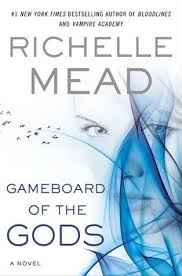
Book Review: Gameboard of the Gods by Rachel Mead

Pros: fascinating characters, interesting world, exciting climax

Cons: pacing, gods don't make much of an appearance

RUNA - the Republic of United North America - was founded after the Decline, a period in which thousands died, and which people believe was caused by three things: disease, religion and cultural separation.  Servitors are tasked with making sure their remaining religions are not a danger to society.  When servitor Justin March is brought back from his exile in Panama to take on a murder investigation with unexplainable evidence, he knows it has something to do with his own inexplicable experiences in the past.  One of which left him with two ravens in his head, and an unknown god asking for his devotion.  He's got less than a month to solve the case before another person is murdered and he and his ward are deported.

For a bodyguard he's given Mae Koskinen, a member of the praetorian guard, elite soldiers with implants that provide faster reflexes and greater strength.  A member of the upper class, which was allowed to avoid the gene mixing forced on others after the Decline, Mae has surprisingly perfect genes.  While finding each other attractive, a misunderstanding upon meeting creates tension between them, even as Mae attracts gods looking for perfect followers.

The novel jumps between three viewpoints, those of Justin, Mae and Teresa, Justin's ward from Panama, whom he's hoping to give a better life.  Teresa, as a fish out of water, is the reader's introduction to the politics and history of this new world.  The author builds things slowly, making you piece together what's happened.  Only through Teresa do you get any concentrated information.  There are no info dumps.  You have to pay close attention to what's being said as conversations are completely natural, since the characters know the context for what's happening, even if you, as the reader, don't.  As such, it takes a while to feel comfortable in this world.

This is the first book of a new series and is basically set up for what's to come.  The aspects of the book that interested me, the murder mystery and the idea of gods playing with the lives of humans, were not as central to the plot of this book as I'd expected.  The investigation into the murder stalls a bit and only picks up around the half way point in the book.  As a result, I found the pacing to be very uneven.  The opening is fascinating with a lot of information being imparted to the reader.  Then there's the move to the RUNA, where stuff happens, including learning most of the information about the country's background, but little plot development.  The plot picks up again and things stay interesting until the climactic ending.  The second quarter stalls though, and as a reader I couldn't understand why so little was being done with regards to the murder investigation.  I was hoping for something akin to Three Parts Dead by Max Gladstone, but what I got was a strange not quite romance, with the protagonists obviously wanting each other but kept apart for various reasons.

While I loved Mae and Teresa, there were times Justin drove me nuts.  He's such a smug SOB.  Still, watching the characters interact was amusing, even when either Justin or Mae manufactured another reason they couldn't have sex again.

I was disappointed by how little the gods showed up.  The ending makes me hopeful that this aspect will have a larger role in the next book.  Indeed, this more than anything made the novel feel like a set up.  It was as though this entire book was for readers to understand the world and characters so the next book could start dealing with the gods and their intrigues.  Not to say that this book ignored the intrigue, the gods do make appearances, but both Mae and Justin try to ignore what's happening until they're no longer given that option.

Speaking of Justin and his god, I was surprised that it took him so long to figure out who He was.  The rune, I thought, gave it away pretty quickly.

I'm not sure who to recommend this book to.  There's a little bit of everything - fighting, romance, mystery, dystopia - but not enough of any one thing to say: "This is for you if you like..."  I suspect the next book will have more focus, given how this one ended.  The writing is good and the series shows promise, yet I feel this book leaves the reader wanting more.   

Tuesday, June 4, 2013

Book Review: The Long Walk by Stephen King (Writing as Richard Bachman)

Pros: creepy premise, really get to know the characters, thought provoking

Cons: don't learn much about the world or why the walk is put on, crass discourse

Every year 100 teen boys join the Long Walk.  They walk at 4 miles per hour, day and night, until they can't go any further and are given their ticket.  The prize for the winner is great.  But it's a long, long road.

This is a character driven dystopian novel that focuses on a small group of walkers in the current year's Long Walk.  The characters become very real, three dimentional people.  Which makes reading the book difficult, as you're slowly watching them die.

As the walk progresses and the characters discuss why they've joined it and who will survive, you're left questioning many things as the reader - are you the same as the crowd that lines the road, hoping to see blood?  Or are you one of the boys, learning that you don't want to die because death is suddenly so close?  Unlike the crowd you see the characters as human.  You feel their pain.  As someone who walked the last 100+ km of the Santiago de Compostella pilgrimmage in 5 days, I really did feel their pain.  But even as you feel their pain and sympathise with their situation, you're still a spectator, safe in the knowledge that you can stop walking, sit down, enjoy today with the knowledge that tomorrow is coming.

The book also makes you think about peer pressure, and how much easier it is to go with the status quo than to fight it, even when you life is on the line.

I was disappointed that you don't learn much about the society that allows - nay encourages - the Long Walk year after year.  Clues in the text indicate that America has become in some ways a police state, but the extent of it is hidden from the reader.  Similarly, the early text leads you to believe that the boys volunteer for the walk, which isn't quite the case.

I wasn't a fan of some of the boys' discussion, but I accept it as realistic.  There's some crass humour as well as discussions of bodily functions, etc.


If you liked The Hunger Games or Battle Royale and want a less violent, more introspective version of the same ideas, then check this out.

Tuesday, May 21, 2013

Book Review: The 5th Wave by Rick Yancey

Pros: horrifying invasion story, believable protagonists, compelling story

Cons: 

For Parents: some swearing, kissing, the violence isn't graphic but there are child soldiers, executions, and murder

Cassie has survived the first 4 waves of the alien invasion: light's out, surf's up, pestilence and the silencer.  Seven billion people didn't, including her mother and father.  Her five year old brother was taken away in the 4th wave.  Now she waits for the 5th wave and the courage to keep the promise she made to her brother, that she'd come after him.

This is a brutal invasion story.  These aliens know how to wipe out humanity and do so in sweeping waves, each more destructive than the last.  Through Cassie's eyes we learn about the 4 previous waves, and through her eyes, and those of a few other characters, we slowly learn what the 5th and final wave is.

There's a fair amount of violence, particularly when the child soldiers come into the picture.  But it's violence that serves a purpose and isn't graphically portrayed.  This is a book that questions humanity.  What will humans do to survive?  What makes you human in the first place?  The book doesn't answer these questions, making it a great jumping point for discussion.

The characters are believable, falling apart under the pressures of the new world and picking themselves up again because doing otherwise means death.  This makes the book difficult to put down.  The writing is intense and while you may see the revelation that is the 5th wave coming, it doesn't stop it from being horrifying in its implications.

The ending is very tense, though I'm not sure I believe the kids could accomplish everything they do, and it ignores the larger picture.  But it does give a good closure for the book.

I highly recommend it.

Thursday, May 16, 2013

Book Review: Up Against It by M. J. Locke


Pros: hard SF, interesting characters, complex interconnected story lines

Cons: characters sometimes solve problems too easily, ending felt too pat

Jane Navio manages resources for 25 Phocaea, an asteroid settlement.  When an accident destroys most of the current shipment of ice that provides water, air and fuel for the colony, she's beset by numerous problems.  A feral sapient is born from the disaster and must be dealt with before it creates havoc and the martian mob appears to be the only ones in possession of enough ice to save them.  But Jane's dealth with the mob before, on her previous home, Vesta.  She barely escaped with her life.  Many others she knew weren't so lucky.

Meanwhile, four young bikers who happened to be at the scene of the accident, keep getting in and out of trouble as they cross paths multiple times with those investigating and those exacerbating the crises.
This is a clever hard SF story with multiple major conflicts and some great protagonists.  Jane is a complex character who's used to dealing with politics even though she's not keen on them.  She's first introduced making a life or death decision reminiscent of Ripley, but while she's got a cold exterior, she's got a sense of morality that won't let her deal with the mob, even when their ice shipment appers to be the colony's only means of survival.

While the book focuses on certain people, it's clear that this is a large colony, with multiple layers of bureaucracy that are mentioned when necessary, but not in enough detail to swamp the book.  I only remember one occasion where a name was mentioned and I couldn't place it because it was a beurocrat only mentioned in passing before.

The larger world is also shown to have complex politics and economics, even if they're only hinted at.  There's the martian mob, the 'Stroders (cameras that record what happens in the colony) sending data to reality TV watchers on Earth, and the Earth politics that made gene splicing illegal and forced the Viridians to emigrate.  Apparently Canada's no longer a nice place to live, as it's referenced as having refuge camps and detainee centres.

I appreciated the mix of races and religions represented, as well as sexualities, from the expectant homosexual couple barely mentioned in a park to the Viridians who prefer non-gendered pronouns that reflect their gene spliced states.

One of my favourite things in the book was Tonal-Z, a music based programming language used to talk to the feral sapient.  The acknowledgements credit a real life interface concept as the genesis for it and I'd have loved to see more of it in action.

The only problems with the book that I found were that the 4 teens kept running into more and more problems in a way that started to feel manufactured even though there were logical reasons why they were in each of the places.  And while I liked the fact that, given the locations, characters realized if they were going to get out of bad situations they needed to save themselves as the chances of someone else learning of their problem and/or arriving in time to help were slim, there were a few times when characters got out of tough spots remarkably easily.  Similarly, given all the problems the protagonists faced, the ending seemed a little too pat.  

If you're looking for space battles, look elsewhere.  There are a few fight scenes (which are all remarkably different), but on the whole this is a cerebral SF novel.

If you like interesting science, cool characters, depictions of what it might be like to live in space and complex world building, then give this book a try.

Tuesday, May 14, 2013

Book Review: 14 by Peter Clines


Pros: very interesting mystery, well paced, some great twists 

Cons: characters don't consider that the past dangers might still be around, don't really get to know any of the characters

Nate Tucker's new apartment has a few issues.  The kitchen light always shines as a blacklight, no matter what bulb he puts in, the cockroaches are green, and the elevator doesn't work.  But the price was unbelievably low for L.A. and his data entry job doesn't pay well.  The mysteries of the building intrigue him and he slowly gathers a group of other tenants who want to know why it is the way it is and why so many rooms are padlocked. 

When I requested this for review I thought it was a horror novel.  It's not.  The cover's calling it an  "Apocalyptic Mystery" is accurate.  There are no jump out of the closet scares.  But, the last third of the book has a lot of horror based imagery (and location) in it.  The book is predominantly a mystery regarding the apartment building.  Why does each room have a different layout?  Why does room 14 have four padlocks on it?  What's up with the mutant cockroaches?  Where's the elevator?  Some famous people are mentioned, including an important horror author, whose works the last few chapters reference.

The mystery is very intriguing and is well paced so you never get bored.  And this building is WEIRD, with a lot of minor and some major issues the group discovers.

The characters themselves are interesting, with all sorts of backgrounds.  You don't learn as much about them as you'd like, but it makes it feel real as how much do you know your neighbours?  

Most of the twists were completely unpredictable, though I was surprised that, given what they'd discovered, the tenants never considered that the danger that faced the people who built the building might still be around.

The ending fit all of the build up, being appropriately freaky and challenging.

Thursday, May 9, 2013

Book Review: Without a Summer by Mary Robinette Kowal


Pros: historical accuracy, intricate plot, complex characters

Cons:

The year is much colder than usual as Jane and Vincent visit with her family, and while they know the coldmongers aren't to blame, those less educated in the working of glamour aren't conviced.  They take a commission for a glamural in London and ask Melody, whose marriage prospects at home are slim, to accompany them.  But the weather remains dark and cold, and riots are breaking out.  And when Vincent's family comes calling, things get worse.

Like Kowal's other books in this series, this one starts off by showing the life and times of the Vincents and slowly adds in intrigue.  Only at the end of the book, when the full plot is revealed, do you realize how brilliant Kowal's writing is.

She takes great care getting the details in her book accurate, with notes at the back where readers can both check up on her facts and contact her if they discover an error.

The characters continue to grow, even as they're sometimes reminded of the events of the previous two books.  The finale depends heavily on the climax of book two, so keep that in mind if you chose to start here.

This book didn't have the uneven pacing of book two, and, with its ending, is probably my favourite of the three so far.

Tuesday, May 7, 2013

Book Review: Swans & Klons by Nora Olsen


Pros: interesting premise, great characters, positive depictions of lesbian relationships, positive depictions of handicapped, thought provoking, doesn't provide easy answers, great use of linguistical shifts

Cons: underdeveloped world-building, less development than the story deserved

For Parents: no sex but there is kissing, swearing done in German, minor violence

After a mysterious disease turned all men into 'Cretinous Males' with degenerative disorders, humanity chose 300 specimens of female perfection on which to build Society.  Hatched from tanks, those without modifications are human.  Those with modifications are klons, stronger and without the passions and intelligence of their human similars, they serve so the humans can achieve their full potential. 

Rubrik and Salmon Jo are sixteen, schatzies (lovers), and leaving the academy for their first mentoring assignments in the city.  Rubrik is an artist.  Salmon Jo is a scientist working at the hatcheries.  When Salmon Jo makes a startling discovery about the klons, their lives are forever changed.

This is a quick, fun read.  The characters are a little quirky and their relationship fantastic (no angst, no unwarranted fights or wafflings of affections, no love triangles, just a nice, functional relationship).

I loved that the girls are products of their society, thinking pregnancy and males (at least on Rubrik's side) are disgusting.  Similarly, the linguistical shifts, adding in some German words (or, German based words) was neat, and I loved their misunderstanding/misuse of the word 'hacker'.

Later in the book there are some descriptions of handicapped people that are done with great care and respect.  Indeed, this is a great book for questioning biases on several accounts, and specifically what makes a person human.  I loved that the author provided no answers, just ethical and philosophical questions

The biggest downside to the book was its low word count.  The publisher lists the page count at 264, but the epub file on my iPad came up to 108.  On numerous occasions the pacing felt rushed as the story jumped from one aspect to another trying to get everything in.  I think the world-building especially suffered here.  There's enough information to follow the story, but I'd have loved to see it fleshed out better, especially given the complexity of the issues being addressed.

Also, things on the whole go too easily for the girls.  With very little planning most of their crazy schemes turn out ok, which seemed a bit far fetched considering what they were doing.

Still, it's an interesting read.