Wednesday, March 14, 2012

Taking Stock

I've had this blog for 7+ years and it's really changed a lot.  When I started it was an extension of the SF/Fantasy newsletter I printed up and handed out at the store.  It contained a listing of all the books coming out the following month and book/film reviews by staff members of the World's Biggest Bookstore.  I then started posting my endcap display lists as reading lists.

About a year later I started posting my book reviews on this, my professional blog, rather than my personal blog.  And while my personal blog has since fallen to the wayside, this blog is still here.  I've kept it professional and focused.  And I'm wondering if that's what you, my readers, like.

In response to all the posts about blogs being eligible for Hugo nominations, Fantasy Book Cafe did an interesting post where she mentions that a lot of great blogs by women aren't being mentioned by these posts.

Which made me wonder how many book blogs by women I actually read.  I use google reader to keep track of my rather large blog list.  I also follow mostly industry blogs (publishers, book news sites, SF news sites, editors, authors, agents).  In fact, I only follow a few fellow bloggers, and they're mostly people I know from SF Signal.  It turns out I'm only following one female blogger (Fantasy and Sci-Fi Lovin' News and Reviews) - by which I mean, women who review books. (I do follow a few aggregate sites, like The Susquehenna Writers and Fantasy Book Critic but on the whole I don't follow many book bloggers).  So I can't properly judge the validity of the following comment made by Fantasy Book Cafe with regards to women's review blogs:

However, I find it a worrying trend that just like female authors, female book bloggers are also being overlooked [with regards to Hugo nominations]. 
I’m wondering if it may partially be because female book bloggers seem to be more eclectic than a lot of male book bloggers. Most of the blogs run by men I read almost exclusively read and review science fiction and fantasy while most of the blogs by women I read review some fantasy and/or science fiction but tend to read and review books in other genres as well. Even if they don’t necessarily review SFF 100% of the time, there are a lot of great blogs run women raising awareness about great science fiction and fantasy authors.

I'm afraid of the classification that all blogs by women are eclectic, mainly because mine isn't.  And once people have decided on a stereotype it's hard to change their minds about it, even when they know a stereotype isn't true for individual situations.  I've made sure that the only posts going up here deal with science fiction, fantasy and their subgenres in some fashion or other.  And I don't want readers to avoid my site because I'm a female blogger and must therefore blog about a wide variety of non sf/fantasy related things.

Then again, maybe that's a problem with my blog.  That it's too focused.

So here's my question.  Do you like my blog?  Is it too focused?  Are there posts you don't like or posts you'd like to see more of (author interviews, book reviews, movie reviews, author spotlights, artist spotlights, books received, upcoming books, etc.)?

I spoke with a friend who mentioned that her blog gets more hits when she mentions personal issues.  And looking at the author blogs I follow (Jim Hines, Lynn Veihl and Malinda Lo), they all mention personal things, or at least non-book related things, fairly often.

I don't really want to do that.  I like keeping this blog professional and focused on SF/Fantasy works.  Having said that though, I would like reader input so I can improve this blog and perhaps attract new readers.

Please leave a comment telling me something constructive (eg: 'I want to see fewer new author spotlight posts.' Please don't give general comments like 'your site's great' or 'this site sucks').  Let me know why you come here, what you'd like to see more of or less of.  Help me make this an even better site.  Conversely, if you like everything I'm doing already, let me know of new things you'd like to see here.  Because there's always room for improvement.

Tuesday, March 13, 2012

Book Review: The Man From Primrose Lane by James Renner

Pros: brilliantly intricate plot, fantastic finish, compelling, interesting characters

Cons: some disturbing imagery, some gross imagery, complicated plot was sometimes hard to follow

David Neff hasn't written since his wife's suicide 4 years ago, on the day they were to bring their new baby home from the hospital.  So when his agent suggests he try his hand at solving the murder of the Man from Primrose Lane, he baulks.  But his naturally obsessive nature takes over and he soon discovers that the case is connected to that of his wife, whose twin sister was kidnapped in front of her eyes when they were ten.  

The first 231 pages of this novel are straight up crime fiction.  The author, James Renner, has written two true crime books, and so knows what's required to investigate the kinds of cases David Neff faces.  This section of the novel tells about David's present and two parts of his past: his meeting and marriage to Elizabeth and the murder case he solves (and subsequently writes a book about).  This case, something he obsesses over for many years, requires crime scene descriptions of rape and murder victims, most of whom are children.  The imagery, while not gratuitous, caused this reviewer some unease, as did some of the gross descriptions found in the book.  While hearing that someone vomits is fine, knowing WHAT they've vomited up... isn't something this reviewer was prepared to learn.  One scene in particular caused this reviewer some concern for the contents of her own stomach.

The last third of the novel is pure science fiction.  The SF is fundamental to the story and complicates the already complicated plot.  In many ways this segment of the book reminded me of the movie Primer.  It would have been incredibly helpful to have a flowchart of what happened to whom and when.  Even before this segment, keeping characters straight was a bit of a challenge.  And unlike most books, where you can flip back through the linear narrative to refresh your memory, trying to find earlier passages - with the way the book jumps through time - was tough.

The mystery was very compelling and David's character fascinating.  And once I learned the twist I couldn't put the book down.  There were a few things that appeared to be plot holes but the author meticulously dealt with each one before finishing the book.  Indeed, the ending was absolutely brilliant.

The Man from Primrose Lane is not for the faint of heart but is ultimately rewarding for those who finish the book.

Friday, March 9, 2012

Author Interview: Tobias Buckell

Novels: Crystal Rain
Ragamuffin
Sly Mongoose
Halo: The Cole Protocol
Arctic Rising
The Apocalypse Ocean (forthcoming, kickstarter project)

Short Stories: Lots, listed here


> What is Arctic Rising about?

The future is hot, and getting hotter. The polar ice cap has all but melted, and the resource rush in the icy north is in full swing. The Gaia Corporation has a plan to roll back global warming, but the solution may be worse than the problem if it ends up in the wrong hands. In the middle of all this is Anika Duncan, an airship pilot caught up in a hunt for a nuclear weapon that's gone missing. One that she's sure has ended up in the Arctic...

> Arctic Rising is different from the other books you've written. What persuaded you focus on global warming for this book?

It came out of reading some declassified US military documents and Navy memos about the changing geo-political situation of the Arctic that needed addressed at current warming rates. I've often joked that the US military is more of a green, hippy organization than the rest of US government, as it's one of the largest investors in alternative energy research, adoption, and climate change modeling. Reading this stuff just began to spark ideas about a near-future thriller set in this environment.

> What made you want to be a writer?

I love telling stories and making things up. As long as I can remember I've always dropped everything to pay attention to narrative. As a kid my mom would leave me on the floor with a matchbox full of slips of paper with words on them and I'd construct sentences. It's been bubbling inside of me my entire life. I'm also rare in that I grew up without TV, living on a boat, for the most part. So it was all books most of my life.

> How did living on boats for much of your youth impact your writing?

It impacts a whole outlook. I grew up on a home that was both cramped, and yet open. Space was used efficiently. You had to adopt a zen minimalist approach with belongings. We generated our own electricity and caught a lot of our own water, and we often moved our home to different places to explore. As a result I grew up with a different view of national boundaries, what a home meant, and with a different relationship with consumerism. I'm grateful for it.

> In the books you’ve written, who is you favourite character and why?

I've always enjoyed writing the popular character of Pepper from my novels Crystal Rain, Ragamuffin, and Sly Mongoose. He's powerful, dangerous, a wild card, and as a writer that's fun because it brings a chaos and unpredictability to hand that spices things up.

> If you could, would you change places with any of your characters?

Very few of my characters rich, in a stable place, and free of drama in their life. I grew up in the middle of a war and in the remains of its recovery, and had a tough childhood. I've been through some of the sort of drama that makes for good literature. It's not really for me anymore.

> Beyond the matter of length, do you find it easier writing short stories or novels?

Each has its benefits and downsides. For me personally, it's a wash. I do wish short fiction paid better so I could do more of it!

> What was the first novel (published or unpublished) that you wrote and how long did it take to write it?

From high school to college I had this perpetual novel I was always 'working on.' Best thing that ever happened to me was a hard drive crash my sophomore year of high school that killed it.

> When and where do you write?

That always changes depending on the mix of freelance and fiction work I'm doing. But I prefer to do my more creative, first draft work just after midnight until I get tired.

> What’s the best/worst thing about writing?

As I mentioned, I really enjoy the act of creation. Losing myself in other worlds. Keeping my own hours is a nice perk, though.

> What is something you didn’t know about the publishing industry before you had your first book published?

Just how many people are involved in the entire process. Sales reps, marketing, publicity, art, proofreaders and copyeditors and your editor, the finance people, and so on.

> Do you have any advice for hopeful authors?

Write is the biggest part of the word 'writer.' Write often. Read often. They're the two basics!

> Any tips against writers block?

It could be a sign you're bored of the work, or that your subconscious recognizes a problem it is trying to untangle. How you choose to react to that is up to you. Some push through, some take a break, some work on something else, some take the time to try and untangle what is holding things up. All are valid ways through.

> How do you discipline yourself to write?

I leave my house and go to a local coffee shop more often than not to get in the right frame of mind for productivity. After midnight I find there are fewer interruptions, I get a lot more done.

Thursday, March 8, 2012

Cool New YA Dystopian and Post-Apocalyptic Novels

While I was looking for the youtube videos for yesterday's post, I saw this book trailer as one of the pre-video ads.  Intrigued, I looked up the book and it sounds pretty awesome.  The book is Starters by Lissa Price, out March 13th.


HER WORLD IS CHANGED FOREVER
Callie lost her parents when the Spore Wars wiped out everyone between the ages of twenty and sixty. She and her little brother, Tyler, go on the run, living as squatters with their friend Michael and fighting off renegades who would kill them for a cookie. Callie's only hope is Prime Destinations, a disturbing place in Beverly Hills run by a mysterious figure known as the Old Man.
He hires teens to rent their bodies to Enders—seniors who want to be young again. Callie, desperate for the money that will keep her, Tyler, and Michael alive, agrees to be a donor. But the neurochip they place in Callie's head malfunctions and she wakes up in the life of her renter, living in her mansion, driving her cars, and going out with a senator's grandson. It feels almost like a fairy tale, until Callie discovers that her renter intends to do more than party—and that Prime Destinations' plans are more evil than Callie could ever have imagined. . . .

Another book I've been waiting to read that has a great book trailer is Dan Wells's Partials.


The human race is all but extinct after a war with Partials, engineered organic beings identical to humans, has decimated the population. Reduced to only tens of thousands by RM, a weaponized virus to which only a fraction of humanity is immune, the survivors in North America have huddled together on Long Island while the Partials have mysteriously retreated. The threat of the Partials is still imminent, but, worse, no baby has been born immune to RM in more than a decade. Our time is running out.
Kira, a sixteen-year-old medic-in-training, is on the front lines of this battle, seeing RM ravage the community while mandatory pregnancy laws have pushed what's left of humanity to the brink of civil war, and she's not content to stand by and watch. But as she makes a desperate decision to save the last of her race, she will find that the survival of humans and Partials alike rests in her attempts to uncover the connections between them, connections that humanity has forgotten, or perhaps never even knew were there.

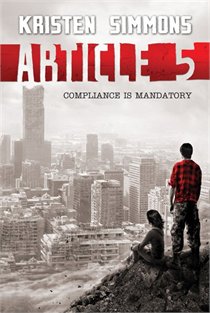
Article 5, by Kristen Simmons, is sitting by my chair, waiting for me to finish my current book so I can pick it up.

New York, Los Angeles, and Washington, D.C., have been abandoned.
The Bill of Rights has been revoked, and replaced with the Moral Statutes.
There are no more police-instead, there are soldiers. There are no more fines for bad behavior-instead, there are arrests, trials, and maybe worse. People who get arrested usually don''t come back.
Seventeen-year-old Ember Miller is old enough to remember that things weren't always this way. Living with her rebellious single mother, it's hard for her to forget that people weren't always arrested for reading the wrong books or staying out after dark. It's hard to forget that life in the United States used to be different.
Ember has perfected the art of keeping a low profile. She knows how to get the things she needs, like food stamps and hand-me-down clothes, and how to pass the random home inspections by the military. Her life is as close to peaceful as circumstances allow.
That is, until her mother is arrested for noncompliance with Article 5 of the Moral Statutes. And one of the arresting officers is none other than Chase Jennings…the only boy Ember has ever loved.

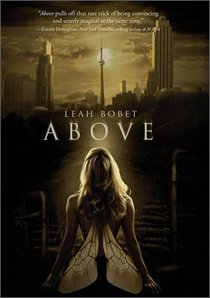
And last but not least is Above by Leah Bobet.

Matthew has always lived in Safe, a community hidden far beneath the pipes and tunnels of the city Above. The residents fled to Safe years before to escape the Whitecoats and their cruel experiments, and now Matthew is responsible for both the keeping of Safe's stories and for Ariel-a golden-haired shapeshifter, and the most beautiful girl he's ever seen.
But one horrifying night, an old enemy murders Safe's founder, Atticus, and the community is taken over by an army of shadows. Only Matthew, Ariel, and a handful of friends escape Above. Now they not only have to survive in a sunlit world they barely know, but they must unravel the mystery of the shadows'' fury and Atticus's death. It's up to Matthew to find a way to remake Safe-not just for himself and his family, but for Ariel, who''s again faced with the life she fled, and who needs him more than ever before.

Too many books to read, too little time...

Wednesday, March 7, 2012

Mari0 - Super Mario Bros. meets Portal

Dorkly Bits did a Mario With a Portal Gun video around a year ago:


Well, the fine people at Stabyourself.net obviously thought it was a great idea because now the game actually exists!  And it's available for the low, low cost of free.

A complete from scratch recreation of Super Mario Bros. with a focus on perfectly imitating the feel the 1985 classic gave us.  Then give Mario a portal gun, add puzzle game mechanics from Portal and there you go. And if that wasn't crazy enough, play 4-player coop, with everyone having their own portal gun!


And here's a video by CaptainSparklez, showing it off, which is how I heard of the game.

Tuesday, March 6, 2012

Book Review: Fleas, Flies and Friars: Children's Poetry from the Middle Ages by Nicholas Orme

Pros: designed to be read by anyone (not just scholars), wide variety of examples, good introduction

Cons: little commentary on the different poems/examples, no conclusion, no easy way to see the original poems he translates

Nicholas Orme has put together a short book of poetry that would have been told to or written/spoken by children in the Middle Ages.  He's done so using full English translations so the book is accessible to those without a background in the field or a knowledge of Latin or middle English.  The downside to this is that if you do know the languages there's no checking his translations to see what (if any) liberties he's taken to get the meaning across or to force the rhythm and rhymes of the poems.  He did keep some old words, to help with the rhymes and maintain flavour, and here he helpfully added translations/modernisations at the bottom of the page.

The book covers a wide variety of poems, from games to manners, stories, and grammar school exercises.  This allows for a nice window into the lives of children, at work and at play, increasing our knowledge of how people lived.  It shows that children were not thought of as 'little adults', that they were allowed to play and were catered to in many ways, according to their age and abilities.

I would have liked more commentary on the individual pieces and a conclusion showing some of the things these poems show us about how children were treated in the middle ages.  But again, Orme wanted this book to be less scholarly and more easily accessible and so kept commentary to a minimum.

An interesting glimpse of an aspect of the middle ages that is not well understood.

Friday, March 2, 2012

Sail to Success

I heard about this a month ago, but as there still seem to be places available, I figured I'd mention it here.  Phoenix Pick, whose free ebook this month is The Big Jump by Leigh Brackett (use coupon code: 9991393) is sponsoring a cruise with publishing professionals.

Sail to Success.  
A SERIES OF SEMINARS FOR THE SERIOUS WRITER 
on board a luxury cruise liner visiting the Bahamas.  

They've got some great participants: Literary Agent Eleanor Wood, Baen Books publisher Toni Weisskopf, Jack Skillingstead, Mike Resnick, Rebecca Moesta, Nancy Kress, Paul Cook and Kevin Anderson.  I've seen several of these people speak before and they're fantastic.  It's an all-inclusive cruise in the Bahamas, and if I didn't have vacation plans already this year (and didn't work retail where taking vacation during the Christmas season is nigh on impossible) I'd be temped by this.  The cruise takes place from December 3-7 and leaves from Miami.  Full details available here.