Showing posts with label Fantasy. Show all posts

Friday, September 6, 2013

Author Interview: Samantha Shannon

Novel: The Bone Season

Website: www.boneseasonbooks.com

Blog: samantha-shannon.blogspot.com

[Taken from an interview for The Today Show. Reprinted here with permission.]

> When did you begin writing The Bone Season and what inspired the story?

I started writing The Bone Season when I was nineteen years old, shortly after completing an internship at David Godwin Associates (DGA), a literary agency in Seven Dials, a small district in London. While I was there, I had a vivid image of a girl having the same day at work as me, but she happened to be clairvoyant – and The Bone Season was born. I sent the finished book to the same agency in April 2012 and it was bought by Bloomsbury a month later.

> Can you describe The Bone Season and the world of Scion? What inspired you to come up with the idea of clairvoyant powers?

The novel begins in 2059, two hundred years after the day that triggered its events, but 1859 still shapes the world of Scion. The way I handle this in the book is through anachronism. You’ll see gramophones, Victorian clothes and herbal remedies in the same space as oxygen bars, data pads and advanced painkillers. I’ve tried to find a word that fits what I’m doing with the novel in this respect. One of the guys at Bloomsbury suggested ‘penny farthing futurism’, which I love. The idea of clairvoyant powers just came to me while I was working at Seven Dials.

> Some of the themes are quite complex, how did you research the book? How many of the clairvoyant ideas are from historic stories, and how many created by you?

I wanted my clairvoyant society to be a cross-section of historical types of divination, extending to encompass twenty-first century parapsychology. I did quite a bit of reading about classical and Renaissance impressions of augury, soothsaying and so on. After that I moved on to nineteenth century Spiritualism, mainly using The Book on Mediums by Allan Kardec. I also integrated Native American legend for Paige’s gift. Although I did a lot of research, I wanted to put my own spin on each type, hence the Seven Orders classification system. I wanted there to be a sense of inheritance and progression, a coming together of legends and phenomena.

> Why is fantasy/dystopia as a genre growing steadily in popularity? Do you think women authors seem to have a better handle on it currently? How does the fantasy aspect of the book help you to get your ideas across?

I think they're still two distinct genres – dystopia tends to veer more towards science fiction than fantasy – but both crucially allow the reader to escape from reality. Personally I like writing and reading dystopian fiction because it takes its characters to the edge: the edge of sanity, of safety, of survival. They're in extremis, and that allows you to see a side of them that you wouldn't be see if they were in, say, a kitchen sink drama, which is pure realism. Fantasy provides a more luxurious escapism. It can often be as gritty as a dystopia, but instead of being woven from nightmares, it plays with the stuff of dreams.

I don't think female authors necessarily have a better handle on the genres, although it certainly can't be disputed that they're writing most of the 'blockbusters': Harry Potter, The Hunger Games, The Mortal Instruments and so on. Part of the success of these books may be that they boast female characters in leading roles. The vogue for ‘strong heroines’ has transformed the face of fantasy. While it’s great that so many series have female protagonists, the fact that they are still considered noteworthy shows that we need to keep writing them. I’ve never yet been asked why I put ‘strong male characters’ in my book. I think it’s time we stopped being surprised when female-driven books become successful. Paige is ‘strong’ in that she’s relatively independent, a fighter, not defined by her love interest, and driven by the need for freedom, but she has plenty of weaknesses. She’s proud and stubborn, has a knack for
trusting the wrong people, and in many ways, she’s very vulnerable. I try to treat my characters first and foremost as people, not as sexes.

> Do you have any advice for budding authors?


Be open to constructive criticism, don't be afraid to start again, and whatever you do, don't give up at the first hurdle.

Sunday, September 1, 2013

Science Fiction and Fantasy Books Coming in October 2013

There might be more errors/omissions than usual this list as Amazon's SF/F listing wouldn't go far enough back for me to do this the way I normally do.  Instead, I had to go through SF and fantasy separately.  I also added the YA category back in.  I noticed some kids books creeping into the list, which I then deleted, but be aware that there might be some kids books.  Oh, and I used the US page (which, come to think of it, might be why I had trouble) rather than the Canadian one.  So these reflect the US release dates.  As always, release dates are subject to change.  If you spot a mistake, please tell me in the comments and I'll correct it.

Hardcover:

Balfour and Meriweather in The Incident of the Harrowmoor Dogs – Daniel Abraham
Esrever Doom – Piers Anthony
Allegiance – Beth Bernobich
Behind the Sofa: Celebrity Memories of Doctor Who – Steve Berry, Ed.
Dark Talisman – Steven Booth
The Necromancer's House – Christopher Buehlman
Star Trek: The Stardate Collection, Vol 1 – John Byrne, Patrick Zircher, Greg Adams & Josep Maria Beroy
Autumn Bones – Jacqueline Carey
Copperhead – Tina Connolly
Memory of the Trees – F. G. Cottam
Childless – James Dobson & Kurt Bruner
The Last Dark – Stephen Donaldson
1636: The Devil's Opera – Eric Flint & David Carrico
The Power of Twelve – William Gladstone
Parasite – Mira Grant
After Dead: What Came Next in the World of Sookie Stackhouse – Charlaine Harris & Lisa Desimini
Doctor Who The Vault: Treasures from the First 50 Years – Marcus Hearn
Johannes Cabal: The Fear Instituted – Jonathan Howard
The Cusanus Game – Wolfgang Jeschke
Fiendish Schemes – K. W. Jeter
Dead Set – Richard Kadrey
Day One – Nate Kenyon
Bastion – Mercedes Lackey
Love in the Time of Metal and Flesh – Jay Lake
The Last Man Standing – David Longo 
The Republic of Thieves – Scott Lynch
Old Mars – George Martin & Gardner Dozois, Ed.
Summer's End – Lisa Morton
Pachyderme – Frederik Peeters
The Wolves of Midwinter – Anne Rice
The Heavens Rise – Christopher Rice
Path of Anger – Antoine Rouaud
Veil of the Deserters – Jeff Salyards
The Estate – Craig Saunders
The Violent Century – Lavie Tidhar
The End of Love – Marcos Girald Torrente & Katherine Silver
Luminous Chaos – Jean-Christophe Valtat & Mahendra Singh
The Bounty Hunter Code: From the Files of Boba Fett – Daniel Wallace, Ryder Windham & Jason Fry

Trade Paperback:

Escaping Home – A. American
Tesseracts Seventeen – Colleen Anderson & Steve Vernon, Ed.
Rage's Echo – J. S. Bailey
In the Company of Thieves – Kage Baker
The Obsidian Heart – Mark Barnes
Tomorrowland – Joseph Bates
Steal the Day – Lexi Blake
Katabasis – Joseph Brassey, Cooper Moo, Mark Teppo & Angus Trim
Coins of Chaos – Jennifer Brozek
Light – Nathan Burgoine
The Demon Abraxas – Rachel Calish
Dreams and Shadows – C. Robert Cargill
Cold Blooded – Amanda Carlson
Iron Guard – Mark Clapham
The Wasteland Saga: Old Man and the Wasteland, The Savage Boy, and The Road is a River – Nick Cole
The Diamond Deep – Brenda Cooper
The Law of Superheroes – James Daily & Ryan Davidson
A Dance of Cloaks – David Dalglish
In Space No One Can Hear You Scream – Hank Davis
Knights Templar: A Secret History – Graeme Davis
The Night Eternal – Guillermo Del Toro & Chuck Hogan
Tales of the Wold Newton Universe – Philip Jose Farmer
Man in the Empty Suit – Sean Ferrell
The Science of Herself – Karen Joy Fowler
Once Upon a Time: New Fairy Tales – Paula Guran, Ed.
Gotrek & Felix: City of the Damned – David Guymer
His Sacred Bones – Ginn Hale
Theodore Savage – Cicely Hamilton
Lighthouse Island – Paulette Jiles
Child of Time – Bob Johnson
Weird Shadows Over Innsmouth – Stephen Jones, Ed.
Dying is my Business – Nicholas Kaufmann
Trollslayer – William King
Scarecrow Has a Gun – M. P. Kozlowsky
Warhammer 40K: Salamanders Omnibus – Nick Kyme
Autodrome – Kim Lakin-Smith
A Sojourn of Sorts – Douglas LeBlanc
Ancillary Justice – Ann Leckie
Lucia's Masks – Wendy MacIntyre
Fire Logic – Laurie Marks
Layman's Report – Eugene Marten
The Book of Ash – John McCaffrey
Red Hill – Jamie McGuire
Things Withered – Susie Moloney 
Dead North: Canadian Zombie Fiction – Silvia Moreno-Garcia, Ed.
Rogue Calls / Carbon Harbour – Garry Thomas Morse
The Quorum – Kim Newman
Robert Asprin's Dragon's Run – Jody Lynn Nye
Kabu Kabu – Nnedi Okorafor
Saving Morgan – M. B. Panichi
Fairy Tales from the Brothers Grimm – Philip Pullman
The Educated Ape and Other Wonders of the World – Robert Rankin
The Worlds of Edgar Rice Burroughs – Mike Resnick & Robert Garcia, Ed.
Jack Glass – Adam Roberts
Heartwood – Freya Robertson
Omega – Jeremy Robinson & Kane Gilmour
Was – Geoff Ryman
Children of the Uprising – Trevor Shane
The Man Who Rained – Ali Shaw
Waking up Dead – Emma Shortt
E. E. 'Doc' Smith, SF Gateway Omnibus: The Skylark of Space, Skylark Three, Skylark of Valeron, Skylark Duquesne – E. E. Smith
Magellania – Jules Verne
The Palace Job – Patrick Weekes
Doctor Who: Summer Falls and Other Stories – Amelia Williams, Melody Malone & Justin Richards
Afrofuturism: The World of Black Sci-Fi and Fantasy Culture – Ytasha Womack
Flatland: The Early Days – Frannie Zellman

Mass Market Paperback:

Battleground – Terry Adams
Bronze Gods – A. A. Aguirre
Luck of the Draw – Piers Anthony
Kiss the Night Goodbye – Keri Arthur
The Beautiful Land – Alan Averill
Dream London – Tony Ballantyne
Bronze Summer – Stephen Baxter
The Lost Stars – Jack Campbell
Dark Currents – Jacqueline Carey
Rising Sun – Robert Conroy
King Breaker – Rowena Cory Daniells
Spellbound – Sylvia Day
Abyss Deep – Ian Douglas
Dragon Age: The Calling – David Gaider
Star Wars: Ewocks: Shadows of Endor – Zack Giallongo & Dave Marshall
Cursed – S. J. Harper
Ever After – Kim Harrison
Black Heart – Christina Henry
Herbmaster of Tarodash – Colin Hollis
A Study in Darkness – Emma Jane Holloway
Hellhound – Nancy Holzner
Darkship Renegades – Sarah Hoyt
The Scribe – Elizabeth Hunter
Star Wars: Annihilation – Drew Karpyshyn
Star Wars: The Clone Assassin – Steven Kent
The Clone Rebellion – Steven Kent
Redoubt – Mercedes Lackey
V-Wars – Jonathan Maberry, Ed.
Star Trek: A Ceremony of Losses – David Mack
The Disappearances – Gemma Malley
The Cassandra Project – Jack McDevitt & Mike Resnick
My Lady Quicksilver – Bec McMaster
Tour of the Merrimack – R. M. Meluch
Imager's Battalion – L. E. Modesitt, Jr.
Merge / Disciple – Walter Mosley
All is Fair – Emma Newman
Accidentally in Love With... A God? – Mimi Jean Pamfiloff
Firebrand – Gillian Philip
Death and Mr. Right – Kendra Saunders
Kris Longknife: Defender – Mike Shepherd
Prince Rescue Me's Ride to Ruin – Lynne Tapper
Ecko Burning – Danie Ware

Ebook:

Vampire Games – Tiffany Allee
Redemption – C. J. Barry
The Dark Age of Apollos – Paul Moses Burrow, Jr.
Trancehack – Sonya Clark
Realm Walker – Kathleen Collins
Secret Unleashed – Sierra Dean
The Mountain's Shadow – Cecilia Dominic
Blood of an Ancient – Rinda Elliott
Paint it Black – John Hartness
Pushing Luck – Elliott James
Taste of Passion – Renae Jones
Rogue's Possession – Jeffe Kennedy
Agamemnon Frost and the Crown of Towers – Kim Knox
Nightlife – Matthew Quinn Martin
Wicked Misery – Tracey Martin
Battle Scars – Sheryl Nantus
Death Bringer – Kate Pearce
Whatever Happened to Billy Parks – Gareth Roberts
Undead Chaos – Joshua Roots
Redemption – Stephanie Tyler
Disenchanted & Co pt2: His Lordship Possessed – Lynn Viehl

Y. A. Fiction

Horde – Ann Aguirre
Altered – Gennifer Albin
Crewel – Gennifer Albin
Skulk – Rosie Best
Sorrow's Knot – Erin Bow
The Never Fade – Alexandra Bracken
Martyr's Fire – Sigmund Brouwer
Evanescent – Andria Buchanan
Entangled – Amy Rose Capetta
The Crimson Crown – Cinda Williams Chima
The Shadowhunter's Codex – Cassandra Clare & Joshua Lewis
Endless Knight – Kresley Cole
One Crow Alone – S. D. Crockett
The Eye of Minds – James Dashner
The King's Assassin – Stephen Deas
The Company of Ghosts – Berlie Doherty
Arthur Quinn & Hell's Keeper – Alan Early
The Lethal Target – Jim Eldridge
The Owling – Robert Elmer
Fearsome Dreamer – Laurie Eve
Starlight Grey – Liz Flanagan & Valeria Docampo
Beautiful Redemption – Kami Garcia & Margaret Stohl
Venus Angel – Susan Gates
Dragonfly – Julia Golding
Blythewood – Carol Goodman
The Dollhouse Asylum – Mary Gray
Slayers – C. J. Hill
Waterfell – Amalie Howard
Skyship Academy: Strikeforce – Nick James
Romeo Redeemed – Stacey Jay
Death and the Girl He Loves – Darynda Jones
The Iron Traitor – Julie Kagawa
The Brokenhearted – Amelia Kahaney
Teardrop – Lauren Kate
No Angel – Helen Keeble
Blinded by the Light – Joe Kipling
Hero – Alethea Kontis
Pull Down the Night – Nathan Kotecki
Flutter – Gina Linko
Backward Glass – David Lomax
Jet Black and the Ninja Wind – Leza Lowitz & Shogo Oketani
The Princess in the Opal Mask – Jenny Lundquist
Desert Tales – Melissa Marr
Rags & Bones: New Twists on Timeless Tales – Melissa Marr & Tim Pratt, Ed.
Scarlet in the Snow – Sophie Masson
Necromancing the Stone – Lish McBride
The Indigo Spell – Rachelle Mead
Midnight City – J. Barton Mitchell
Allure – Lea Nolan
The Field – Tracy Richardson
Grail of Stars – Katherine Roberts
Tainted – A. E. Rought
The Invisible Kingdom – Rob Ryan
Endless – Jessica Shirvington
Unsouled – Neal Shusterman
Renegade – J. A. Souders
Shadowlark – Meagan Spooner
Blood Bound – Keshia Swaim
Phantom Eyes – Scott Tracey
Merlin's Shadow – Robert Treskillard
Second Verse – Jennifer Walkup
Treecat Wars – David Weber & Jane Lindskold
Black Out – Robison Wells
The Other Book – Philip Womack

Rebel Heart – Moira Young

Tuesday, August 20, 2013

Book Review: The Bone Season by Samantha Shannon

Pros: intricate world-building, strong female protagonist, glossary of terms

Cons: lots of characters to remember (no character list)

Paige Mahoney is a dreamwalker, able to send her spirit into the aether.  She works for the criminal underworld of Scion London because clairvoyant powers like hers are illegal.  Unnatural.  A series of unfortunate events leaves her hunted by the Night Vigilance Division, voyants who work for the state against their own kind.  But it's a different group that finds her.  Instead of being executed or brought to the tower, she's drugged and woken up in a different city.  She finds herself a prisoner of a race of beings called Rephaite.  Beings who helped bring Scion to power.  Beings who are now her masters.

The world building in this novel is incredible.  Shannon has created 1) an alternate history from 1859, when clairvoyance became widespread, 2) a kind of caste system for clairvoyants, including numerous ways to access the aether, 3) a complex crime syndicate based in London, 4) a dystopian government that's extending its powers, 5) the Rephaite and Emim, and 6) the penal city of Sheol I.

While there are a few info dump style scenes, they're quick and intigrated into the story.  And you really need them.  So much is going on that the faster you're grounded in the background of each section, the more interesting the story is.  The information is explained in different ways, the branches of clairvoyance are delivered via an infographic at the start of the novel, there's an orientation meeting for Shoel I, and Paige learns more about the city from other inmates.  I really appreciated that Paige's flashbacks not only allowed you to learn more about her character but were used as a point of intrigue later on in the narrative.   

Paige is a flawed but still kick-ass protagonist.  She makes mistakes in the book and pays for them, but comes back fighting.  Her progression through the book feels realistic.  She's trying not to give in to hopelessness like so many others around her, while at the same time understanding that she has something to return to should she escape, unlike many of the others. 

The Rephaite are fantastic bad guys.  The more Paige learns about them, the more evil they become.  And yet, she's drawn to her keeper, who isn't quite like the others.  Their relationship is complicated and rather fun to read.

One of the few complaints I had about the novel was the large number of characters.  There are Paige's syndicate members (by name and codename), people in government, people from history, numerous Rephaite, and the people in Shoel I, who you have to remember by both name and number.  The numbers could confuse you too, as Paige was sometimes her full number, XX-59-40, sometimes XX-40 and sometimes just 40.  A list of characters, with their numbers/aliases, would have been a helpful addition alongside the included glossary of terms (which I had to refer to several times towards the end of the book).  

Another complaint was that amaranth became too powerful towards the end of the novel, which reduced tension in some otherwise tense scenes.


This is the first of a planned 7 book series.  Given everything introduced in this book, I can't wait to see what the author does next.  There's so much left unexplored, especially with regards to the Rephaite.  And while this book is definitely open ended, there is a sense of completion to this volume, which I appreciated.

Friday, August 9, 2013

Author Interview: Mark Lawrence

Novels:
Prince of Thorns
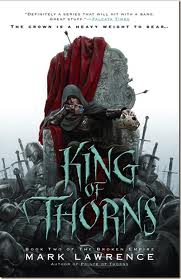
King of Thorns
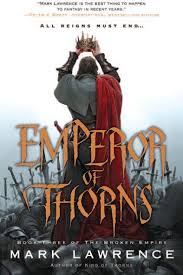
Emperor of Thorns

In addition to writing novels, Mr. Lawrence also writes short stories and poetry (click the links to read several of each).

Website: princeofthorns.com

> What can readers expect from your Broken Empire trilogy?

I think a lot of authors find this a hard question to answer. Authors like to talk about the writing. Talking about the story is more difficult because it's asking for hundreds of thousands of words to be shoe-horned into tens of words.

The Broken Empire trilogy is about a charming, dangerous, and amoral boy growing into a charming, dangerous, and amoral young man. On the journey he cuts down pretty much everything and everyone who gets in his way, and he's rather creative when it comes to the business of killing.

Where Prince of Thorns differs from a lot of fantasy books is that the story is the main character, Jorg. It's as much about who he is and why he is as it is about what he does. There's no evil overlord threatening the goodly lands of Generica. There are no dragons, no fireworky mages spewing out magic like they just ate a bad spell. Our protagonist is a nasty piece of work and no crime seems too bad for him if it’s a path to his goals. He makes no apologies for his actions and isn’t seeking redemption. However, if you read between the lines he delivers, you discover a new perspective on him that whilst it doesn't excuse his deeds, does go some way to explaining them.

So, turning tens of words into ten, it's a violent enthusiastic fantasy with a deeper sub-text.

> Why did you decide to make Jorg an anti-hero rather than a traditional hero figure?
I find these tags of hero, anti-hero, and villain rather restrictive, as if fantasy were something laid out according to certain rules, when in reality it should be the least constrained of all fiction.

The inspiration for the character came from Anthony Burgess’ A Clockwork Orange which also features a violent and amoral protagonist who confuses us by being at the same time charming and intelligent. I wanted to see if I could work a similar magic in a fantasy book.

 > You've worked in the field of artificial intelligence.  Why do you write fantasy rather than science fiction?

I still work in that field, but if I worked as a doctor should I then write medical dramas? Or if I were a lawyer should I write fiction about crime and judgement? If that were true who would we be left with to write fantasy? Would we need people who worked by day as unicorn wranglers or dragon farmers to write fantasy? Fantasy was my first love long before I discovered I could solve equations. My mother read me Lord of the Rings when I was seven.

> What made you want to be a writer?

I never harboured any great desire to be a writer, and certainly no expectation of it. I just enjoyed writing – so I did! Nobody was more surprised than me when someone wanted to print my work and sell it.
 > If you could, would you change places with any of your characters?

No. My life isn’t all milk and honey but my characters all have it much tougher than I do. I’m much happier on this side of the keyboard.

> What were your literary influences for the Broken Empire trilogy ?
The inspiration for the protagonist, Jorg, came from A Clockwork Orange. Beyond that I have no influences I’m aware of, and probably many that I’m not aware of. Certainly reading George Martin’s A Game of Thronesreawakened my interest in fantasy, convincing me that the elements I loved in fantasy when growing up could be re-imagined in a much more adult and literary fashion without losing that magic.

> Beyond the matter of length, do you find it easier writing short stories, poems or novels?

When it’s time for a poem then a poem comes easy. But I couldn’t write one every day. The shorter the form the more effort per word I would say in general, but that effort is mainly in waiting for the idea or sentiment or vision to bubble up from wherever it is that these things bubble from.

> What was the hardest scene for you to write?

Emotionally that would be a scene in King of Thorns involving a dog. I had my only ever piece of hate-mail over that.
> When and where do you write?
I write wherever I can sit down and get some quiet, normally late at night when all my other duties are taken care of.
> What’s the best/worst thing about writing?
Writing is like scratching an itch. The need to do it builds up. Then you do it, and for a while the need is satisfied. So the best thing is that it scratches that itch. If I didn’t write I’d have to do something else creative.
I’m having difficulty coming up with a worst thing... it’s all pretty good. I guess the worst thing is that it’s time consuming and you could have done something else good in those hours. I’ve not managed to play a computer game in two years and I’d really quite like to. It’s just I’d rather write.

> What is something you didn’t know about the publishing industry before you had your first book published?

That would be EVERYTHING. I didn’t have the slightest clue about or interest in the publishing industry before my first book was published. I guess my biggest misconception was that the authors of the books in the bookshops were making their living by writing, when in fact very few of them can afford to give up the day job.

> Do you have any advice for hopeful authors?

Keep hoping.

But really it’s only sensible to invest all that time and effort if you enjoy it and find the writing to be its own reward.

> Any tips against writers block?

No. I’ve never had it. If I don’t want to write, I don’t write. I don’t consider that to be writer’s block.

> How do you discipline yourself to write? 

I don’t. I write if I want to.

Thursday, August 1, 2013

Science Fiction and Fantasy Novels Coming in September 2013

This list is drawn from Amazon.ca and therefore reflects Canadian release dates for books.

Hardcover:

Doctor Who: The Official 50th Anniversary Annual – BBC
Book of Iron – Elizabeth Bear
Terra – Mitch Benn
The Halloween Legion: The Great Goblin Invasion – Martin Powell, Thomas Boatwright & Diana Leto
Jewels in the Dust – Peter Crowther
Monsters of the Earth – David Drake
Marauder – Gary Gibson
The Power of Twelve – William Gladstone
Mage's Blood – David Hair
The Year of the Ladybird – Graham Joyce
Kinslayer – Jay Kristoff
The Dead Run – Adam Mansbach
Evening's Empires – Paul McAuley
Warhammer 40K: Lords of Mars – Graham McNeill
The One-Eyed Man – L. E. Modesitt, Jr. 
Delia's Shadow – Jaime Lee Moyer
Anno Dracula: Johnny Alucard – Kim Newman
Isaac Asimov's I Robot: To Obey – Mickey Zucker Reichert
On the Steel Breeze – Alastair Reynolds
Shaman – Kim Stanley Robinson
Vicious – V. E. Schwab
The Grim Company – Luke Scull
Hot Times in Magma City – Robert Silverberg
Crysis: Escalation – Gavin Smith
The Given Sacrifice – S. M. Stirling
How the World Became Quiet – Rachel Swirsky
Horse of a Different Color: Stories – Howard Waldrop
Happy Hour in Hell – Tad Williams

Trade Paperback:

War of the Worlds: Global Dispatches – Kevin J. Anderson
Betraying the God of Light – Jared Angel
Torchwood: Another Life – Peter Anghelides
Blue – Lou Aronica
Jupiter War – Neal Asher
The Mammoth Book of Time Travel SF – Mike Ashley, Ed.
Expedition Beyond – Roger Bagg
Fuse – Julianna Baggott
The Hydrogen Sonata – Iain Banks
Gideon Smith and the Mechanical Girl – David Barnett
Who is Killing the Great Capes of Heropa? – Andrez Bergen
Shades of Blue and Gray: Ghosts of the Civil War – Steve Berman, Ed.
The Incrementalists – Steven Brust & Skyler White
Between Two Fires – Christopher Buehlman
Captain Vorpatril's Alliance – Lois McMaster Bujold
A Calculated Life – Anne Charnock
The Angel Stone – Juliet Dark
Myths and Legends: Thor: The Viking God of Thunder – Graeme Davis & Miguel Coimbra
Gods of Earth – Craig DeLancey
The Early Science Fiction of Philip K. Dick – Philip K. Dick
Wikiworld – Paul DiFilippo
Warhammer 40K: Space Marine Omnibus – Christian Dunn
Fire: The Witch Hunt Continues – Sara Elfgren & Mats Strandberg
The Circle: The Witch Hunt Continues – Sara Elfgren & Mats Strandberg
Herald of the Storm – Richard Ford
Orders From Above – J. M. Forrest
Tombstone Blues – Chadwick Ginther
Stories of Terror and the Supernatural – Herman Graf
Warhammer 40K: The Death of Integrity – Guy Haley
Gallow: Cold Redemption – Nathan Hawke
Warhammer: The Tears of Isha – Darius Hinks
Charming – Elliott James
The Trillionist – Sagan Jeffries
Torchwood: Exodus Code – John & Carole Barrowman
Shadows Over Innsmouth – Stephen Jones, Ed.
The Maggot People – Henning Koch
The Spirit Keeper – K. B. Laugheed
Torchwood: Trace Memory – David Llewellyn
Fire Logic – Laurie Marks
The Delphi Room – Melia McClure
Warhammer 40K: Priests of Mars – Graham McNeill
The Undead Hordes of Kangul – Jon Merz
Father Gaetano's Puppet Cathechism – Mike Mignola & Christopher Golden
The Patron Saint of Unattractive People – Teresa Milbrodt
This Strange Way of Dying – Silvia Moreno-Garcia
Heroes Lost and Found – Sheryl Nantus
Torchwood: Into the Silence – Sarah Pinborough
Coming of Age – B. Pine
Was – Geoff Ryman
23 Years on Fire – Joel Shepherd
The Rose and the Thorn – Michael Sullivan
War Master's Gate – Adrian Tchaikovsky
Empire of the Blood Omnibus – Gav Thorpe
Roverandom – J. R. R. Tolkien
Dateline: Atlantis – Lynn Voedisch
The God's Wife – Lynn Voedisch
She Walks in Darkness – Evangeline Walton
The Scroll of Years – Chris Willrich
About Time 7: The Unauthorized Guide to Doctor Who – Tat Wood
The Uncovering – Jes Young
The Legend of Snow Wolf: Redemption – F. Lit Yu

Mass Market Paperback:

Until Again – Lou Aronica
Chasing the Shadows – Keri Arthur
Daughter of the Sword – Steve Bein
Shaman of Stonewylde – Kit Berry
The Daylight War – Peter Brett
Cold Days – Jim Butcher
The Lost Stars: Tarnished Knight – Jack Campbell
Dr. Who: Sting of the Zygons – Stephen Cole
Dr. Who: The Krillitane Storm – Christopher Cooper
King Breaker – Rowena Cory Daniells
Celtic Moon – Jan DeLima
Warhammer 40K: Betrayer – Aaron Dembski-Bowden
Dr. Who: Hunter's Moon – Paul Finch
Dr. Who: The Slitheen Excursion – Simon Guerrier
A Study in Silks – Emma Jane Holloway
The Plague Forge – Jason Hough
V-Wars – Jonathan Maberry
Freedom's Challenge – Anne McCaffrey (reprint)
Star Trek: The Fall: The Crimson Shadow – Una McCormack
Voyage of the Fox Rider – Dennis McKiernan
The Savage Dead – Joe McKinney
Seven Forges – James Moore
On Midnight Wings – Adrian Phoenix
Dr. Who: Winner Takes All – Jacqueline Rayner
Dr. Who: The Deviant Strain – Justin Richards
Forgotten Realms: The Last Threshold – R. A. Salvatore
Still Life With Shape-Shifter – Sharon Shinn
Revenant Eve – Sherwood Smith
Sea Glass – Maria Snyder
Phoenix Rising – Ryk E. Spoor
Lord of Mountains – S. M. Stirling
Stonecast – Anton Strout
Prince Thief – David Tallerman 
Hunter of Sherwood: Knight of Shadows – Tony Venables
Kiss of Death – Debbie Viguie
Ritual Magic – Eileen Wilks
Previous Dragon – Liz Williams 
Snake Agent – Liz Williams 
The Demon and the City – Liz Williams 
The Iron Khan – Liz Williams
The Poison Maker – Liz Williams
The Shadow Pavilion – Liz Williams 

ebook (Kindle and Carina Press releases):

Fangborn – Dana Cameron
Corroded – Karina Cooper
Cry Murder! In a Small Voice – Greer Gilman
Voice of the Demon – Kate Jacoby
The Volatile Amazon – Sandy James
Fairies in My Fireplace – R. L. Naquin
Redemption – Stephanie Tyler
Crystal Venom – Steve Wheeler

Ice Red – Jael Wye

Tuesday, June 18, 2013

Book Review: A Natural History of Dragons: A Memoir by Lady Trent by Marie Brennan

Pros: realistic world, fascinating protagonist, good pacing

Cons: protagonist is remarkably lucky 

Isabella, Lady Trent, looks back on her life in this memoir.  It begins with her as a child obsessed with dragons and some of the crazier things she did in order to learn more about them.  Her hijinks don't end as she becomes a young lady looking for a suitable match with a library he'll let her read.  The book concludes with the first of what would be many excursions researching dragons.

Peppered with illustrations by Todd Lockwood, this is a gorgeous book.  The print is a faded brown, rather than black, making it feel old and venerable.

Brennan obviously cribbed from history for this, as Scirland feels much like Victorian England in its social conventions and expansionist ideals.  Similarly, Vystrana made me think of Eastern European villages, perhaps along the Russian border (as they're ruled by a Tsar).  Regardless of what she cribbed from however, the world feels REAL.  There are numerous languages, religions, customs, economic concerns, social concerns (different for men and women), class concerns, etc.  In many ways, reading this memoir felt like reading an actual memoir, with just enough details about the daily life and times of the protagonist (which she mentions were different from the life and times of the present from which she's writing).

The pacing is great, with new challenges appearing for Isabella just as the previous ones are dealt with.  

The only problem I could see with the book was that Isabella is amazingly lucky.  She manages to get herself in and out of some difficult situations with fewer negative consequences than one would expect.  


The ending is properly shocking, with the acknowledgement that there's more to the story.  Given what she goes through in this volume I look forward to reading about her further adventures.

Monday, April 29, 2013

Book Review: A Turn of Light by Julie Czerneda


Pros: gorgeous setting, lyrical writing, interesting characters and magic, unique creatures

Cons: Jenn is surprisingly obtuse at times, uneven pacing

Jenn has never been outside the village of Marrowdell, but she's turning 19 soon and with adulthood comes her opportunity to leave and visit all the place she's heard of.  But Jenn is special, and if she leaves Marrowdell, it will destroy not only Marrowdell but the magical Verge it borders.  

A dragon, and creature of the Verge, Wisp's penance is to keep Jenn happy - and in the village.  But when she wishes him into human form, it becomes more difficult to do both.  Because now that he's a human named Wyll, she can marry him, and fulfill her dream to leave.

Bannon is a Rhothan captain and a truthseer, able to see lies.  His country's new alliance has forced him to leave and search for a new home.  When he stumbles on Marrowdell he realizes he's found it.  He quickly falls in love with the village, the life of a farmer, and Jenn.

The Great Turn is coming, an eclipse during which anything is possible.  And Jenn isn't the only one hoping to change her destiny.

Czerneda's writing is very lyrical and she does a brilliant job bringing Marrowdell and it's people to life.  You quickly get a feel for who's who and what the various connections between the families are.  Peggs, Jenn's older sister, who funnels her emotions into baking, was especially fun to read about.

The magic in the book is interesting, from Jenn's ability to wish things into being to Wen's ability to talk to the Verge creatures trapped on their side.  I especially liked how Wainn, considered simple, has wisdom where magic and knowing yourself comes into play. 

The Verge creatures, dragons aside, are all unique to this book.  I loved how they look different in the human realm vs when they're in the Verge.

This is a book that calls out the joy of the fantasy genre.  Reading this I felt how I did when I was younger and reading a book for the first time - fully immersed in the experience.  Czerneda's book feels fresh and optimistic in a way I'd forgotten fantasy could, what with the influx of gritty, more 'realistic' fantasy these past few years. 

That doesn't mean it was perfect.  My main complaints centered on Jenn and her use of magic.  For the most part I really liked her, but there were times when she seemed very naive of consequences and the fact that other people have wishes and desires that might disagree with her own.  She's also fairly oblivious to her use of magic, which makes sense when she doesn't know she can do magic.  But even once she learns what she is capable of, she still somehow remains ignorant of the magic she performs.  I also disliked how, though she promises to ask Wisp/Wyll what he wants before making decisions for him, she continues to do so anyway.

Because the book is so long and focused on so many people, I found the pacing somewhat uneven.  There were parts that were fascinating and others that weren't.  At times my interest was in the sections dealing with magic and the main plot while at other times the scenes that were about village gossip and daily life were much more fun.  And while I enjoyed the various romance threads, particularly Peggs', Jenn's waffling about which guy she wanted drove me nuts.

The ending was a little anti-climactic given the build up.  I did, however, appreciate that it didn't depend on everyone keeping secrets.  Indeed it was great seeing everyone learning about the various difficulties Jenn would face and trying to find solutions.  I also liked that the various plot points were tied up, making this a self-contained novel, though it's the first of a series.  Still, if you like a good pay-off with lots of action, you won't find it here.

If you're nostalgic for the feel of wonder in your stories or like soap opera style drama and coming of age tales, than this is for you.  If you want action and gritty reality, look elsewhere.

Friday, April 19, 2013

Author Interview: Chandler Klang Smith

Novels: Goldenland Past Dark  
            - two ghostwritten YA novels

Website: http://www.chandlerklangsmith.com

> What is Goldenland Past Dark about?


Goldenland Past Dark tells the story of a hunchbacked clown, Webern Bell, who survives unpleasant experiences by translating them into circus performances that come to him in dreams. When murder, heartbreak, and betrayal throw his life entirely off the rails, though, he loses his already frail grip on reality and falls into the vortex of his imagination. Other characters include a delusional ringmaster, a haughty Lizard Girl, an imaginary friend with a mind of his own, and a kindly, Scotch-swilling ape.

> What drew you to writing about a travelling circus?


Circuses are like misfit families, made up of people united by their difference from the norm – not necessarily their similarity or compatibility with each other. I was interested in the variety of characters a circus would allow me to use, and the colorful conflicts and personality clashes that would result. Also, as a writer in a culture that’s usually focused on celebrities and new media more than books, I wanted to explore an art form that was going out of fashion, as the circus was in the 1960’s, when my book is set.

> Were the various talents of the characters in your book drawn from real circus acts or did you create some of them yourself?  


It was really a combination. As part of my “research,” I attended a bunch of live circus, clown, and carnival shows: Ringling Bros & Barnum and Bailey, Cirque de Soleil, the New York Goofs, the Coney Island Sideshow, and most notably, Circus Contraption (an extraordinary vaudeville team from Seattle). I also watched many classic films, including Children of Paradise, Tod Browning’s Freaks, The Greatest Show on Earth, and Charlie Chaplin’s The Circus, to get a sense of historical perspective. These all seeped into my imagination in various ways and informed the performances I describe in my book.

> You've ghostwritten two YA novels. How did that process differ from being published under your own name?


Ghostwriting taught me a lot about how to create a page-turning structure, and how to write quickly, even when I didn’t feel inspired or excited about it. But it’s not something I’d want to do again, unless the money was amazing. Writing is inherently an act of communication, and there’s something straining and false-feeling about speaking for that many pages in a voice that’s not your own.

> What made you want to be a writer?


I’m an only child, and, like many writers, grew up feeling lonely, awkward, and weird. Reading gave me a way of feeling connected not only with fictitious characters, but also with the authors who created them. My hope is that someday my books will reach readers the same way.

> If you could, would you change places with any of your characters?


Probably not – a lot of terrible things happen to them! But I do greatly admire the way that clowns, stage magicians, and other performers can create their art on the spot, in front of a live audience. I wish I could do that.

> What’s the best/worst thing about writing?


It’s ironic that I became a writer partly because of loneliness, because it’s one of the loneliest activities a person can undertake. So that’s the downside. The upside, though, is that it’s one of the few modes of creative expression where it’s possible to do practically anything you want. Unlike filmmaking or theater, you don’t have to consider the cost and logistics of special effects, costumes, or sets when you come up with fantastical imagery to use in your work. If you can find the words to describe it, then it’s there. To me, that’s magic.

> What is something you didn’t know about the publishing industry before you had your first book published?


Fortunately or unfortunately, I had a lot of experience working in publishing prior to the publication of my first book, even successfully selling a nonfiction title by a client during a stint as an associate agent at a literary firm. So there weren’t a lot of surprises in the process for me… although I did learn that it feels very different when it’s your own work at stake!

> Do you have any advice for hopeful authors?


Don’t get too attached to your first draft of a novel – keep yourself open to reimagining even the major things, like structure and characterization.

> Any tips against writers block?


If you’re struggling to muster the enthusiasm and energy required to get through a scene or expository passage, take a second to pull back and consider what purpose you want the section to serve in the work. Why does it matter? Too often, I think writers (myself included) get it in their heads that certain events or ideas have to be included in the book when they’re actually just an unnecessary slog – for writer and reader both. Jonathan Lethem has a great quote about how to avoid this conundrum: "I learned to write fiction the way I learned to read fiction - by skipping the parts thatbored me."

Tuesday, April 16, 2013

Book Review: Firebrand by Gillian Philip


Pros: characters feel real, interesting story, compelling, emotionally gripping

Cons: Kate's cruelty made her queenship hard to understand, worldbuilding had some gaps

Seth is an angry child, abandoned by his mother and ignored by his father.  Only his older half-brother, Conal, cared for him in his youth.  So when Conal is exiled to the mortal realms by Kate, the Sithe queen, Seth travels with him.  But life in the late 16th century is hard, especially when they're obvious targets for the witch craze.  This is the first part of Seth's tale.

I'm not a fan of character driven novels, but there are exceptions to every rule.  And boy, is this an exception.  Seth's angry youth and damaged pride grabbed my interest and never let it go.  This isn't an angsty story and Seth does grow up, but he only learns there are more things in the world that deserve his anger and that love brings its own kinds of pain.

As a narrator, Seth constantly alludes to future happenings, meaning that even when things are going well for him in the book - as rare as that is - it won't last.  Indeed, the tension caused by knowing things will get worse is partly why this book was so compelling.  It's also what makes the ending so forceful.

I was surprised that Kate, a queen who ruled by consent, was able to keep power considering as readers we only hear of the cruel things she does.  I found this a flaw in the worldbuiding, that we're so focused on Seth's family's dun (holding) that there's no sense of a larger world on their side of the veil.

It also took me longer than I'd care to admit to figure out that the Sithe switched terms with humans, calling themselves human beings, us the full-mortals and stories about us 'fairy stories'.  At first I thought the fairy story reference was an error.  This swapping of terms could have been made clearer, though Philip did do a great job of explaining other aspects of Sithe culture through realistic circumstances.  I loved the inclusion of truenames and water-horses, and the Lammyr were a creepy invention.  There was also a great conversation half way through the book between Seth and one of his lovers about some differences between Sithe and mortal customs with regards to women.  And I loved that the Sithe were an equal society, with no bias with regards to lovers, though also little love for offspring.

I don't always mention this but there are 2 rapes that occur in the book.  One is off stage and neither is described in any detail.  I appreciated the care given one of the characters with regards to healing and finding love despite the reality of the horrors of the world.

Ultimately it's a great book that's hard to put down, though it won't leave you feeling warm and fuzzy at the end.

Thursday, April 4, 2013

Author Interview: Julie Czerneda

Novels: WAY too many to list. She's written numerous science fiction novels one fantasy novel and several short stories. She has also edited anthologies. 

Website: www.czerneda.com

> What made you want to be a writer? 

I can't say I ever did. I've always wanted to be a biologist. There was a time when I passionately wanted to be a nuclear physicist too, because that skill set -- according to the movies -- guaranteed me a spot on the first starship to go forth and greet any aliens. Being of a family where the motto was do your best, whatever you do, with a hefty dose of anything's possible if you work at it, I did my utmost to figure out how to do just that, only to be stopped by the whole “astronauts must be test pilots” bit. (I did enrol in ground school, but that's another story.) Suffice to say, by the tender age of ten, I'd decided I'd best stick with biology and stay interested in everything else. In Case.

Being a writer wasn't remotely on my radar. Though it was about then I started typing out my own stories, but they were for my own fun. A hobby.

I was on maternity leave from the University of Waterloo when a job writing textbooks found me, through a friend who knew my “hobby.” After my surprise -- weren't published authors dead people? -- I realized here was something to keep my brain active, while bouncing a baby, while earning a living. Bring it on! Writing about science turned out, to my joy, to be something I was good at and thoroughly enjoyed. After all, I could stay interested in biology and everything else! Before I knew it, I was a professional writer and editor -- even a publisher.

As for my own stories, well, those were still in a drawer. It took a fair amount of convincing before I put one of them out into the world. That was A Thousand Words for Stranger. I haven't looked back since.

> You have a background in biology and have written quite a number of science fiction novels. What made you decide to switch to fantasy for, A Turn of Light?

Several things came together to make it happen. I'd been working, quietly, towards writing fantasy for many years. It's something I love, and I've many favourite authors who do it sublimely. At last, I felt I had a story worth telling. But when? I'd finished the prequels in The Clan Chronicles, setting the stage for the final trilogy. I knew I could use a change of pace and wanted to write something lighter. So the time seemed right. My editor at DAW, Sheila Gilbert, was willing to let me take the gamble, though she cautioned I'd be a “new” author again. (This is why Turn is in trade paperback rather than hardcover. I'm new!) Last, but not least, I had to see if I could do it. Could I develop a strong fantasy “voice” in my writing? Could I find the words, the cadence, the flow that, to me, makes fantasy stories come alive? The only way was to do my best and work at it.

> You've also edited several anthologies. How has editing others' writing affected your own?

It's made me humble. There are writers out there of astonishing ability and imagination. Whenever I read their work, I'm overwhelmed with delight that it's ALL MINE!!! Yes, I eventually share their stories with the world, but believe me, there's chortling and greedy sighs of joy first. Editing is a joyful occupation.

I do work with authors who need a wee polish or two, and that interaction is something I treasure, especially with new authors. MINE!!! (Sorry. My inner chortle at that never ends. Ask MY authors.) As for any impact on my work? I relish discovering how many authors, new and pro, are better than I am. It gives me confidence that I've more to learn and do. I love that challenge. Otherwise, there's no overlap. I was a professional editor for several years and it's a hat I don when required, then take off. Yes, I know what will make production's job a little easier and I try not to make the same mistakes two books in a row, but otherwise, as an author, I'm as much a quivering bowl of jelly as the next.

> When and where do you write?

I have an office in my home. I do the bulk of my writing there. In summer, I take a laptop out beside the pond, but I suspect that's more to sit by the pond than it is to really produce much. Bus and train stations. Airplanes. I write in those. The bathtub. As for when? Whenever I can. I'm a morning person, so early is my preference. That said, some stories insist on taking off just before supper, so meals can be late. Others are evening tales. Close to deadline -- or to a story's end -- I'll write non-stop unless reminded about the exercise/sleep/be social thing.

> Any tips against writers block?

I don't believe in it, so I'm not sure what help I can be. Writing is my job. Sometimes it's hard, sometimes ridiculously easy. If I catch myself fixated by a blinking cursor, i.e. not accomplishing much, I get up and do something else for a while. The brain needs a break and so does the body. I'll get dirty in the garden. Bike around the block. Play. Sometimes I'll take a pad of paper anywhere but my office, lie down, and scribble some other part of the story. After a bit (bit can be 10 minutes or a couple of days), I go back to my office, sit down, and write.

> How do you discipline yourself to write?

Fear helps. Okay, maybe not fear but definitely a sense of responsibility. This is how I earn my living, after all, and has been since 1985. Deadlines matter. My readers matter. Doing my best matters most. The books I've yet to write are the only job security available. I like that feeling, but it's not for everyone.

But there's more. A long time ago, I heard Cory Doctorow describe writing a novel as a marathon. It's that. The finish line is beyond the horizon and you can't use it as a goal. You have to be satisfied by the innumerable steps along the way. This scene, that paragraph, those words. And every now and again, they work so well your heart pounds with joy.

You asked at the start what made me want to be a writer. That's what's made me stay one. Those moments. That joy. I wish it for everyone.

Tuesday, February 5, 2013

Book Review: The Daylight War by Peter V. Brett

Pros: characters continue to grow, several people get much needed dressing downs, lots of romance (and sex), more background on the dama'ting

Cons: several characters in Everam's Bounty have similar names, which got confusing at times, cliffhanger ending

The Daylight War picks up directly where Brett's previous book, The Desert Spear, left off.  The third in the Demon Cycle, I can't give much of a synopsis without seriously spoiling the previous books.  So all I will say is that you learn more about the dama'ting, from Inevera's POV as she grows to womanhood within the organization and both Arlen and Leesha return to the Hollow, much changed by recent events.

The characters continue to grow, with - and I loved this - several of them growing backbones and telling the interfering people in their lives to butt out while they make life changing decisions.  It was great seeing Rojer come into his own and Gared getting some much deserved recognition for his contributions.  I'm still not sure how I felt about some of Leesha's decisions but I loved seeing Arlen's relationship.

One of the most interesting parts of the book was Inevera's upbringing and her reasoning behind certain decisions.  You also learn a lot about pillow dancing, as most of the characters in the book indulge in it, multiple times.

This only happened a few times, but there are several characters in Jardir's court at Everam's Bounty whose names start with 'A' and who all appear in the same scenes, specifically Ashia, Asome, Ashan and Asukaji.  There's a glossary of certain characters and terms at the back of the book (called the Krasian Dictionary), but I've found using those with ebooks (the form of my review copy) more hindrance than help.  Context usually helped with who was whom, and the author tried to remind the reader of everyone's connections, but there were a lot of similar names in this book.

The ending is shocking, with a sudden cliffhanger that will have your cursing the fact that the next book isn't out yet.

If you've liked Brett's previous books, this is a superb follow-up.  If you haven't read Peter Brett and like well written fantasy, I urge you to give him a try.

Friday, February 1, 2013

Science Fiction and Fantasy Book Coming in March, 2013

As always this list was compiled from the Indigo and Carina websites.  They reflect Canadian release dates for the books.  I made the 50th Anniversary Dr. Who collection a separate category so they'd all be together.  Terry Pratchett's stuff is being reprinted as trade paperbacks again, but I chose not to mention those titles in the list as they're all in print already in several formats.

Hardcover:

The Necromancer's Grimoire – Annmarie Banks
Halo: Silentium – Greg Bear
Shattered Pillars – Elizabeth Bear
Written in Red – Anne Bishop
Children of Kings – Marion Zimmer Bradley & Deborah Ross
Frost Burned – Patricia Briggs
Bloodfire Quest – Terry Brooks
The Gate Thief – Orson Scott Card
Deep Down – Deborah Coates
Hellhole Awakening – Brian Herbert & Kevin Anderson
Wolfhound Century – Peter Higgins
No Return – Zachary Jernigan
Rebel Angels – Michele Lang
Forgotten Realms: The Last Threshold – R. A. Salvatore
Red Planet Blues – Robert Sawyer
A Conspiracy of Alchemists – Liesel Schwarz
A Wolf From the Outlands – Richard Taylor
Quintessence – David Walton
Shadow of Freedom – David Weber

Trade Paperback:

Cyberpunk: Stories of Hardware, Software, Wetware, Evolution and Revolution – Victoria Blake, Ed.
The Scourge – Roberto Calas
Seven Kinds of Hell – Dana Cameron
The Shape Stealer – Lee Carroll
The Age Atomic – Adam Christopher
Garrett For Hire – Glen Cook (omnibus)
A Turn of the Light – Julie Czerneda
Queen Victoria's Book of Spells – Ellen Datlow & Terri Windling Ed.
Under My Skin – Charles de Lint
Freaks in a Box: The Myths of Media – Paul Di Fillippo
The Wind Whales of Ishmael – Philip Jose Farmer (reprint)
Warhammer 40K: Fire Caste - Peter Fehervari
The Wreck of the River of Stars – Michael Flynn
Dead Reckoning – Charlaine Harris
Doughnut – Tom Holt
A Few Good Men – Sarah Hoyt
Revenge of Frankenstein – Shaun Hutson
Rebellion – Ian Irvine
Warhammer: Gothrek & Felix the 3rd Omnibus – William King
Warhammer: Gotrek & Felix the 4th Omnibus – Nathan Long
The Human Front – Ken MacLeod
The Scrivener's Tale – Fiona McIntosh
Star Trek TNG: On Board the U.S.S. Enterprise – Michael Okuda
The Lost – Vicki Pettersson
Knuckleduster – Andrew Post
Pathfinder Tales: Liar's Blade – Tim Pratt
Ashes of Candesce – Karl Schroeder
Goldenland Past Dark – Chandler Klang Smith
Hope Returns – S. M. Stirling & David Drake
Best Science Fiction and Fantasy of the Year, Volume 7 – Jonathan Strahan
The Air War – Adrian Tchaikovsky
Farthing – Jo Walton (reprint)

Mass Market Paperback:

The Good, The Bad and the Infernal – Guy Adams
Agave Kiss – Ann Aguire
Marching Dead – Lee Battersby
Bridge of Dreams – Anne Bishop
Galactic Courier – A. Bertram Chandler
Intruder – C. J. Cherryh
Star Trek: The Weight of Worlds – Greg Cox
Black Feathers – Joseph D'Lacey
Deadly Sting – Jennifer Estep
1636: The Kremlin Games - Eric Flint, Gorg Huff & Paula Goodlett
Dog and Dragon – Dave Freer
Deadlocked – Charlaine Harris
A Dance With Dragons – George R. R. Martin  [My apologies, the publisher has pushed back the publication of this book yet again.  It's now slated for the end of October]
Freedom's Landing – Anne McCaffrey (reprint)
Midnight Blue Light Special – Seanan McGuire
Princeps – L. E. Modesitt, Jr.
The Gift of Fire / On the Head of a Pin – Walter Mosley
The Books of Barakhal – Mickey Zucker Reichert
Triggers – Robert Sawyer
Of Shadows Born – Dianne Sylvan 
Slashback – Rob Thurman
Kitty Rocks the House – Carrie Vaughn
Solaris Rising 2 – Ian Whated, Ed.

Doctor Who 50th Anniversary Collection

Remembrance of the Daleks – Ben Aaronovitch
The Silent Stars Go By – Dan Abnett
Fear of the Dark – Trevor Baxendale
Ten Little Aliens – Stephen Cole
Players – Terrance Dicks
Last of the Gaderene – Mark Gatiss
Festival of Death – Jonathan Morris
Earthworld – Jacqueline Rayner
Dreams of Empire – Justin Richards
Only Human – Gareth Roberts
Beautiful Chaos – Gary Russell

Carina ebooks

The League of Illusion: Prophecy – Vivi Anna
Hunger Awakened – Dee Carney
Soul of Kandrith – Nicole Luiken
Pooka in my Pantry – R. L. Naquin
Magick by Moonrise – Laura Navarre
Cards and Caravans – Cindy Spencer Pape

Friday, December 21, 2012

New Author Spotlight: Col Buchanan

New Author Spotlight is a series designed to introduce authors with up to 3 books in the different SF/F subgenres.

Today's spotlight shines on Col Buchanan!

His books are:
  • Farlander
  • Stands a Shadow, both published by Tor.
Here's the cover copy for Farlander:

The Heart of the World is a land in strife. For fifty years the Holy Empire of Mann, an empire and religion born from a nihilistic urban cult, has been conquering nation after nation. Their leader, Holy Matriarch Sasheen, ruthlessly maintains control through her Diplomats, priests trained as subtle predators.
Ash is a member of an elite group of assassins, the Roshun, who offer protection through the threat of vendetta. Forced by his ailing health to take on an apprentice, he chooses Nico, a young man living in the besieged city of Bar-Khos. At the time, Nico is hungry, desperate, and alone in a city that finds itself teetering on the brink.
When the Holy Matriarch's son deliberately murders a woman under the protection of the Roshun; he forces the sect to seek his life in retribution. As Ash and his young apprentice set out to fulfil the Roshun orders, their journey takes them into the heart of the conflict between the Empire and the Free Ports . . . into bloodshed and death.
Check out his books if you like tales of assassins, subversive religions or conquering empires, like these:
  • The Way of Shadows by Brent Weeks (Orbit)
  • The Left Hand of God by Paul Hoffman (NAL Trade)
  • Lamentation by Ken Scholes (Tor Fantasy)

Tuesday, November 13, 2012

Book Review: Knife Sworn by Mazarkis Williams


Pros: tight storytelling, several interesting viewpoints, complex characters

Cons: no book one synopsis/reminders

A year as Emperor hasn't brought Sarmin or his empire peace.  His army, under General Arigu at the command of the previous emperor, has attacked Fryth.  In an attept to mitigate the army's evils, Sarmin invites a Fryth envoy to discuss peace between their nations.

Cuious about the gifts of concubines he has received, Sarmin sends the untouchable Grada to follow the slave caravans that train the women.

Meanwhile, Sarmin's mother is worried that his new child will force the death of her own newborn son and a kitchen slave hears more than she ought while avoiding a fellow slave who likes to beat her.  And Mesema finds Sarmin turning away from her as a dangerous emptiness spreads from Beyon's tomb.

If you haven't read the first book, The Emperor's Knife, you'll definitely need to before picking this book up.  And if you haven't read the first book recently, you'll want to reread or skim it as this book has no recap for those with poor memories.

The writing is tight with several interconnected plots running through the book, showing various viewpoints.  The characters are all complex, with some unrepentant scoundrels as well as serious growth by Sarmin and his mother.

As with the first book I highly recommend this series.  And the ending really has me wishing the third book were already out.